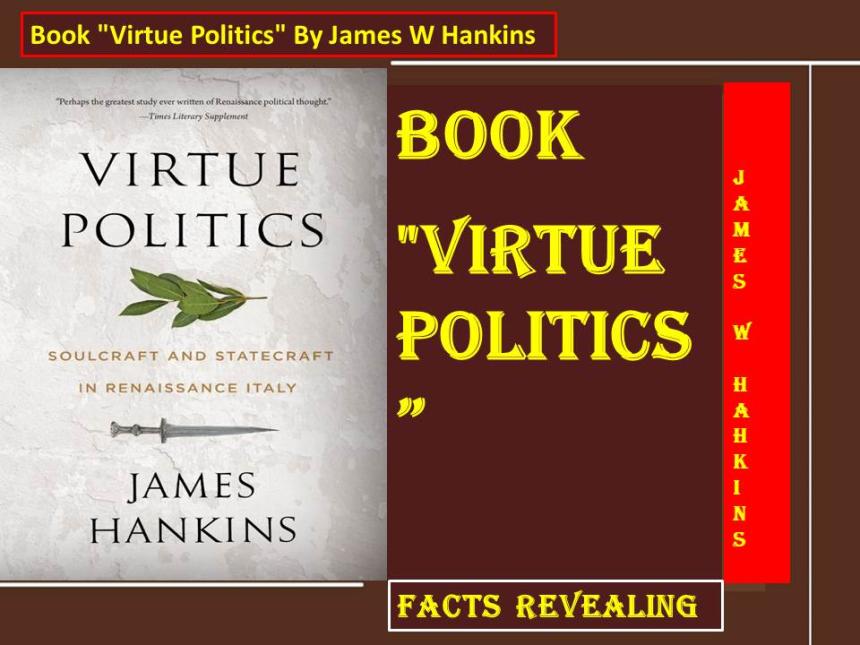

Book "Virtue Politics" By James W Hankins
James W. Hankins (1955) is an American intellectual historian and professor specializing in the Italian Renaissance, classical tradition, and history of political thought. Book "Virtue Politics" By James W Hankins is a bold, revisionist account of the political thought of the Italian Renaissance--from Petrarch to Machiavelli--that reveals the all-important role of character in shaping society, both in citizens and in their leaders. This write up is about "Virtue Politics" By James W Hankins and has been arranged for educational purposes.
أَعُوذُ بِاللّٰهِ مِنَ الشَّيْطَانِ الرَّجِيمِ
بِسۡمِ ٱللهِ ٱلرَّحۡمَـٰنِ ٱلرَّحِيمِ
In the name of ALLAH, the Most Gracious, the Most Merciful
Book "Virtue Politics" By James W Hankins
James Hankins (1955) is an American intellectual historian specializing in the Italian Renaissance. He is a professor in the History Department of Harvard University. Since spring 2018, he is a Visiting Research Fellow at the University of Notre Dame Center for Ethics and Culture. In 2012 he was honored with the Paul Oskar Kristeller Lifetime Achievement Award of the Renaissance Society of America.
James Hankins is winner of the Helen and Howard Marraro Prize (2020) and Times Literary Supplement Book of the Year (2024). Book “Virtue politics” by James Hankins describes the central concerns of Renaissance political philosophy. James Hankins is regarded as one of the world’s leading authorities on Renaissance philosophy and political thought, he is also a Corresponding Member of the British Academy.
Book "Virtue Politics" By James W Hankins is a bold, revisionist account of the political thought of the Italian Renaissance--from Petrarch to Machiavelli--that reveals the all-important role of character in shaping society, both in citizens and in their leaders.
The great thinkers of the Renaissance were convulsed by a civilizational crisis, set out to reconceive the nature of society. Everywhere they saw problems. Corrupt and reckless tyrants were sowing discord and ruling through fear; elites who prized wealth and status over the common good; military leaders waging endless wars. Their solution was at once simple and radical. "Men, not walls, make a city," as Thucydides so memorably said. They would rebuild their city, and their civilization, by transforming the moral character of its citizens. Soulcraft, they believed, was a precondition of successful statecraft.
A dazzlingly ambitious reappraisal of Renaissance political thought by one of our generation's foremost intellectual historians, Virtue Politics challenges the traditional narrative that looks to the Renaissance as the seedbed of modern republicanism and sees Machiavelli as its exemplary thinker. James Hankins reveals that what most concerned the humanists was not reforming laws or institutions so much as shaping citizens. If character mattered more than constitutions, it would have to be nurtured through a new program of education they called the studia humanitatis the humanities.
We owe liberal arts education and much else besides to the bold experiment of these passionate and principled thinkers. The questions they asked--Should a good man serve a corrupt regime? What virtues are necessary in a leader? What is the source of political legitimacy? Is wealth concentration detrimental to social cohesion? Should citizens be expected to fight for their country?--would have a profound impact on later debates about good government and seem as vital today as they did then.
The central theme of "Virtue Politics"; Soul craft and Statecraft in Renaissance Italy by James Hankins is that Renaissance humanism was primarily a moral reform movement focused on the character of the ruling class rather than a seedbed for modern constitutionalism or republicanism. Hankins challenges the traditional modern historical narrative (often associated with scholars like Hans Baron and Quentin Skinner) that looks to the Renaissance to find the origins of secular republics and figures like Machiavelli as the exemplary thinker of the era.
Book "Virtue Politics" By James W Hankins indicates that the primary conviction of humanist political thought was that a society’s political well-being depends on the moral and spiritual character of its leaders. Humanists believed that without virtuous rulers, even the most perfect legal or institutional frameworks would eventually fail. Renaissance humanists were largely unconcerned with whether a state was a monarchy, oligarchy, or republic. Their goal was to ensure the governing class was educated, morally serious, just, and prudent enough to rule well regardless of the constitution.
Book "Virtue Politics" By James W Hankins reflects that to achieve this moral regeneration, humanists promoted a specialized educational curriculum—the studia humanitatis (the precursor to the modern humanities). The study of history, poetry, moral philosophy, and eloquence was designed to "uproot tyranny" from the soul of the leader and inspire a sense of duty. Hankins frames Machiavelli not as the ultimate culmination of Renaissance humanist thought, but as its greatest betrayer. Machiavelli abandoned the humanist belief in moral reform and soul craft, arguing instead that statecraft relies on mastering power, manipulating appearances, and discarding morality for political survival.
In short, Hankins argues that Renaissance humanists viewed politics not as a matter of mechanical laws, but as an ethical project focused on cultivating human excellence.
Summary of Book "Virtue Politics" By James W Hankins
James Hankins's Virtue Politics: Soul craft and Statecraft in Renaissance Italy is a landmark intellectual history that challenges the idea that the Renaissance was the birthplace of modern secular republicanism. Instead, Hankins argues that Renaissance humanists focused on "virtue politics"—the belief that a society's success depends on the moral character of its leaders.
Hankins concentrates on the classic Italian Renaissance – Petrarch to Machiavelli – and dispenses with fashionable efforts to diversify his subject chronologically or geographically. Within these parameters, Leonardo Bruni and Machiavelli are here, but so too are the Roman jurist Mario Salamonio, the Greek translator George of Trebizond, the travelling “merchant scholar” Cyriac of Ancona. Nor does Hankins limit himself to the familiar canon, but mines a deep vein of histories, biographies, letters, orations and treatises, both printed and scribally published. His mastery of the archive is astonishing.
Hankins defines "virtue politics" as the idea that reforming a state requires improving the virtue, practical wisdom, and moral disposition of its ruling classes, rather than just changing laws or constitutions. The humanists believed that good laws are useless without good leaders to enforce them. "The Studia Humanitatis" was the curriculum developed to cultivate these virtuous leaders, by humanists as an educational program. This curriculum, the precursor to the modern humanities, was designed to train the mind and shape citizens through history, rhetoric, poetry, moral philosophy, and grammar.
Renaissance thinkers were often indifferent to the specific type of government (whether it was a republic, monarchy, or oligarchy). What mattered to them was that the government was meritocratic—led by the most virtuous and educated individuals—rather than being ruled by a wealthy elite or a corrupt tyrant. Hankins positions Niccolò Machiavelli not as the crowning achievement of Renaissance political thought, but as its betrayer. While humanists believed that ethics and politics were intertwined, Machiavelli separated politics from traditional morality, advocating for a pragmatic, power-driven approach that undermined the humanist project.
The book "Virtue Politics" By James W Hankins explores this philosophy through a wide variety of Renaissance figures. It traces the idea of virtue politics from Petrarch and Leonardo Bruni to lesser-known, highly influential political philosophers like Francesco Patrizi. Ultimately, the book serves as both an extensive historical survey of Renaissance political philosophy and a provocative commentary on modern politics. Hankins suggests that modern societies, struggling with partisan divides and institutional corruption, might learn from the humanists' emphasis on cultivating character and wisdom in the political class.
Lesson Learnt from Book "Virtue Politics" By James W Hankins
In Virtue Politics, James W. Hankins argues that Renaissance thinkers viewed state success as dependent on the moral character of leaders ("soul craft") rather than merely institutional design. The book emphasizes that Renaissance "Humanism", through the studia humanitatis, focused on cultivating virtue in rulers to prevent tyranny and manage political life.
Words, like books, have their fates, and the recent fate of the word “humanism” has been a strange one. Humanism is “a worldview which says that reason and science are the best ways to understand the world around us.” Though the humanists of the fourteenth and fifteenth centuries produced no great work of political philosophy, they did change fundamentally the intellectual world within which political thought would henceforward have to live. Their importance lay in producing not a system of thought, but a climate of thought.
Renaissance humanists did not generally use any version of the word “humanist” to describe themselves, but they did employ the phrase “studia humanitatis” to mean the study of ancient literature, history, and philosophy. And that was what lay at the heart of humanism: a passion for rediscovering the ancient Greek and Roman world, absorbing its values, and trying to apply them to the world of the present.
James Hankins’s Virtue Politics puts the politics back into humanism in an extraordinarily deep and far-reaching way. He does not deny that the whole cultural movement of humanism ranged much more broadly than any specific political project. Borrowing a Greek term, as adapted by a modern ethnologist, Hankins writes that Renaissance humanism represented a special paideuma, by which he means “an intentional form of elite culture that seeks power within a society with the aim of altering the moral attitudes and behaviors of the society’s members, especially its leadership class.” He notes too that a paideuma will typically produce “a paideia, a set of social technologies designed to alter minds and hearts, which constitute its soulcraft.”
Humanism was not purely political, as it promoted a much wider range of human values. But it believed that those values, if properly absorbed and internalized, could transform politics; and, what is more, it held that only such a revalorizing of human beings could have such a transformative effect in the political realm. The legal approach to politics, seeking to improve the state by revising its laws, was deemed worthless so long as the people—especially the ones administering those laws—lacked virtue. Constitutional change would, in itself, be similarly ineffective; and the essential difference did not lie in the form of government itself. Virtue was not merely the sine qua non, the necessary cause of good politics; it was, if fully developed and practiced, the sufficient cause. And instilling virtue was the rationale of all political education and political counsel.
Good Laws and Good Institutions needed to promote virtue among the population.
The basic concept of “virtue politics” illuminates the whole nature of humanist political thought, but it does so at a general level, taking the concept of “virtue” as abstractly as the humanist writers did themselves. Some principles were, admittedly, held by these writers almost universally. One intriguing example, highlighted by Hankins, is what he calls “virtue egalitarianism”—an equality principle which, as he points out, differs from all modern egalitarianisms, as it accepts most kinds of actual inequality, while insisting that human beings are equal in their capacity for virtue.
Closely tied to this was a principle of meritocracy: because virtue was attainable by people of the lowest birth, it was right that virtue, not birth status, should be the key criterion for office. (This principle operated only as a preference, however, not as a justification for social revolution: since humanists accepted actual inequalities as given, their typical response to noble office-holding was not to eject the nobles, but to seek to educate them.) The general assumption, nevertheless, was that people were led toward virtuous behavior by two things: exhortation and example. The latter had a special importance in the political realm, as it reinforced the need for princes and civic leaders to be virtuous themselves: not only would they make better laws and policies, but they would also raise the moral tone of the population.
Hankins has hinted that politics as a mere mechanism for juggling conflicting interests is not enough. Politics as mere legalism is not enough, no matter how important the abstract principles of a rule of law may be. “Some agreement,” Hankins argues, “about what constitutes decent and moral behavior is surely necessary to build the trust required for personal freedom and moderate rule in large-scale, multi-ethnic societies.” And again: “Those in power need to be shaped by education and culture to understand, respect, and even love their political opponents as well as powerless people under their care.”
We can all agree that both a society and a political culture need some elements of shared morality, and that the state-as-mere-mechanism will not supply, or account for, all the aspects of our relationship with it—such as true patriotism—that are bearers of fundamental value. In these ways virtues are of course important, and the Roman virtue of pietas, a respect for those who have gone before us and made us the way we are, may also have a special role to play.
The Conclusion
James Hankins’ book, Virtue Politics, asserts that human flourishing depends primarily on the moral character of leaders ("soul craft") rather than the institutional design of government ("statecraft"). Today, this lesson is vital; it highlights that systemic institutional and constitutional fixes are insufficient without an educated, virtuous, and public-spirited ruling class. The lessons from Hankins’ landmark study map onto contemporary sociopolitical challenges in several key ways:
The Primacy of "Soulcraft" over "Statecraft": Hankins upends the modern assumption that changing laws or governmental systems is the best way to fix society. Renaissance humanists—and the American Founders who were influenced by them—believed that even the most brilliantly designed institutions will eventually fail if run by corrupt or self-serving elites. We frequently witness the decay of democratic norms and institutional integrity. Hankins' book serves as a reminder that no amount of legislative reform can compensate for a lack of genuine wisdom, justice, and moral character in the ruling class.
Character Education and the Humanities: Hankins revives the humanist idea of studia humanitatis—a curriculum designed to develop a moral and ethical core. Politics is an art heavily reliant on rhetoric, moral philosophy, and history, which inspire leaders to value the common good over personal enrichment. Modern education tends to prioritize hyper-specialized technical or STEM skills. Virtue Politics provides a strong intellectual defense for the humanities. It argues that studying history, literature, and philosophy trains the mind to resist commercialized sham values, avoiding ideological manipulation and fostering genuine empathy.
The Rejection of Pure Power Politics (Machiavellianism): Virtue Politics sharply contrasts with the legacy of Niccolò Machiavelli, who separated political success from moral righteousness, paving the way for the "ends justify the means" approach. Machiavellian politics reduces statecraft to a mere struggle for dominance, often leading to coercion and fear. When modern politics is dominated solely by power-grabbing and partisan polarization, it breeds deep cynicism. Hankins urges a return to the classical ideal where politics is viewed as a noble calling, centered on justice, social cohesion, and the willing obedience of the citizens.
Meritocracy and the Responsibilities of the Elite: Hankins explores the Renaissance concept of "virtue egalitarianism," which posited that true nobility and the right to lead come from one's wisdom and moral virtue rather than mere wealth or aristocratic birth. As public distrust in modern elites and technocracies grows, Hankins’ book offers a standard for judging those in power. It asks whether our contemporary leaders actually exhibit the wisdom, temperance, and public spirit required to govern, or if they operate merely as self-interested factions.
Audio Transformers in Public Address Systems: Why Are They Needed?
Imagine yourself inside an active factory during the first hour of a working shift. You ne...