
أَعُوذُ بِاللّٰهِ مِنَ الشَّيْطَانِ الرَّجِيمِ
بِسۡمِ ٱللهِ ٱلرَّحۡمَـٰنِ ٱلرَّحِيمِ
In the name of ALLAH, the Most Gracious, the Most Merciful
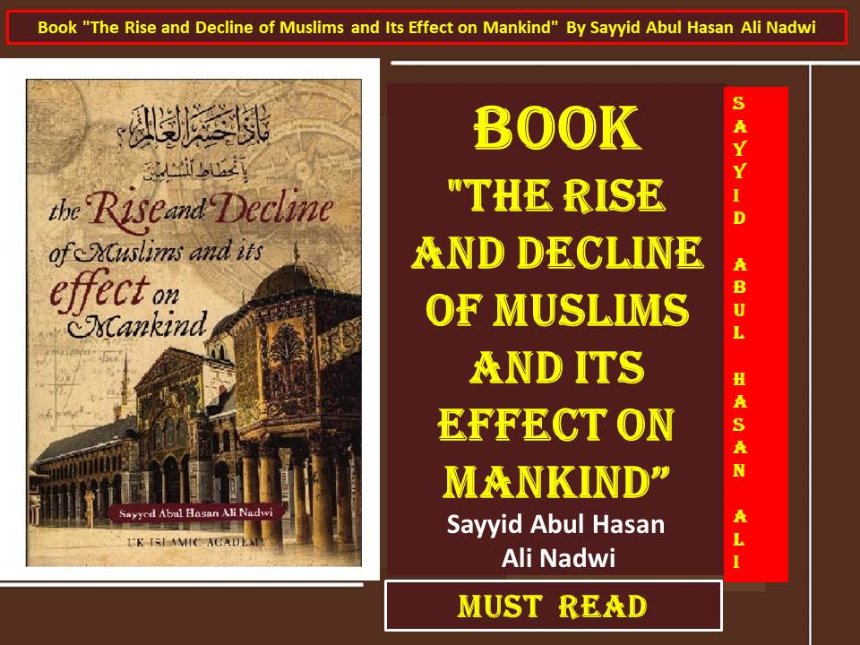
Book "The Rise and Decline of Muslims and Its Effect on Mankind" By Sayyid Abul Hasan Ali Nadwi
Book "The Rise and Decline of Muslims and Its Effect on Mankind" (often published as Islam and the World) is a 1950 book by Indian Islamic scholar Sayyid Abul Hasan Ali Nadwi (1914–1999). Sayyid Abul Hasan Ali Nadwi (popularly known as Ali Miyan, 1914–1999) was one of the twentieth century's most prominent Indian Islamic scholars, historians, and authors. Born in Raebareli, India, he served for decades as the Rector of Darul Uloom Nadwatul Ulama in Lucknow and was a founding member of the Muslim World League. Fluent in Arabic, Urdu, Persian, and English, he authored over 50 books and was awarded the King Faisal International Prize in 1980 for his service to Islam.
Book "The Rise and Decline of Muslims and Its Effect on Mankind" (widely published in English as Islam and the World) is a landmark 1950 work of Islamic historiography and civilizational analysis by the Indian scholar Sayyid Abul Hasan Ali Nadwi (1914–1999). Originally written in Arabic as Mādhā Khasira al-ʿĀlam bi-Inḥiṭāṭ al-Muslimīn ("What Has the World Lost by the Decline of the Muslims?"), it quickly became one of the most influential modern Islamic texts across both South Asia and the Arab world.
• Urdu Title. Insani Dunya Par Musalmano Ke Uruj wa Zawal Ka Athar.
• First Published. Completed in 1947 and first published in Egypt in 1950/1951, featuring a foreword by the Egyptian thinker Sayyid Qutb.
• English Translation. Translated from Arabic by Dr. Mohammad Asif Kidwai and published in revised editions by the the UK Islamic Academy.
The central theme of Sayyid Abul Hasan Ali Nadwi’s "The Rise and Decline of Muslims and Its Effect on Mankind" is that the decline of Muslim civilization represents a profound moral and spiritual loss for all of humanity, not merely a political setback for Muslims. Nadwi argues that early Islam rescued a sixth-century world mired in decay by harmonizing material progress with divine guidance and justice. When Muslims later abandoned their ethical and intellectual leadership, global leadership shifted to purely materialistic civilizations. Despite modern scientific advancement, Nadwi contends humanity now suffers from a spiritual vacuum—calling Muslims to reclaim their moral responsibilities for mankind's benefit.
Book "The Rise and Decline of Muslims and Its Effect on Mankind" By Sayyid Abul Hasan Ali Nadwi - Core Arguments & Structure
The Sixth-Century World:-
In the opening section of the book, Sayyid Abul Hasan Ali Nadwi paints a vivid portrait of global civilization during the sixth century CE, a period he characterizes as the Age of Ignorance (Jahiliyyah). Surveying the major powers and religious traditions of the era, Nadwi demonstrates that humanity had reached a state of profound moral, social, and spiritual bankruptcy. The Byzantine and Sassanid empires, locked in endless warfare, suffered from autocratic tyranny, crushing taxation, and extreme decadence among their ruling elites. Christianity had lost its original monotheistic simplicity through doctrinal disputes and clerical corruption, while Zoroastrianism in Persia had devolved into rigid ritualism and social stratification. In India, society was fractured by the oppressive caste system, widespread idolatry, and extremes of self-torture or unchecked sensuality. Meanwhile, pre-Islamic Arabia was plagued by tribal blood feuds, economic exploitation, and female infanticide. Nadwi argues that across the globe, human intellect and conscience had become paralyzed, leaving mankind without a guiding moral compass and desperately in need of spiritual revival.
The Prophetic Transformation:-
Nadwi then examines the revolutionary impact of Prophet Muhammad’s mission, presenting it as the turning point that rescued humanity from civilizational collapse. By anchoring human life in pure monotheism (Tawhid) and accountability before God, Islam dismantled racial, tribal, and class hierarchies, establishing a universal brotherhood based on righteousness and justice. Nadwi emphasizes that the Prophetic movement did not demand a retreat from worldly life; instead, it harmonized material progress with spiritual purpose. Under the guidance of the Prophet and the Rightly Guided Caliphs, believers were transformed from fragmented desert tribes into disciplined custodians of truth, compassion, and intellectual inquiry. Governance became a sacred trust accountable to the rule of law, while wealth was directed toward social welfare rather than personal indulgence. Through this balanced synthesis of faith, ethics, and reason, early Islamic civilization fostered unprecedented advancements in science, law, and human dignity, demonstrating that true worldly success flourishes when guided by divine morality.
The Cost of Muslim Decline:-
Departing from conventional historians who measure the rise and fall of empires strictly through territorial borders, military victories, or economic output, Nadwi reframes Muslim decline as a global moral tragedy. He traces how, over subsequent centuries, internal political fragmentation, intellectual stagnation, sectarian rigidities, and indulgence in luxury eroded the spiritual vitality of the Muslim world. As rulers grew despotic and scholars retreated into narrow formalism, Muslims gradually abdicated their dual role as active pioneers of useful knowledge and ethical witnesses to humanity. Nadwi’s central thesis is that this retreat did not harm Muslims alone; rather, it deprived the entire world of a balanced, God-conscious leadership. With the custodians of divine guidance stepping back from the vanguard of global affairs, a profound leadership vacuum emerged. Consequently, human civilization lost the vital moral anchor that had previously restrained raw power, greed, and exploitation, setting the stage for a new era dominated by purely secular forces.
Critique of Modern Materialism:-
Evaluating the subsequent rise of modern Western civilization, Nadwi adopts a nuanced, analytical perspective rather than a purely dismissive one. He openly acknowledges Europe’s remarkable achievements in scientific discovery, technological innovation, industrial organization, and mastery over the forces of nature. However, he argues that because Western modernity emerged through a historical rebellion against a corrupted church, it severed the vital link between empirical progress and divine guidance. Deprived of a transcendent moral framework, modern civilization became overwhelmingly materialistic, measuring human worth primarily through wealth, consumption, and national power. Nadwi warns that immense physical capability without spiritual wisdom inevitably turns destructive, pointing to European colonialism, devastating world wars, stark economic inequality, and widespread psychological alienation as symptoms of this imbalance. While modern humanity successfully conquered outer space and harnessed the atom, it failed to conquer human selfishness and greed. Thus, Nadwi contends that modern materialism has merely clothed sixth-century ignorance in sophisticated scientific and technological garments.
Call to Renewal:-
In the concluding part of his work, Nadwi forcefully rejects the defeatist assumption that Islam is an obsolete historical relic incapable of addressing modern global challenges. He insists that the crisis of contemporary civilization stems not from any flaw in Islamic teachings, but from the failure of Muslims to embody and articulate their living message. Calling for comprehensive intellectual, moral, and spiritual renewal, Nadwi urges Muslims to move beyond passive nostalgia for past imperial glories or blind imitation of Western materialism. Instead, he advocates reclaiming authentic faith, ethical integrity, and creative engagement with modern science and useful knowledge. By reuniting technical competence with deep spiritual conviction, Muslims can once again offer humanity a balanced, humane alternative to secular excess. Ultimately, Nadwi’s message is one of urgent hope and global responsibility: true civilizational revival requires sincere self-reform, courageous moral leadership, and an unwavering commitment to serving the spiritual and material well-being of all mankind.
Book "The Rise and Decline of Muslims and Its Effect on Mankind" By Sayyid Abul Hasan Ali Nadwi - Lessons to learn
Book "The Rise and Decline of Muslims and Its Effect on Mankind" By Sayyid Abul Hasan Ali Nadwi offers distinct, practical lessons for both Muslims and non-Muslims, framing global history as a shared human story rather than a narrow sectarian tale.
Lessons for a Common Muslim:-
• Faith Requires Moral Integrity, Not Just Ritual: Nadwi warns that outward religious observance without honesty, justice, and compassion leads to spiritual decay; a Muslim’s daily character is the primary testimony of their faith.
• Avoid Nostalgia and Blaming Others: Rather than taking pride in past golden ages or blaming external forces for decline, everyday Muslims must engage in honest self-accountability and personal reform.
• Integrate Spiritual and Worldly Excellence: Islam does not separate religious devotion from useful worldly knowledge; ordinary Muslims are called to pursue education, science, and honest work while anchoring them in ethical responsibility.
• Live as a Benefactor to Humanity: Muslims are not meant to live in isolation; their purpose is to actively promote fairness, mercy, and the common good for everyone around them.
Lessons for a Non-Muslim:-
• Material Progress Needs an Ethical Anchor: Nadwi’s central warning to the modern world is that scientific breakthroughs, wealth, and technology cannot guarantee human happiness or peace if separated from moral wisdom and spiritual purpose.
• Distinguish Islam from Muslim Shortcomings: The book encourages non-Muslims to evaluate Islam by its core principles of human dignity, justice, and equality rather than judging it solely by the historical failings or current struggles of Muslim societies.
• Shared Global Interdependence: Humanity rises and falls together; when any civilization abandons ethical leadership for unchecked greed or power, the consequences—such as inequality, conflict, and alienation—are felt globally.
• Look Beyond Purely Material Success: It invites readers of all backgrounds to reflect on deeper questions of purpose, restraint, and service to others in an increasingly consumer-driven world.
Book "The Rise and Decline of Muslims and Its Effect on Mankind" By Sayyid Abul Hasan Ali Nadwi - Digital Age Relevance
In the digital age—defined by rapid technological innovation, endless information, and hyper-connectivity—Sayyid Abul Hasan Ali Nadwi’s message urges Muslims to move beyond passive nostalgia or performative online debates, calling them instead to unite modern technological competence with deep moral integrity, truthfulness, and genuine service to humanity. For non-Muslims, the book serves as a timely reminder that artificial intelligence, material wealth, and digital progress cannot bring lasting peace or fulfillment if detached from timeless ethical values, while encouraging them to judge Islam by its core principles of justice and human dignity rather than the failings of Muslim societies. Together, it challenges all modern citizens to ensure that human wisdom and moral responsibility govern technology, rather than letting algorithms and materialism dictate human worth.
Sayyid Abul Hasan Ali Nadwi’s VS Russian Philosopher Alexander Dugin : Modernity in the Digital Age:-
Sayyid Abul Hasan Ali Nadwi book was published some 75 years ago and the Russian philosopher Alexander Dugin is pressing call today in 2026; but they both diagnose modern secularism as a spiritual crisis that detaches humanity from transcendent meaning; however their proposed remedies diverge sharply. Drawing on radical Traditionalism, Dugin urges a wholesale rejection of modernity, rationalism, and technological progress as inherently corrosive forces that must be dismantled in favor of pre-modern hierarchies and multipolar civilizational resistance. Conversely, Nadwi’s message for the digital age rejects escapism or anti-scientific retreat. Instead of shunning modern tools, Nadwi calls on Muslims to master contemporary science and technology while anchoring them in divine ethics, justice, and service to all humanity. Simultaneously, he invites non-Muslims to recognize that digital advancement requires a moral compass rather than abandonment. Ultimately, whereas Dugin demands abandoning modernity altogether, Nadwi advocates redeeming it—ensuring spiritual wisdom governs technological power rather than letting materialism dictate human worth.
The Conclusion
Separated by more than seven decades, Sayyid Abul Hasan Ali Nadwi in 1950 and Russian philosopher Alexander Dugin in 2026 both arrive at a remarkably similar diagnosis of human decline and global turmoil: unchecked materialism and boundless human desires severed from transcendent moral restraint. Both thinkers recognize that when humanity makes material gain, power, and appetite its ultimate purpose, civilization descends into spiritual emptiness and perpetual conflict. Yet while their diagnosis converges, their solutions point in very different directions. Whereas Dugin’s Traditionalist response calls for dismantling and shunning modernity altogether, Nadwi’s timeless work offers a constructive middle way grounded in enduring Quranic principles.
Ultimately, Sayyid Abul Hasan Ali Nadwi’s timeless work—written some 75 years ago, well before the birth of digital tools—reminds us, through enduring Quranic principles, of the ways and means to confront human challenges across all ages and eras. In a modern world shaped by artificial intelligence, algorithmic echo chambers, and hyper-materialism, neither retreating from modernity nor blindly surrendering to its tools offers a sustainable path. Instead, the religion Islam through the lens of Nadwi provides a constructive middle way—grounded in the Quranic truth that all knowledge (Ilm) is a gift to mankind from Allah—by harnessing digital innovation and scientific mastery while anchoring them in revelation, truthfulness, and human dignity. For Muslims and non-Muslims alike, genuine progress depends on treating knowledge as a sacred trust, ensuring that conscience governs code, empathy guides connectivity, and timeless spiritual wisdom remains firmly in command of every era’s creations.