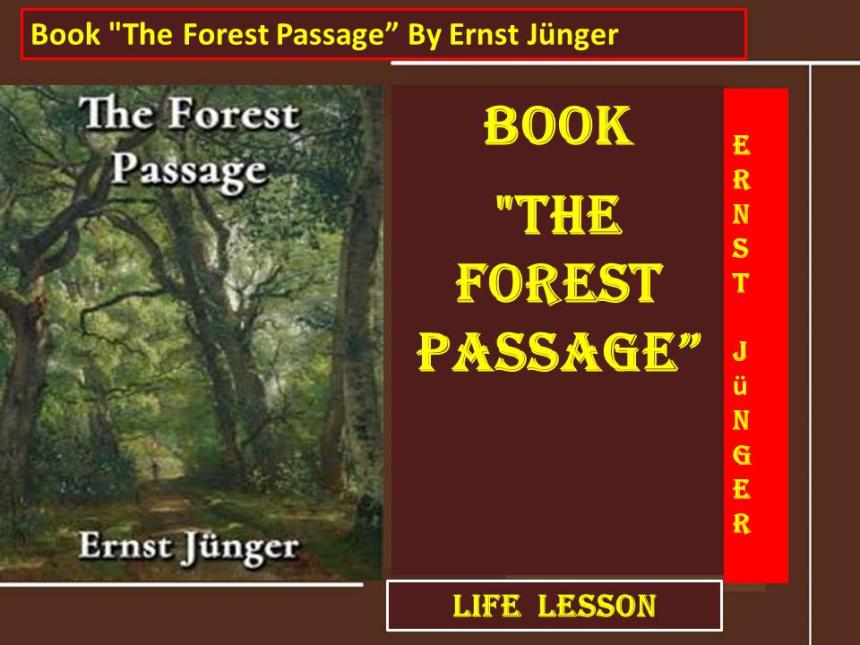

Book "The Forest Passage” By Ernst Jünger
Ernst Jünger (1895- 1998) was a German author, soldier, philosopher, and entomologist who became publicly known for his World War I memoir "Storm of Steel". A prolific writer of over forty books, Jünger wrote particularly in the furtherance of conservatism and against what he perceived as the spiritual oppression of man. This write up is an introduction of the Book "The Forest Passage” By Ernst Jünger and arranged for educational purposes from material available freely on Web Net.
أَعُوذُ بِاللّٰهِ مِنَ الشَّيْطَانِ الرَّجِيمِ
بِسۡمِ ٱللهِ ٱلرَّحۡمَـٰنِ ٱلرَّحِيمِ
In the name of ALLAH, the Most Gracious, the Most Merciful
Book "The Forest Passage” By Ernst Jünger
Ernst Jünger (March 29, 1895, Heidelberg, Germany - February 17, 1998 Riedlingen, Germany) was a German author, soldier, philosopher, and entomologist who became publicly known for his World War I memoir Storm of Steel. A prolific writer of over forty books, Jünger wrote particularly in the furtherance of conservatism and against what he perceived as the spiritual oppression of man.
The central theme of book "The Forest Passage" by Ernst Jünger is individual freedom, spiritual autonomy, and non-conformist resistance against the crushing power of the modern, omnipresent, and totalitarian state. The book discusses the "Crisis of Modern Freedom" in following ways:-
Loss of liberty: Jünger argues that modern technological societies and bureaucratic states slowly rob people of their freedom under the guise of comfort and safety.
The passive passenger: Most citizens act like passengers on a big ship, happy as long as things go well, but helpless when a crisis or tyranny arises.
Conformity and fear: Totalitarian regimes use surveillance, propaganda, and fear to force people to obey and give up their independent thought.
The book continues to show "The Figure of the Forest Rebel" (Der Waldgang) in following ways:-
The internal withdrawal: "Making the forest passage" does not just mean hiding in real woods; it means an inner spiritual and intellectual retreat to a place where the state cannot touch your core self.
The sovereign individual: The "forest flea" or rebel is a person who decides to stand up for their own human nature and say "no" to state control and criminal demands.
Conquering fear: True freedom begins when a person stops being afraid of the powers ruling the world, allowing them to resist manipulation and preserve their personal dignity.
Summary of Book "The Forest Passage” By Ernst Jünger
Published in 1951, Ernst Jünger’s The Forest Passage is a philosophical essay that explores individual freedom, state tyranny, and the role of the "forest rebel". It defends personal autonomy against the pressures of modern totalitarian states and mass conformity.
Core Themes
The Omnipresent State: Jünger analyzes how modern governments use surveillance, propaganda, and technology to crush human liberty.
The Forest Rebel (Waldgänger): This is a symbolic figure who refuses to surrender his inner freedom, stepping outside the bounds of conformist society to resist tyranny.
Inner Freedom: The book argues that true resistance starts in the mind and spirit, requiring courage and self-reliance rather than just political action.
Key Takeaways
Rejection of Mass Ideology: Jünger warns against blindly following political parties, whether democratic or communist, which demand total conformity.
The Metaphorical Forest: The "forest" represents a safe space of inner strength and natural law where the independent thinker can hide and fight back against oppression.
Personal Responsibility: The individual must choose to stand alone and protect human dignity, even when society collapses around them.
Book "The Forest Passage” By Ernst Jünger Explains
The Book Read (https://www.goodreads.com/en/book/show/19167350-the-forest-passage) introduces the "The Forest Passage" By Ernst Jünger; "explores the possibility of resistance: how the independent thinker can withstand and oppose the power of the omnipresent state. No matter how extensive the technologies of surveillance become, the forest can shelter the rebel, and the rebel can strike back against tyranny. Jünger's manifesto is a defense of freedom against the pressure to conform to political manipulation and artificial consensus. A response to the European experience under Nazism, Fascism, and Communism, The Forest Passage has lessons equally relevant for today, wherever an imposed uniformity threatens to stifle liberty".
"In a strikingly poetic political statement written soon after the Second World War, Ernst Jünger rejects the two reigning ideologies, democracy and communism, in favor of an individualistic stance anticipating what we now call libertarianism. The ideal that Jünger projects for us is a metaphorical 'passage through the forest' in which we remain constantly put to the test, with the result that we emerge self-sufficient, rebellious, heroic." --Herbert Lindenberger, Stanford University
"The Forest Rebel says no to power, outwardly unobtrusive but inwardly rebellious and martial, spiritually, politically, and intellectually, an anarch as opposed to an anarchist. Many of the ideas here reflect Germany's geopolitical situation in the Cold War, powerless against the occupiers of East and West. But the treatise transcends the context in which it was born and manifests Jünger's sharp analysis of trends and problems that are as relevant today as ever. Particularly in the age of the mass plebiscite called the internet and as the marriage of the state and technology has given government unprecedented power over its citizens, a book about how to resist modern forms of tyranny is timely and much needed." --Elliot Neaman, University of San Francisco
"In the Anglophone world the intellectual and writer Ernst Jünger has been overshadowed by the image of the fierce World War I warrior and the radical right-wing ideologue of the 1920s. The result has been an uneven and one-sided public reception that has severely underestimated the significance and complexity of Jünger's literary oeuvre. Especially his late work has barely been noticed. A critical revision of old approaches is definitely overdue. Therefore the publication of The Forest Passage is a truly important step in the right direction." --Peter Uwe Hohendahl, Cornell University
"This fascinating work seeks out a place of inner subjective freedom where the besieged citizen of the modern world may withhold consent and refuse participation in the hellish tyranny of administrative totalitarianism. Jünger invites his reader to become a passenger in this forest of thoughtful reflection beyond the reach of political coercion and conformism." --Robert Harrison, Stanford University.
A Brief Discussion on Book "The Forest Passage” By Ernst Jünger
"At all times, in all places, and in every heart, human fear is the same: it is the fear of destruction, the fear of death. We can already hear it in Gilgamesh, we hear it in Psalm 90, and to this day nothing has changed. To overcome the fear of death is at once to overcome every other terror, for they all have meaning only in relation to this fundamental problem." These lines are from Ernst Jünger (German WWI hero, novelist, dissident philosopher); who wrote "The Forest Passage" in 1951, a slim volume on resistance to totalitarian tyranny, one of the most poetic meditations on the nature of individual freedom ever written.
The “Forest Passage” may be referred as "an inward flight into the sheltered wilderness of one’s own inner being, where the “forest rebel” can find refuge even amidst the most oppressive cityscapes of unthinking public automatism". The "Forest Passage" leads the “forest rebel” to "a passage through death.” A forest is verdant but also a place of darkness, terror, and death. Thus the forest rebel’s “path leads to the brink of death itself – indeed, if necessary, it passes through it.” Only “when the line is successfully crossed, the forest as a place of life is revealed in all its preternatural fullness.” The path to the most powerful and abundant freedom begins with the resolute acceptance of death.
Freedom is on the other side of fear. “If a man succeeds in creating breathing room here,” Jünger wrote, “Then he will fell the giants whose weapons are terror.” But how can man overthrow fear’s rule? All humans may do it by one means alone: through overcoming the terror of death. However, crossing this threshold is not that easy. “At this threshold,” every individual will find himself surrounded, encircled by fear, which pushes walls in against him on all sides,” that “man is initiated into his theological trial whether he realizes it or not.” Jünger concluded, there is only one thing that can truly overcome man’s fear "a faith in the immortality of the spirit".
Ernst Jünger describes "Mass Fear" particularly dangerous; because "changes from fear to open hate, the moment, they notice a weakening in those they feared only a moment before”; as an instrument of control by authoritarian regimes. Suddenly cruelties and even atrocities become permissible in the name of safety and the alleviation of acute anxiety. Humanity diminishes as brutality increases. Jünger therefore, asserted that the “emergence of this condition [of widespread fear] is a clearer omen of downfall” for a nation “than any physical danger.”
Ernst Jünger also raises “The basic question is whether man can be liberated from fear,” and answers that when “forced back into a dialogue” within a human heart, “this represents the first meaningful step toward [real] security” for the individual. Only “the individual who has renounced his inner fear” has a chance at breaking free from "captivity" and regaining his sovereignty. “The illusion of encirclement will also disappear therewith, and another solution will always become "visible" beyond the visible one. Two paths will then be possible – or, in other words, free choice will have been restored.”
The Conclusion
The primary conclusion of Ernst Jünger’s The Forest Passage is that true human freedom can be preserved against modern totalitarianism and technological control through an inner spiritual and intellectual withdrawal, transforming the isolated individual into an autonomous "forest rebel" who refuses internal conformity. Ernst Jünger uses "Leviathan" to describe the modern, all-encompassing state that uses bureaucracy, propaganda, and technology to crush human liberty. Totalitarian systems rely on engineering acute fear and artificial consensus, making citizens surrender their freedom for safety.
The "forest passage" (Waldgang) is not a physical escape into the woods, but a decisive, sovereign mental and spiritual retreat into one's inner core. The forest rebel rejects mass conformity and political ideologies, choosing instead to live by personal integrity, courage, and an older, absolute sense of freedom. Any individual may take the role model of "Forest Rebel" to cultivate inner spiritual sovereignty, reject mass conformity, and maintain personal freedom against the pressures of an all-controlling state or technological society among the sea of conformist mortal beings. It is exceptionally difficult to be a "Forest Rebel" requiring immense psychic strength and sacrifices that most people are unable or unwilling to make.


How to Sell Post Office Building Assets: A Guide for USPS Property Own...
Looking to sell post office building assets? This practical guide covers valuation, qualif...