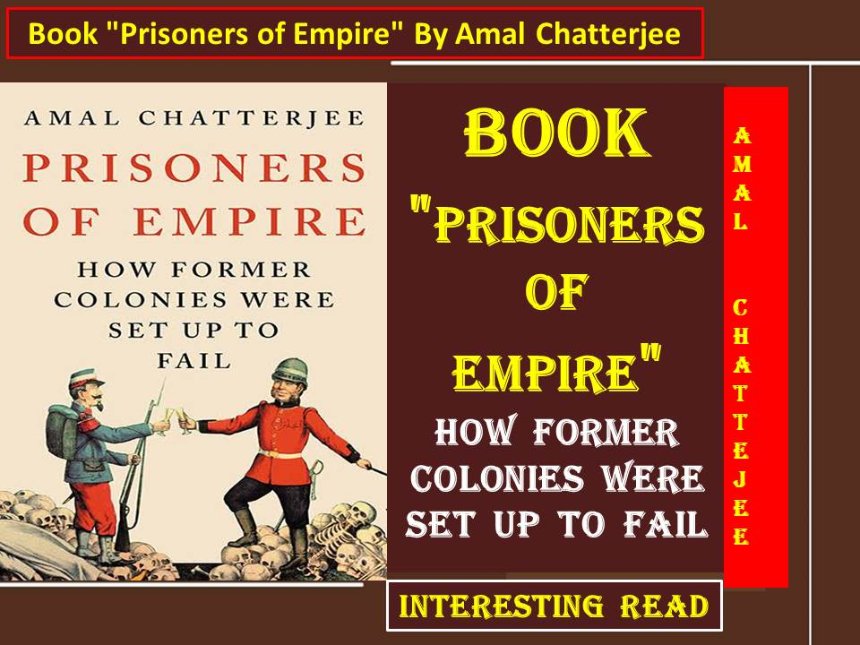

Book "Prisoners of Empire" By Amal Chatterjee
Amal ChatterJee was born in Colombo, Sri Lanka, to Sri Lankan and Indian parents and educated in India (Kolkata), before pursuing higher education and his career in the United Kingdom. Amal Chatterjee is an accomplished historian, author, and senior creative writing tutor at the University of Oxford's Department for Continuing Education. A Fellow of the Royal Historical Society, his academic work focuses heavily on the lasting legacies of colonialism, global capitalism, and systemic inequality. This write up is an introduction of Book "Prisoners of Empire" By Amal Chatterjee and has been arranged for educational purposes from material available freely on Web Net.
أَعُوذُ بِاللّٰهِ مِنَ الشَّيْطَانِ الرَّجِيمِ
بِسۡمِ ٱللهِ ٱلرَّحۡمَـٰنِ ٱلرَّحِيمِ
In the name of ALLAH, the Most Gracious, the Most Merciful
Book "Prisoners of Empire" By Amal Chatterjee
(How Former Colonies Were Set Up to Fail)
Amal ChatterJee was born in Colombo, Sri Lanka, to Sri Lankan and Indian parents. He grew up and was educated in India (specifically Kolkata), before pursuing higher education and his career in the United Kingdom. He holds a multicultural, transnational identity and is currently based between Amsterdam, the Netherlands, and Oxford, UK, speaking English, Dutch, and Bengali. Amal Chatterjee is an accomplished historian, author, and senior creative writing tutor at the University of Oxford's Department for Continuing Education. A Fellow of the Royal Historical Society, his academic work focuses heavily on the lasting legacies of colonialism, global capitalism, and systemic inequality. He has published both acclaimed historical non-fiction and fiction, utilizing his diverse background to explore complex cross-cultural themes. Beyond his writing, Chatterjee is highly regarded for his mentorship, helping aspiring authors develop their voices across various literary genres.
Book "Prisoners of Empire": (How Former Colonies Were Set Up to Fail) By Amal Chatterjee is a non-fiction book by historian and Oxford creative writing tutor Amal Chatterjee. Published by C Hurst & Co Publishers Ltd, the book delivers a global assessment of how persistent colonial frameworks continue to oppress and exploit nations long after independence.
Book "Prisoners of Empire" By Amal Chatterjee is "A compelling social and political balance-sheet of empire, revealing how former colonies worldwide are still shackled by the legacies of colonial oppression. The Book "Prisoners of Empire" By Amal Chatterjee raises questions as to "Why do some former colonies fail, staggering from crisis to crisis, while others recover? and "Why did so many succumb to dictatorship, corruption, civil war and instability after independence?".
Book "Prisoners of Empire" By Amal Chatterjee then goes on to argue that these ‘failures’ are underpinned by persistent, robust colonial structures which preserve and reproduce the oppressive, exploitative systems of the past. From land ownership to mining, transport networks to education provision, morality to law, many post-colonial institutions function almost exactly as they did under foreign rule, with power still concentrated in the hands of elites, and inequalities baked in. Drawing on a wide range of contemporary and historical material, including memoirs, economic data and administrative documents, Chatterjee explains how empire not only made its colonies into places of extraction and exploitation, but keeps them there today. Offering a truly global account–from the British Empire to the Belgian, from Mexico to Mozambique, from the Sahel to Sri Lanka–he shows how extractive capitalism and colonialism are intertwined, and how human rights and development are hostage to the imperatives of profit-making.
Book "Prisoners of Empire" By Amal Chatterjee raises the awareness about the past, present and future in a manner that "the world built by empire can still be challenged and changed–but to design a new, equitable future for all, we must first understand the legacies of the past.
Book "Prisoners of Empire" By Amal Chatterjee - Explains
Prisoners of Empire: How Former Colonies Were Set Up to Fail provides a comprehensive social, political, and economic balance-sheet of empire, detailing how former colonies worldwide remain systematically shackled by the legacies of foreign oppression. Author Amal Chatterjee reframes the global narrative surrounding "failed states," arguing that the modern crises plaguing post-colonial nations—such as political corruption, civil wars, and economic instability—are not isolated local failures. Instead, they are the direct byproduct of persistent, robust colonial blueprints engineered to preserve unequal power dynamics long after independence.
1. The Core Premise: Baked-In Inequality
The central thesis of the book is that modern global capitalism and historical colonialism remain deeply intertwined. When European empires withdrew, they did not dismantle their infrastructure; instead, they left behind administrative, economic, and legal frameworks. As a result, many post-colonial institutions function almost identically to how they did under foreign rule. Power remains heavily concentrated in the hands of small domestic elites who benefit from maintaining these systems, ensuring that structural inequalities remain permanently baked into the fabric of the society.
2. Pillars of Persistent Subjugation
Chatterjee traces this exploitation across several key socio-economic networks that hold human rights and national development hostage to corporate profit-making:
• Extraction Economies: Frameworks governing land ownership and mining operations are still structured to funnel natural resources and raw wealth out of the country to foreign markets rather than serving the local population.
• Designed Infrastructure: Logistics and transport networks built by empires were never designed for internal integration or community growth; they were built as transit corridors to move extracted goods to ports, a setup that still dictates modern trade.
• Cultural & Social Control: Systems of education provision, public morality, and law remain weaponized. They serve to uphold historical hierarchies, silence dissent, and protect institutional corruption.
3. A Truly Global Methodology
Rather than focusing on a single region or empire, Chatterjee delivers an expansive, comparative global account. He draws parallels across vastly different geographic landscapes, bridging the actions of the British Empire to the Belgian Empire, and evaluating long-term systemic damages in nations ranging from Mexico to Mozambique, and from the Sahel to Sri Lanka.
To build this historical balance sheet, Chatterjee utilizes a diverse array of foundational primary and secondary source materials, including:
• Personal memoirs and colonial administrative records.
• Historical and contemporary economic data.
• Legal frameworks and modern corporate-state contracts.
Ultimately, the book functions as both a warning and an analytical tool. Chatterjee stresses that while the oppressive world built by empire can still be challenged and changed, creating an equitable global future is entirely impossible without first fully diagnosing how these past frameworks continue to operate today.
Book "Prisoners of Empire" By Amal Chatterjee - Core lessons
The core thematic pillars of the book divide the text into specific socio-economic frameworks left by foreign rule:-
1. Land Ownership & Agriculture (The colonial architecture of property)
In Prisoners of Empire, Amal Chatterjee exposes how colonial authorities warped traditional, communal land practices into rigid, state-controlled title deeds designed solely to benefit foreign rulers. This colonial architecture of property concentrated vast territories into the hands of a small elite, weaponizing agriculture for cash-crop export rather than local sustenance. Long after independence, these deeply entrenched legal and structural frameworks persist. Modern states continue to honor these skewed property rights, ensuring that land ownership remains unequally distributed and trapping rural populations in cycles of systemic poverty.
2. Resource Extraction & Mining (How wealth is funneled away)
Chatterjee details how colonial empires meticulously engineered the legal and physical infrastructure of resource extraction and mining to strip occupied nations of their natural wealth. Instead of enriching local populations, minerals and raw materials were systematically funneled directly to foreign markets. Today, these exact structural arrangements endure through modern corporate-state contracts. Multinational corporations and corrupt domestic elites exploit these inherited legal loopholes, ensuring that the financial windfalls from oil, gas, and mining bypass public development and continue to flow out of the country.
3. Transport & Trade Networks (Infrastructure designed for export, not local growth)
In Prisoners of Empire, Chatterjee argues that colonial transport and trade networks were never built to foster internal economic unity or local development. Instead, rail lines, roads, and shipping ports were meticulously laid out as strict transit corridors, engineered solely to funnel raw wealth from deep inland directly to global markets. Modern post-colonial nations remain physically trapped by this lopsided infrastructure. Because these transit routes still prioritize external export over domestic connectivity, they continue to stifle regional trade and keep independent economies completely dependent on foreign corporate buyers.
4. Education & Cultural Control (How colonial hierarchies persist)
Chatterjee explains that colonial powers used education and cultural control as psychological tools to cement their dominance. Foreign rulers dismantled indigenous knowledge systems, replacing them with institutional curricula designed to train a compliant, Westernized local elite to administer the empire. Long after independence, these Eurocentric educational and cultural frameworks remain largely unchanged. By preserving historical social hierarchies and alienating students from their own heritage, these systems continue to normalize inequality, stifle critical domestic thought, and protect the power dynamics favored by modern ruling classes.
5. Morality & Legal Frameworks (The systemic laws weaponized by modern elites)
In Prisoners of Empire, Chatterjee reveals how colonial morality and legal frameworks were codified not to deliver justice, but to police local populations and secure foreign rule. Draconian laws regarding public assembly, state secrecy, and property rights were explicitly designed to criminalize dissent. Upon independence, incoming domestic elites inherited this legislative machinery intact. Rather than repealing these oppressive structures, modern rulers frequently weaponize them to silence political opposition, shield institutional corruption from public scrutiny, and legally protect their own concentrated wealth and authority.
Book "Prisoners of Empire" By Amal Chatterjee- Reviews
‘Examining the persistent infrastructures of extraction from the Global South to the Global North, Chatterjee’s important, concise and accessible book supplies us with the missing link between the colonial exploitation of the past and the predatory global economy of the present.’ — Alan Lester, Professor of Historical Geography, University of Sussex, and editor of The Truth about Empire: Real Histories of British Colonialism.
‘A book that will change the way you see the world. Eloquent and clear-sighted, Amal Chatterjee offers a magisterial survey of the complex and destructive legacy of colonial rule, and might just, by doing so, provide a glimpse of a different, more equitable and sustainable, future.’ — Anna Beer, author of Eve Bites Back: An Alternative History of English Literature.
‘Charged with wonderfully lively detail and narrative conviction, Prisoners of Empire is a highly persuasive account of how initiatives to reduce global inequity remain continually hobbled by the structures of the past. A truly fascinating read.’ — Jane Draycott, poet
‘A masterful, incisive reckoning with colonial empires and their colonies. A damning account of how the past holds nations hostage, and a powerful case for a future of shared equity.’ — Nira Wickramasinghe, Professor of Modern South Asian Studies, Leiden University.
‘In this compelling study of the corrupting legacies of colonialism, Chatterjee exposes the debilitating impact European empires had on the world and how countless nations from Haiti to Greenland continue to struggle under the weight of that appalling inheritance today.’ — David Veevers, Lecturer in Early Modern History, Bangor University.
Book "Prisoners of Empire" By Amal Chatterjee - Relevance to Pakistan
The book "Prisoners of Empire" draws on specific primary case studies like Sri Lanka, Mexico, Mozambique, and the Sahel, it is written as a global macro-history. Its core thesis functions as a historical testimony that perfectly mirrors the structural, political, and economic realities of Pakistan and other post-colonial states of the former British Raj. If we apply Amal Chatterjee's framework specifically to Pakistan's history, the book's "testimony" becomes highly visible across the core pillars:-
• The Land and Feudal Legacy: Chatterjee’s chapter on the architecture of property explains how the British Crown institutionalized land ownership to buy the loyalty of local elites. In Pakistan, this directly explains the permanence of the powerful feudal system (zamindari), where agricultural wealth and political power have remained concentrated in the same ruling families since 1947.
• The Bureaucratic and Legal Machinery: The book's pillar on Morality & Legal Frameworks acts as a direct testimony to Pakistan's legal struggles. The elite-driven governance, civil-bureaucratic overreach, and the use of colonial-era laws (such as sedition, public maintenance orders, and state secrecy laws) are the exact structural blueprints left behind to police the populace rather than protect them.
• Infrastructure for Extraction, Not Unity: Just as Chatterjee outlines how colonial transport networks were built solely to funnel inland goods to ports for foreign export, the historical railway and road blueprints of the subcontinent were laid out for imperial military movement and resource extraction, leaving a lopsided developmental map that the modern state has struggled to internally balance.
In essence, Chatterjee's book serves as a powerful testimony showing that Pakistan’s modern economic and political crises are not isolated domestic failures. Instead, they are the predictable results of a country operating on an unbroken institutional blueprint designed by an empire to enrich a select group of elites at the expense of the wider populace.
The Conclusion
The primary conclusion drawn from Prisoners of Empire is that true decolonization remains unfinished, as modern "failed states" are actually the predictable outcome of unbroken colonial blueprints. Amal Chatterjee demonstrates that political independence did not automatically grant economic or social sovereignty. Because post-colonial nations retained the legal, infrastructural, and administrative machinery engineered by foreign empires, they remained trapped in global cycles of exploitation.
From this core premise, several critical conclusions emerge:
• Systemic Design Over Domestic Failure: The poverty, corruption, and instability seen in former colonies today are not the result of inherent cultural or governance failures. They are the direct, intended consequences of systems designed to extract wealth and suppress local populations.
• The Complicity of Modern Elites: Independence simply transferred the control of colonial machinery from foreign governors to domestic elites. These modern leaders actively preserve oppressive legal and economic frameworks because they directly profit from them.
• Global Capitalism is Neo-Colonialism: Modern multinational corporations and international trade networks rely on the exact same lopsided transport routes, land laws, and mining contracts established during the colonial era to siphon resources from the Global South.
• Dismantling is Required for Development: Real progress, equity, and human rights cannot be achieved by merely reforming existing institutions. To build an equitable future, nations must completely diagnose, confront, and dismantle these inherited colonial architectures.
Reading a Ballistics Chart: Velocity, Energy, Drop and Wind Without Ge...
Ballistics charts look like a wall of numbers. Four columns carry most of the meaning, and...

Eight Mistakes Buyers Make With Mainstream Rifle Ammunition
Eight Mistakes Buyers Make With Mainstream Rifle Ammunition
Twist Rate, Barrel Length and Bullet: Setting Up a Rifle for the Load
A bullet only flies true if the barrel spins it fast enough. Here is how twist rate, bulle...