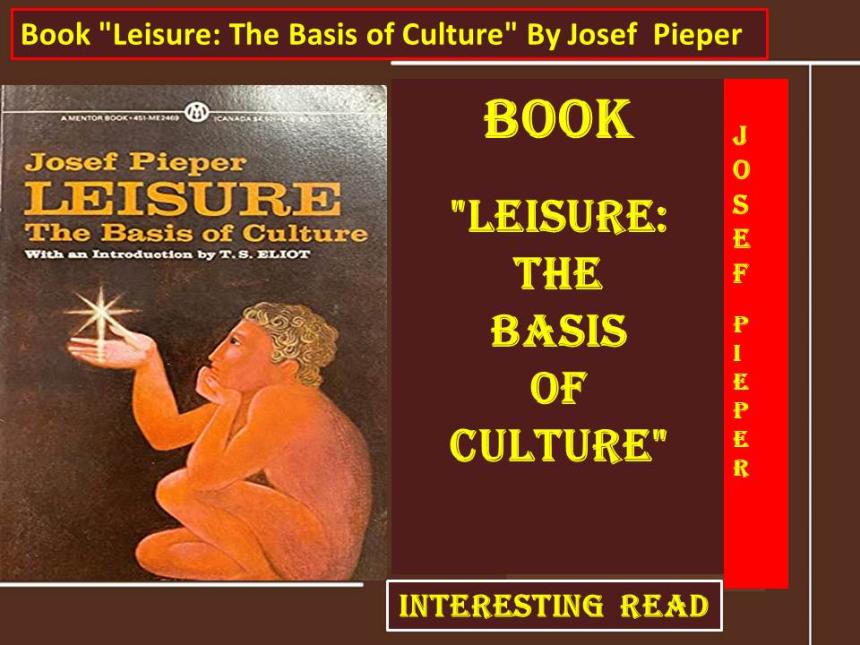

Book "Leisure: The Basis of Culture" By Josef Pieper
Josef Pieper (1904 - 1997) was a German Catholic philosopher and a leading figure in the 20th-century resurgence of Thomism—the philosophical tradition of Thomas Aquinas in early-to-mid 20th-century philosophy. Book "Leisure: The Basis of Culture" By Josef Pieper explains true human culture and higher spiritual insight do not arise from the frantic "world of total work," but rather from a receptive, contemplative state of inner calm known as leisure This write up is an introduction of the Book "Leisure: The Basis of Culture" By Josef Pieper and arranged for educational purposes from material available freely on Web Net.
أَعُوذُ بِاللّٰهِ مِنَ الشَّيْطَانِ الرَّجِيمِ
بِسۡمِ ٱللهِ ٱلرَّحۡمَـٰنِ ٱلرَّحِيمِ
In the name of ALLAH, the Most Gracious, the Most Merciful
Book "Leisure: The Basis of Culture" By Josef Pieper
Josef Pieper (May 4, 1904, Elte, Rheine, Germany- November 6, 1997, Münster, Germany) was a German Catholic philosopher. He was a leading figure in the 20th-century resurgence of Thomism—the philosophical tradition of Thomas Aquinas in early-to-mid 20th-century philosophy. Pieper is best known for integrating ancient Greek and Christian thought to explore human virtue, contemplation, and the meaning of life.
"Leisure: The Basis of Culture" By Josef Pieper (originally published in German as Musse und Kult and Was heisst Philosophieren?) is an important book to read for anyone interested in education, philosophy, theology, or culture. It really cannot be said any better than the quotations on the back of the book. "This book is a gem. No other book of this size will teach us so many true things about everything we need to know to understand what and why we are or about how to live a life worth living."
The central theme of Book "Leisure: The Basis of Culture" By Josef Pieper is that true human culture and higher spiritual insight do not arise from the frantic "world of total work," but rather from a receptive, contemplative state of inner calm known as leisure. It is important to define the true meaning of "Leisure" here before we go into more details of the book.
Josef Pieper defines "Leissure" as not mere "Idleness"; but he argues "Leisure" is not just a break from work or lazy time off. Josef Pieper terms "Leisure" as a "mental state"; representing an inner calmness and silence of the soul. It allows a person to quietly perceive and celebrate reality. "Leisure" doesn't mean "TV, video games, relaxing"; it means active pursuit of educational, philosophical, and spiritual objectives.
The Book "Leisure: The Basis of Culture" By Josef Pieper may also be described as a somber critique of the "Total Work Society". Modern culture reduces human worth entirely to productivity and economic output. Treating labor as the absolute measure of life harms the human spirit and a sea of humans lose depth of living human soul. In such ways cheap entertainment replaces true peace, leading to cultural decay. Therefore, philosophy, art, and higher learning grow out of contemplative leisure and thus humans lose the "Divine Connection". Moreover, the highest form of leisure- celebratory worship, aligning human existence with a transcendent reality becomes outdated.
Book "Leisure: The Basis of Culture" By Josef Pieper Explains
The goodreads.com introduces Book "Leisure: The Basis of Culture" By Josef Pieper as "One of the most important philosophy titles published in the twentieth century, Josef Pieper's Leisure: the Basis of Culture is more significant, even more crucial, today than it was when it first appeared fifty years ago. Pieper shows that the Greeks understood and valued leisure, as did the medieval Europeans. He points out that religion can be born only in leisure - a leisure that allows time for the contemplation of the nature of God. Leisure has been, and always will be, the first foundation of any culture".
"He maintains that our bourgeois world of total labor has vanquished leisure, and issues a startling warning: Unless we regain the art of silence and insight, the ability for non activity, unless we substitute true leisure for our hectic amusements, we will destroy our culture - and ourselves. These astonishing essays contradict all our pragmatic and puritanical conceptions about labor and leisure; Josef Pieper demolishes the twentieth-century cult of "work" as he predicts its destructive consequences".
If you've ever wondered why rest doesn't feel restful, you need this book.
If you've ever wondered why our culture feels so work-focused, you need this book.
If you've ever wondered why the idea that knowledge begins with doubt just sounds wrong, you need this book.
If you've ever wondered, then you are engaging in leisure and philosophy, and you need this book.
Book "Leisure: The Basis of Culture" By Josef Pieper Summary
The book "Leisure: The Basis of Culture" by Josef Pieper consists of two interconnected philosophical essays or public addresses originally published in post-war Germany. The main title essay of the Book "Leisure: the Basis of Culture" is "Musse und Kult" argues that true culture depends on a contemplative, non-utilitarian mindset. The second essay "The Philosophical Act" explores the inner nature and justification of philosophical thinking.
Published in post-World War II Germany, Josef Pieper's "Leisure: The Basis of Culture" argues that modern society's obsession with "total work" and productivity destroys human dignity. True leisure is not mere laziness or time off, but a receptive, inner calmness of the soul essential for philosophy, art, and worship.
Redefining Leisure and Work
Not Just Free Time: Leisure is an inner attitude and a spiritual calm, not just a weekend break or a vacation.
The Trap of "Total Work": Modern culture measures human worth only by output, turning people into mere functionaries or laborers.
Active Receptivity: True leisure is not doing nothing; it is a silent, celebratory attention to reality that allows us to take in the truth of the world.
Intellect versus Ratio
Ratio (Discursive Thought): The active, calculating, and problem-solving muscle of the mind used in daily labor.
Intellectus (Understanding): The receptive, intuitive capacity to simply behold and grasp reality, which functions during true leisure.
The Foundation of Culture
Rooted in Worship: Historically, higher culture and the liberal arts stem from a cultic or religious celebration that exists outside of economic utility.
The Means vs. The End: Work is always a means to an end (earning a living), whereas leisure is an end in itself, sought for its own fulfillment.
A Call to Reclaim Silence: Pieper warns that without recovering the capacity for quiet reflection and non-activity, humanity risks destroying its own culture.
Book "Leisure: The Basis of Culture" By Josef Pieper- Discussion
Book "Leisure: The Basis of Culture" By Josef Pieper explains why the inability to enjoy leisure is also closely related to sloth and despair. "One can only be bored if the spiritual power to be leisurely has been lost." Leisure is rooted in wonder, and therefore brings us a lasting joy that we cannot find in the mere temporary cessation of work ("vacation").
New York Times (NYT) published a Book Review in 1952 and said "Pieper's message to us is plain. The American democracy is not blissfully immune to the Western blight; we have in fact done our part in generating the totalitarian epidemic. The idolatry of the machine, the worship of mindless know-how, the infantile cult of youth and the common man--all this points to our peculiar leadership in the drift toward the slave society. " This book is a lovely, contrarian work of philosophy. Pieper watches how Socrates' prerequisite for philosophy (wonder) was replaced by Hegel's (doubt). Leisure, as he imagines it, is not idleness, but glad and sustaining astonishment.
Intellectus vs. Ratio in the Digital Age
Modern digital work habits supercharge ratio while almost completely suffocating intellectus. Our current environment alters how we use our minds based on Pieper's framework:
Constant Calculation: Digital tools demand non-stop sorting, optimizing, filtering, and responding. This keeps the mind locked in ratio, treating every piece of information as a problem to solve.
The Death of Silence: Notifications and infinite scrolls eliminate the quiet intervals required for intellectus. True insight requires an open, silent mind, which digital architecture actively fragments.
Deep Work vs. Insight: Even modern productivity concepts like "deep work" treat focus as a tool for output. Pieper would argue this is still just highly efficient labor, not the receptive contemplation that sparks true wisdom.
The Philosophical Act
In the second essay of the book, Pieper defines what it means to "step outside" the functional world of work through philosophy:
The World vs. The Environment: Plants and animals live in an "environment" dictated by immediate survival needs. Humans create a functional "working environment" for utility. The philosophical act allows humans to transcend this bubble to experience the "world" as a whole.
The Power of Wonder: Philosophy begins in wonder, which disrupts the daily grind. Wonder forces a person to look at ordinary things and realize they do not fully understand them.
An Act of Freedom: Because philosophy serves no economic purpose, it cannot be commodified. It is a radically free act that declares a human being is more than just a cog in a financial machine.
Book "Leisure: The Basis of Culture" By Josef Pieper- Modern Digital Age Relevance
To cultivate intellectus (receptive, contemplative insight) in a world dominated by ratio (constant processing and task-switching), you must intentionally design friction into your digital environment.
Hard Boundaries for the Mind
Analog Sanctuaries: Designate physical spaces or specific hours completely free of screens to allow the mind to settle into a non-reactive state.
The "Zero-Notification" Framework: Disable all non-human alerts so your brain stops anticipating external disruptions.
Fixed Monotasking Blocks: Dedicate time to a single text or problem without switching tabs, training your attention to stay put rather than skim.
Shifting from Processing to Beholding
The 15-Minute Buffer: Sit in silence for 15 minutes before opening your laptop in the morning to anchor your mind in existence before entering the "working environment."
Active Looking: Spend a few minutes looking at a complex piece of art, architecture, or nature online or in person without trying to analyze, critique, or bookmark it.
Delayed Response Rituals: Wait before replying to non-urgent messages to break the modern impulse of instant, calculation-driven communication.
Reclaiming the "Philosophical Act"
Read Beyond Utility: Read difficult, foundational texts that offer no immediate career value or practical application simply for the sake of understanding.
Unstructured Journaling: Write by hand without a prompt, goal, or character limit to let your thoughts wander organically.
The Conclusion
The book "Leisure: The Basis of Culture" by Josef Pieper teaches a laymen that human worth is not defined by constant work, productivity, or being busy. True leisure is a receptive, celebratory state of mind—an inner calm that allows us to contemplate reality, appreciate existence, and connect with the deeper, spiritual meaning of life. Labor is necessary for survival, but it is not the ultimate purpose of life. Rest is necessary but true rest is an active, silent stillness, not a frantic escape or empty time wasting. Society wrongly measures a person's value by how much they produce.
In this fast paced "digital age" mindless digital distractions and constant entertainment do not refresh the soul; they only numb it. Remember constant rushing (short time glitches; reels) stems from a deep inner anxiety and an inability to be at peace with oneself. Gen Z often experiences a unique sense of emptiness and time-wasting driven by digital burnout, spending over four hours daily scrolling through social media despite recognizing its negative impacts. The book "Leisure: The Basis of Culture" by Josef Pieper is a must read and application for Gen Z and following generations of the world.
My Dear Readers! True learning and art require quiet moments to step back and let the world impress upon us. Pausing for reflection or worship protects human freedom against the demands of the modern work machine. Working in life for bread and butter is essential but involving in "Total Work Society" culture is corrosive for soul and human spirits. We must create moments of "Leisure" for active pursuit of educational, philosophical, and spiritual objectives.




Fluff Pulp Price Trend Q2 2026 | Global Price Trends, Forecast, Chart,...

Lux Live CBD Gummies: Is It Worth Buying? Complete Supplement Review
Lux Live CBD Gummies are marketed as a convenient, chewable wellness supplement containing...
