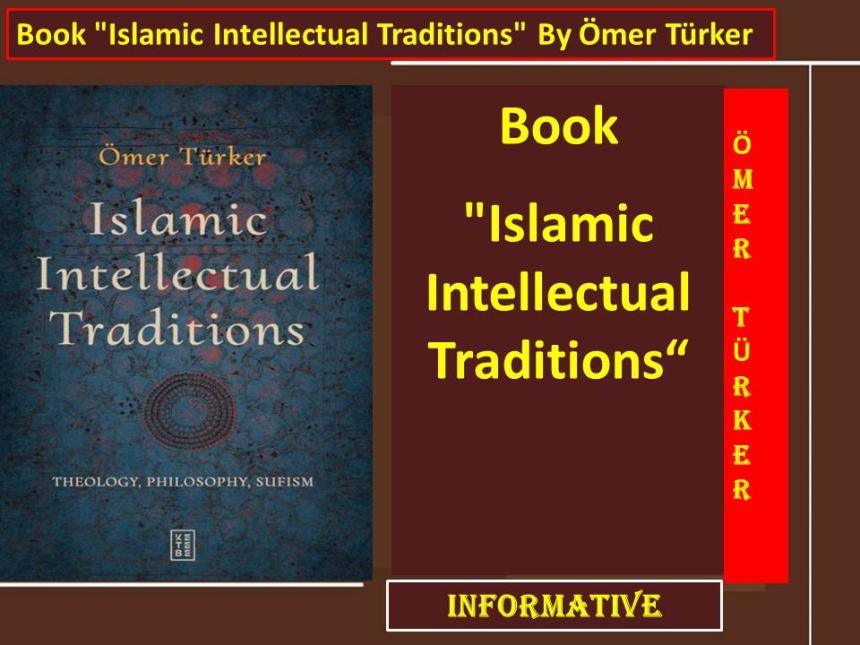

Book "Islamic Intellectual Traditions" By Ömer Türker
Ömer Türker (1975- 51 years) is one of the leading contemporary scholars of Islamic philosophy and intellectual history۔ In this Book "Islamic Intellectual Traditions", Ömer Türker actually introduces readers to the three major intellectual languages of the Muslim world: Theology, Philosophy, and Sufism — not as separate disciplines, but as living traditions that together sought to answer humanity’s most enduring questions. This write up is an introduction of the book and has been arranged for educational purposes.
أَعُوذُ بِاللّٰهِ مِنَ الشَّيْطَانِ الرَّجِيمِ
بِسۡمِ ٱللهِ ٱلرَّحۡمَـٰنِ ٱلرَّحِيمِ
اللہ کے نام سے شروع جو بڑا مہربان نہایت رحم کرنے والا ہے
In the name of ALLAH, the Most Gracious, the Most Merciful
Book "Islamic Intellectual Traditions" By Ömer Türker
Ömer Türker (1975- 51 years) is one of the leading contemporary scholars of Islamic philosophy and intellectual history, exploring the great questions that shaped Muslim civilisation: theology, metaphysics, ethics, language, knowledge, existence, and the human condition. In this Book "Islamic Intellectual Traditions", Ömer Türker explores the great questions that shaped Muslim civilisation: theology, metaphysics, ethics, language, knowledge, existence, and the human condition. Ömer Türker actually introduces readers to the three major intellectual languages of the Muslim world: Theology, Philosophy, and Sufism — not as separate disciplines, but as living traditions that together sought to answer humanity’s most enduring questions.
Book "Islamic Intellectual Traditions" By Ömer Türker explores the central questions that have defined centuries of Muslim intellectual inquiry — existence and ontology, the universe and cosmology, knowledge and epistemology, the nature of the human being, and the relationship between ALLAH / God and the universe. By examining the foundational principles of these traditions, he offers both a clear understanding of their historical development and a thoughtful reflection on their relevance for contemporary thought. Bringing together the theological, philosophical, and Sufi traditions as interconnected intellectual languages expressing a unified vision of reality, this impressive and practical handbook draws upon the author’s deep understanding of the classical sciences and their metaphysical foundations. Written with clarity and precision, the work speaks both to the interested reader and the specialist, offering a synthetic understanding of one of the richest intellectual heritages in world history.
Book "Islamic Intellectual Traditions" By Ömer Türker has following main sections:-
• The Initial Problem Under Consideration: The Relation Between Reason and Revelation
• Section 1: The Theological Tradition
• Section 2: The Philosophical Tradition
• Section 3: The Sufi Tradition
Book "Islamic Intellectual Traditions" By Ömer Türker Explains
Ömer Türker in his Book "Islamic Intellectual Traditions" explores how Islamic intellectual traditions reconciled rational thought with divine revelation by examining the distinct approaches of Kalām theologians, philosophers, and Sufi mystics. The analysis shows that these traditions viewed reason and revelation as a symbiotic partnership, where intellect interprets scripture while revelation guides understanding.
"Reason and Revelation in Islamic Thought" is one of the singular distinctions of Islam is the balance maintained between 'aql and naql', that is, between human rational thought and revealed scripture. Certain people admit the intellect alone to be the source of knowledge, whether in the realm of the manifest or the hidden. Reason confirms revelation and revelation agrees with reason. So, there is no contradiction or conflict between reason and revelation. Thusly, a correct understanding of revelation is only possible by using the mind/by putting the mind into action correctly.
The theological tradition in Islam, known as ‘Ilm al-Kalām (the science of discourse) or ‘Aqā’id (articles of faith), is the systematic study of core Islamic beliefs. It provides rational proofs for the existence of God, explains His attributes, and defends core doctrines against doubt, heresy, and rival philosophies. The nature of God, His Oneness (Tawḥīd), and His eternal attributes (like knowledge, power, and will). The purpose of divine revelation, the role of prophets, and the evidence for miracles. The afterlife, the nature of the soul, divine justice, and human free will.
At the heart of all Islamic theology is the strict concept of Tawḥīd—the absolute Oneness and Uniqueness of God. Traditional theology maintains the principle of Tanzīh, which states that God is entirely incomparable to His creation. For example, when sacred texts mention the "Hand" or "Face" of God, theologians understand these metaphorically as expressions of Divine power and presence, rather than literal physical features.
The Islamic philosophical tradition refers to the collective work of scholars who sought to unite the teachings of the Quran with the logic of ancient Greek philosophy (primarily Aristotle and Plato). It blends reason, theology, and mysticism to explain the nature of God, the soul, and human purpose.
Falsafa (Peripatetic Philosophy) tradition focuses on strict logic and scientific reasoning. Scholars like Al-Farabi and Avicenna (Ibn Sina) used Greek frameworks to prove the existence of God. The "Kalam" (Theology) branch uses rational argument to defend Islamic doctrines against skeptics. The "Irfan" (Sufism) is a mystical tradition; which emphasizes direct, spiritual knowledge of the divine rather than pure logic.
"All knowledge is either conception or assent." "Assent is perception without judgement accompanied by judgement." "All knowledge is either conception or judgement" seems to exclude precisely those cases where a conception is judged. For it implies that if knowledge is a judgement, it cannot be a conception. What we really mean by knowledge is the cognitive state that we pass into once a form becomes present to our mind. When we call a conception ‘knowledge’, this is merely an accidental predication, true only in virtue of the fact that the presence of the form causes the cognitive state. The tradition of philosophical engagement with such division of knowledge is the rich tradition of philosophical discussions on notions of knowledge by Muslim Scholars.
Sufism is the mystical and spiritual core of Islam. Its followers seek direct, personal experience of God. They focus on inner purity, divine love, and overcoming the ego. The word "Sufi" likely comes from the Arabic word for wool, honoring the simple robes worn by early ascetics.
The Path (Tariqa) is a journey of spiritual learning taught by a master to a student. Then there is "Self-Annihilation" (Fana) meaning by erasing one's own ego to exist fully in God's love. Then another is "Stages of Knowledge" which is the journey including following Islamic law (Sharia), walking the inner path (Tariqa), gaining divine wisdom (Ma'rifa), and knowing ultimate Truth (Haqiqa).
Early Muslims practiced deep piety and simple living to avoid worldly temptations as the empire grew. The focus shifted from just fearing God's punishment to loving God deeply, led by famous figures like Rabi'a al-Adawiya. Scholars like Al-Ghazali successfully blended Sufism with mainstream Islamic theology. The tradition grew into organized brotherhoods (Tariqas). Famous poets like Rumi spread messages of divine love and tolerance.
Some common practices are "Dhikr"-the rhythmic, constant repetition of God's names to keep Him in mind; and "Sama / Qawwali" is using spiritual poetry and music to reach ecstatic states of devotion.
The Summary of Book "Islamic Intellectual Traditions" By Ömer Türker
The book may be summarised by an opinion on the book "Ömer Türker through this Book "Islamic Intellectual Traditions" has attempted reinterpreting classical thought in a manner that brings it into conversation with contemporary issues and challenges can only take place by first understanding it. Every effort that fails to achieve such a grasp of the legacy of intellectual thought inevitably results in being incapable of dealing with the most critical problems of our age".
"The present Book "Islamic Intellectual Traditions" By Ömer Türker presents a comprehensive yet concise understanding of the great Islamic intellectual traditions of theology, philosophy, and Sufism, covering the areas of existence and ontology, the universe and cosmology, knowledge and epistemology, the nature of the human subject, and the relation between God and the universe. It explores the foundational principles of each of these traditions, undertakes a critical evaluation of their legacies, and presents the opportunities that they offer to humanity in our contemporary times".
"This impressive and practical handbook provides a synthetic understanding of the Islamic theological, philosophical, and Sufi traditions. These three are historically and intellectually posited, embodying each a particular “language” by which to express a unitive view of Reality. Such synthesis is certainly only made possible by the author’s thorough understanding of the underlying order of the sciences anchored in metaphysics. The ability to simultaneously address the intelligent and interested reader, as well as the specialist, is one of the remarkable achievements that this work presents". (By Dr. Karim Lahham)
What has remained the central theme of Muslims' intellectual pursuit since the very beginning; geminates from Quranic Injection 'Iqra'-the very first revelation upon the Prophet Muhammad (PBH)? The central theme of Muslim intellectual pursuit since the very beginning is the search for knowledge to understand and submit to the divine will. This pursuit blends revelation (the Quran and Sunnah) with reason ('aql), guiding every aspect of life, science, and philosophy to discover truth and justice.
Throughout history, this overarching theme has driven scholars to focus on several specific goals. Believers use logic to understand religious truths. They do not separate the mind from religion. Scholars study the Quran and Hadith (sayings of the Prophet) to live righteously. Thinkers observe the natural world. They believe studying the universe reveals the greatness of the Creator. This is the intellectual struggle to defend the Islamic worldview against doubt or attack.
However it is important to differentiate that the "Islamic Intellectual Traditions" initiated while Muslims were commanding the world through Baghdad (The House of Wisdom) and Cordoba (The Beacon of Spain & the Great Libraries); and today the Muslims' World is in decline since the colonial era and are suffering due lack of political and modern jurisprudence.
Many people think modern science only started in Europe. In reality, European thinkers read books from Baghdad and Cordoba. Scholars and Scientists of Baghdad translated old Greek, Persian, and Indian books into Arabic and used those translated books to do original research. For example, Al-Khwarizmi created algebra in Baghdad. The pursuit of knowledge was a core religious duty. Men and women both learned and taught in these great centers. The rulers of Indulusia built massive libraries. Scholars of different faiths (Muslim, Christian, and Jewish) worked together there. Cordoba became a bridge of light. Ideas from the East traveled through Cordoba. This helped Europe escape the Dark Ages.
It is profoundly important to understand today's struggles in the Muslim world, which is to differentiate between two eras. The first is a golden age of global leadership in places like Baghdad and Cordoba, where open thought thrived. The second is the modern era, where colonialism broke apart traditional systems. Today, a lack of modern jurisprudence—the theory of law—causes political problems; and proper Islamic political system is still debated; although under the umbrella and shadow of Western philosophies and dogmas.
Starting in the last two centuries, the Muslim world faced a slow decline. European powers took over most Muslim lands.They drew fake borders and replaced local laws and customs with European ones. Because outside forces controlled their lands, Muslim scholars stopped adapting traditional laws to new times. Law changes as the world changes. Because of the colonial break, the Muslim world faces a gap in jurisprudence. Old laws were made for a world of horse-drawn carts and kings. Today's world has the internet, nuclear power, and democratic ideas. Modern jurisprudence requires taking ancient Islamic moral values and using them to create fair laws for today's complex political systems.
This is digital age and technology is driving the humanity towards a new horizon. The Muslim World today's social and civilizational problem may be described with an "Analogy"; to think of the law and political system employed as an operating system on a computer. The old operating system worked perfectly for an old computer. But today's world requires new software. Without it, the computer freezes. The Muslim lands have produced thinkers and scholars who have diagnosed the problems and also prescribed the medicines for the cure.
Some well known scholars, who have provided guidance on political thoughts are Syed Qutb (Egypt) Ali Shariati (Iran) Allama Iqbal and Maulana Maududi (Pakistan). These four scholars reshaped modern political thoughts in the Muslim world. They responded to Western ideas with unique Islamic frameworks. All four thinkers believed that Islam is not just a personal religion. They all viewed it as a complete way of life with rules for running a government and society.
The Conclusion
The Book "Islamic Intellectual Traditions" By Ömer Türker explores the central questions that have defined centuries of Muslim intellectual inquiry — existence and ontology, the universe and cosmology, knowledge and epistemology, the nature of the human being, and the relationship between God and the universe. The author suggests to address the challenges of the modern world, that we must first rediscover the unity of meaning embedded in the great traditions of thought. Yet this can only begin through a deep and faithful understanding of the classical heritage.
The Book "Islamic Intellectual Traditions" By Ömer Türker offers a compelling reappraisal of the core intellectual currents of Islamic civilisation. Traversing theology, philosophy, and Sufism, the book explores enduring questions of existence, the cosmos, knowledge, the human self, and the relationship between God, the universe, and humanity. With clarity and depth, Türker reveals how these traditions emerged, how they interacted, and what they still have to offer. Rather than approaching the past as a museum of ideas, he presents it as a living legacy—one that holds transformative insights for those seeking orientation in an age of fragmentation.
There is a need to infuse "the Islamic Intellectual Traditions" with well thought out Islamic political and modern jurisprudence—the theory of law into Muslims' body politics as a source for solutions for "Muslim Ummah" to raise "Muslim Civilization" as was during 'golden age'.
Shri Radha Aqua Garden: 2 BHK vs 3 BHK Home Selection
Choosing between a 2 BHK and a 3 BHK apartment depends on budget, family size and future p...

Reasons Why IVF Fails: Understanding the Common Causes
Reasons Why IVF Fails: Understanding the Common Causes IVF treatment can bring hope to...
