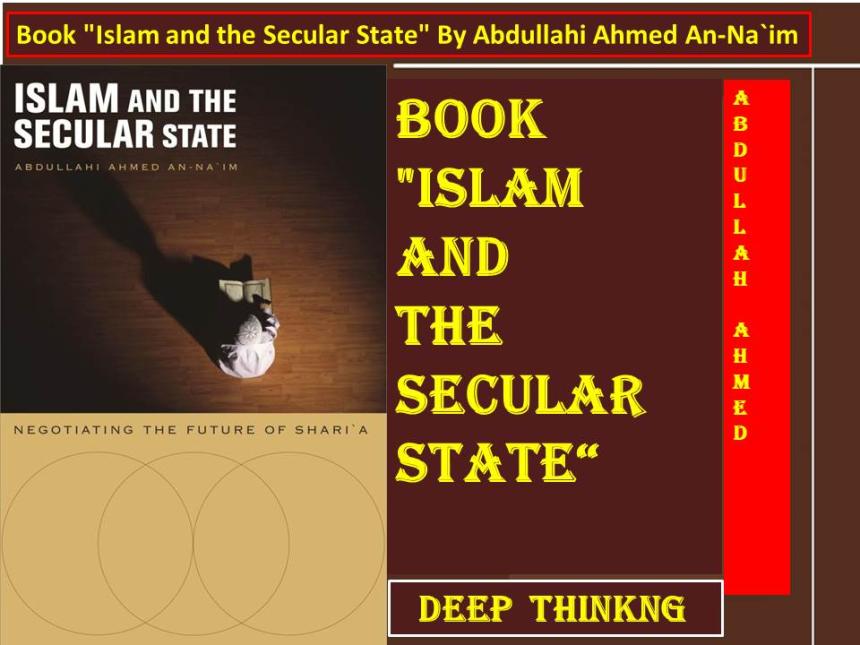

Book "Islam and the Secular State" By Abdullahi Ahmed An-Na`im
Abdullahi Ahmed An-Na'im (April 6, 1946) is a renowned Sudanese-American legal scholar and professor of law at Emory University, known for his work on human rights, Islam, and secularism. Book "Islam and the Secular State": Negotiating the Future of Shari'a by Abdullahi Ahmed An-Na'im argues that a secular state is necessary for the authentic practice of Islam and the protection of human rights. This write up is a review on the book for a wider discussion on the subject.
أَعُوذُ بِاللّٰهِ مِنَ الشَّيْطَانِ الرَّجِيمِ۔
بِسۡمِ ٱللهِ ٱلرَّحۡمَـٰنِ ٱلرَّحِيمِ
In the name of ALLAH, the Most Gracious, the Most Merciful
Book "Islam and the Secular State" By Abdullahi Ahmed An-Na`im
Abdullahi Ahmed An-Na'im (April 6, 1946) is a renowned Sudanese-American legal scholar and professor of law at Emory University, known for his work on human rights, Islam, and secularism. He grew up in northern Sudan and later became a prominent advocate for human rights in Islamic societies. Book "Islam and the Secular State": Negotiating the Future of Shari'a by Abdullahi Ahmed An-Na'im argues that a secular state is necessary for the authentic practice of Islam and the protection of human rights. An-Na'im proposes a "negotiated secularism" where Shari'a is not coerced by the state, but voluntarily adopted by citizens.
He has written important works about the interdependence between religion, human rights and secularism, instead of a dichotomy and incompatibility between them. As a lawyer and human rights activist, his books often tend to "the normative", to the dialogue and negotiation. His ideas are reformist and pacifist, possibly from the influence of the Islamic reform movement of Mahmoud Mohamed Taha in Sudan, a pacifist theologian, who played a prominent role in the Sudanese struggle for independence from Britain and the reform of Islam.
Although the book fails in legitimizing and justifying the principles of constitutionalism, human rights and citizenship in Islamic terms (because their impact would be effective only in a small elite of Muslims already converted and educated in some of these principles), the author's work succeeds in providing an "interpretative framework" to build substantive arguments and analysis about the future of Shari’a, having the great merit of building theory and concepts and setting forth the concepts of context and content in relation to the Shari’a –something fundamental in his research design and communication, which provides the author with an important methodological sensitivity.
The Dogma-Muslim Nation; Secular State
What should be the place of Shari‘a—Islamic religious law—in predominantly Muslim societies of the world? In this ambitious and topical book, Abdullahi Ahmed An-Na'im, a Muslim scholar and human rights activist envisions a positive and sustainable role for Shari‘a, based on a profound rethinking of the relationship between religion and the secular state in all societies. An-Na‘im argues that the coercive enforcement of Shari‘a by the state betrays the Qur’an’s insistence on voluntary acceptance of Islam.
Just as the state should be secure from the misuse of religious authority, Shari’a should be freed from the control of the state. State policies or legislation must be based on civic reasons accessible to citizens of all religions. Showing that throughout the history of Islam (neglecting that most of the Muslim rulers were non religious and their state were strictly non Islamic), Islam and the state have normally been separate, An-Na‘im maintains that ideas of human rights and citizenship are more consistent with Islamic principles than with claims of a supposedly Islamic state to enforce Shari‘a. In fact, he suggests, the very idea of an “Islamic state” is based on European ideas of state and law, and not Shari‘a or the Islamic tradition.
This book "Islam and the Secular State" By Abdullahi Ahmed An-Na`im deals with a controversial and fascinating subject to scholars and researchers: the establishment of a secular state to a genuine religious life, for both Muslims and non-Muslims in the Arab and Islamic world. What lends special interest to this work is that it deals with the regulation of the connectedness of Islam and Politics, which is constitutionalism, human rights and citizenship; three preconditions to provide an environment of freedom and security in order for Muslims to be able to participate in the debate about the Qur’an and the Sunna. At the centre of the book is the problem of the separation of Islam and state, which can be understood through the role of Shari’a in public life and within a secular state -a desirable aim on public-policy grounds and justified on Islamic grounds.
The book "Islam and the Secular State" By Abdullahi Ahmed An-Na`im focuses on three case studies: India, Turkey and Indonesia, to assess respectively the role of religion in public life, the „authoritarian secularism‟ and applicability of the Shari’a through the constitution. The cases are analyzed in a thorough and well-informed manner and have the purpose of highlighting that secularism does not necessarily mean the exclusion of religion from public life; promoting the need of institutional separation of Islam from State; understanding and explaining the relationship between Islam and politics; and assessing the limitations of Shari’a for Muslims and non-Muslims. What seems to be missing from them, however, is a mechanism for achieving a shared vision and respect for constitutionalism, human rights and citizenship, and a secular state that provides and ensures a field for public debate, because "civic reason" and "reasoning" are necessary but not sufficient conditions to achieve it.
Western Scholars' Support to the Book "Islam and the Secular State" By Abdullahi Ahmed An-Na`im
The non Muslim commentators view this book "Islam and the Secular State" By Abdullahi Ahmed An-Na`im Bold, as pragmatic, and deeply rooted in Islamic history and theology, Islam and the Secular State offers a workable future for the place of Shari‘a in Muslim societies. "Two debates pervade almost all discussions about Islam, Muslim societies and the role of both in the 21st century. The first revolves around the shari'a, a kind of comprehensive Muslim guide to good conduct, and its applicability within Muslim majority states. The other frames capitalism, socialism and secularism as antipodes to what Islam cannot or should not be. This book engages both, arguing that secularism is not as an unwelcome counter force to 'true' Islam but is the indispensable path to reclaiming Islam to advance pluralism, human rights, women's rights, civil society and citizenship. Abdullahi An-Na'im is a public intellectual known far beyond the academy and the American continent. In Africa, in Asia and throughout the Middle East his is a courageous voice for secular Islam. There is no book like this one: brilliant, compelling, and optimistic. —Bruce B. Lawrence, Duke University
The author Abdullahi Ahmed An-Na`im draws on other researchers to support their proposal of a secular state. For instance, Ira Lapidus, professor emeritus of History at the University of California, has written about the separation of state and religion and has traced a historical differentiation of state and religious institutions in the Islamic societies. His arguments support the basis of An-Na`im‟s proposal, who emphasizes that a secular state is more consistent with Islamic history, because of the ambiguities with regard to the distribution of authority, functions and relations among institutions within different Islamic models for states (P. 45). Thus, states were neither Islamic nor completely secular, in the sense that there has always existed a difference between the state and the religious institutions in Islamic societies – a point that supports the separation between Islam and state as a condition for a secular state. It is important to highlight that "Islamic" means tradition, culture, language, territory and religion.
The author speaks about "Islamic" perspective and not "Muslim" perspective. In the 324 pages of the book, the author speaks as a Muslim and concludes his life's work, emphasizing the difficulty of resolving the paradox about “how to secure the religious neutrality of the state within the reality of the connectedness of Islam and politics” (p.267). For it, he insists on the followings aspects:-
1) Proposing, supporting and legitimating a concept of a secular state which promotes interdependence and cooperation - from an Islamic perspective.
2) Need for a secular state for being a Muslim that can act from conviction and choice, instead of enforcing Islamic piety.
3) Proposing a process-based model of negotiated secularism to distinguish between secularism and secularization and for discussing how to rehabilitate the public role of religion. These and other assertions are supported with arguments and methodologies proposed by the author, who seeks to legitimize ways to reform the Shari’a, which must be accomplished in consensus within a framework where people-as a human agency- can participate freely. Overall, the book is a useful contribution to the understanding of the relationship between Islam, state and politics, and of the role of Shari’a in public life.
The Summary of the Book "Islam and the Secular State" By Abdullahi Ahmed An-Na`im
Chapter 1. Introduction: Why Muslims Need a Secular State: In order to be a Muslim by conviction and free choice, which is the only way one can be a Muslim, I need a secular state. By a secular state I mean one that is neutral regarding religious doctrine, one that does not claim or pretend to enforce Shariʿa—the religious law of Islam—simply because compliance with Shariʿa cannot be coerced by fear of state institutions or faked to appease their officials. This is what I mean by secularism in this book, namely, a secular state that facilitates the possibility of religious piety out of honest conviction.
Chapter 2. Islam, the State, and Politics in Historical Perspective: The main purpose of this chapter is to show that my proposal for a secular state is more consistent with Islamic history than is the so-called Islamic state model proposed by some Muslims since the second quarter of the twentieth century. An overview of various states or regimes that ruled Islamic societies for many centuries should also help to dispel any romantic notions about Islamic states and pious rulers.
Chapter 3. Constitutionalism, Human Rights, and Citizenship: In this chapter I will discuss constitutionalism, human rights, and citizenship as an integrated framework for regulating the practical way secularism works to negotiate the tension between the religious neutrality of the state and the connectedness of Islam and public policy. Constitutionalism provides a legal and political framework for realizing and safeguarding equal dignity, human rights, and the well-being of all citizens. The standards of human rights, while authoritatively defined in international and regional treaties and customary international law can be applied in practice only through national constitutions, legal systems, and institutions.
Chapter 4. India: State Secularism and Communal Violence: This chapter examines the tension between the secularism of the Indian state and the realities of communal violence and interfaith relations in current Indian society. This issue is approached with reference to the historical context of the relationship among Islam, the state, and politics, which goes back to at least the eleventh century. The underlying concern is the influence of the relationship between the Indian Muslim community and the state, as well as other religious communities, on legitimizing and securing secularism as a deeply contextual concept and practice that is negotiated over time.
Chapter 5. Turkey: Contradictions of Authoritarian Secularism: The end of World War I marked the collapse of the Ottoman Empire and the drastic reduction of its territory. Mustafa Kemal soon led a successful revolution against the remnants of the old Ottoman government, and in 1922 a new republic was established. It instituted a series of rapid reforms aimed at thoroughly transforming Turkish political and social life by secularizing and westernizing the country and by strictly limiting—as well as controlling—the role of religion and religious institutions.
Chapter 6. Indonesia: Realities of Diversity and Prospects of Pluralism: It may be helpful to begin this chapter on the dynamics of diversity and pluralism in Indonesia with an overview of the country’s recent history and context. The present state of Indonesia is a product of the struggle against Dutch colonialism. While there was earlier localized resistance to colonial rule in various parts of the archipelago, the initiative for wider opposition to Dutch rule emerged with the rise of Sarekat Islam in 1917, but this mass political movement broke up over ideological and political differences by the late 1920s, and the initiative shifted to the nationalists
Chapter 7. Conclusion: Negotiating the Future of Sharia: The framework proposed in this book provides the normative and institutional parameters and safeguards for the negotiation and mediation of the role of Shariʿa among Muslims and non-Muslims now and in the future. By negotiation and mediation I mean to emphasize that there is no categorical and permanent resolution of the paradox of how to secure the religious neutrality of the state within the reality of the connectedness of Islam and politics. The conception of the secular state I am proposing offers an alternative vision to perceptions of secularism and the secular state that many Muslims find objectionable.
The Critique on the Book "Islam and the Secular State" By Abdullahi Ahmed An-Na`im
Abdullahi Ahmed An-Na`im's "Islam and the Secular State" argues that a secular state is essential for a true Islamic society, as any Shari'a enforced by the state is, by definition, state law rather than divine law. By arguing that Shari'a can only be realized through personal conscience and not by state enforcement, An-Na'im is criticized for making a "hermeneutical argument" that departs from historical, traditional Islamic understandings of the state's role.
All states are defined as sovereign political entities that possess the authority to create and enforce laws within a defined territory to maintain order and manage society and it is always done by majority vote in democracy or by state's authority. Why the author does wants state to force a Western secular paradigm into Islamic legal tradition, delegitimize traditional interpretations of Shari'a, and risks diluting the religious authority of Islam to conform to modern liberal values? Any state punishes the violator of law then why any violator of Islamic Jurisdictions (Shari'a law) may not be punished? Is Shariah compliance a threat to modern citizenship?
The book adopts a "dominant framework" (liberal secularism) as the standard, evaluating Islam based on whether it conforms to this foreign concept, rather than analyzing Islamic principles on their own terms. This is classic problem of all the Muslim lands where such scholarship has emerged after colonial slavery; as the writer is from Sudan and takes pride in his liberal secular education which was a legacy of western education system imposed on colonized lands.
The premise that Islam and the secular state are compatible is itself a false argument. Critics argue that "secular" is not a neutral term and that creating a secular state often involves the state manipulating or restricting religious expressions that do not conform to liberal standards. Essentially, the book is considered "poor and in bad taste" or controversial by those who believe that a secular state is inherently incompatible with the comprehensive nature of Islamic legal tradition. Islam itself is complete code of life and doesn't require any ism to associate.
The Conclusion
The book "Islam and the Secular State" By Abdullahi Ahmed An-Na`im is an argument for reforming how Shari'ah is applied in modern society, moving away from a model of an "Islamic State" toward a religiously neutral state that protects all citizens. However, the book is written by a liberal secular Muslim who has not taken the base of Islam i.e. Quran and Sunnah of Holy Prophet Muhammad (PBUH) into consideration. There are explicit directions and instructions for all the "Believers" individually and as an "Ummah" / "Nation" to enforce commandments of ALLAH in toto.
There has always been a group since colonial slavery who have attempted to integrate or legalize elements of Sharia within modern, secular legal frameworks; however, attempts to modernise or incorporate Sharia are failing due to fundamental incompatibilities with liberal secularism, and also because, the proponents have always been short of Sharia comprehension. The book "Islam and the Secular State" By Abdullahi Ahmed An-Na`im may also be framed in the same category as a failed attempt to convince educated but religious minds to accept modernization of Islam in the line with liberal secular state paradigm.
The profound aspect that is neglected by such liberal scholars is that almost all the existing Muslim countries are functioning with non Islamic constitution and most of them are suffering from abject poverty and economic misery. Data indicates that a significant number of OIC nations are classified as low-income; as nearly 40% of the world's poor reside in OIC member countries.
There is a significant, ongoing tension between conservative (often Islamist or traditionalist) and liberal (often secularist or progressive) factions in many Muslim-majority states. This conflict centers on the role of religion in public life, the interpretation of Islamic law (Sharia), and the balance between cultural tradition and modernization. The attempt "Islam and the Secular State" By Abdullahi Ahmed An-Na`im is an effort to win over the debate; as such scholars are already enjoying powers and wealth of this world.
The Islamic Republic of Iran is unique in that it is the only state in the world officially governed by the Velayat-e Faqih (Guardianship of the Islamic Jurist) model. Developed by Ayatollah Ruhollah Khomeini, this doctrine justifies clerical rule over the state in the absence of the 12th Shia Imam. This state remained under all kinds of sanctions and bitter confrontation in the region but has emerged miraculously from a war with world greatest military might USA and so called invincible IDF.
As of early 2026, the Islamic Republic of Iran is viewed more as a resilient and assertive middle power navigating a severe, multi-dimensional crisis other than a globally adopted "better model" of state. While its survival against heavy international pressure has drawn attention, the resilience exhibited is not properly attributed to its governance model, IGRC mosaic strategy, and "axis of resistance-Karbala thematic" philosophy. This is because; the world is not ready to accept success of "Islamic System" of governance. IR of Iran has presented a political model implemented successfully and tested as well. Let's see any scholarship undertaking research and publication on the model of Iran's Islamization.
NOTE: This write up has been compiled with the help of material available freely on web net from various sources.





How to Sell Post Office Building Assets: A Guide for USPS Property Own...
Looking to sell post office building assets? This practical guide covers valuation, qualif...