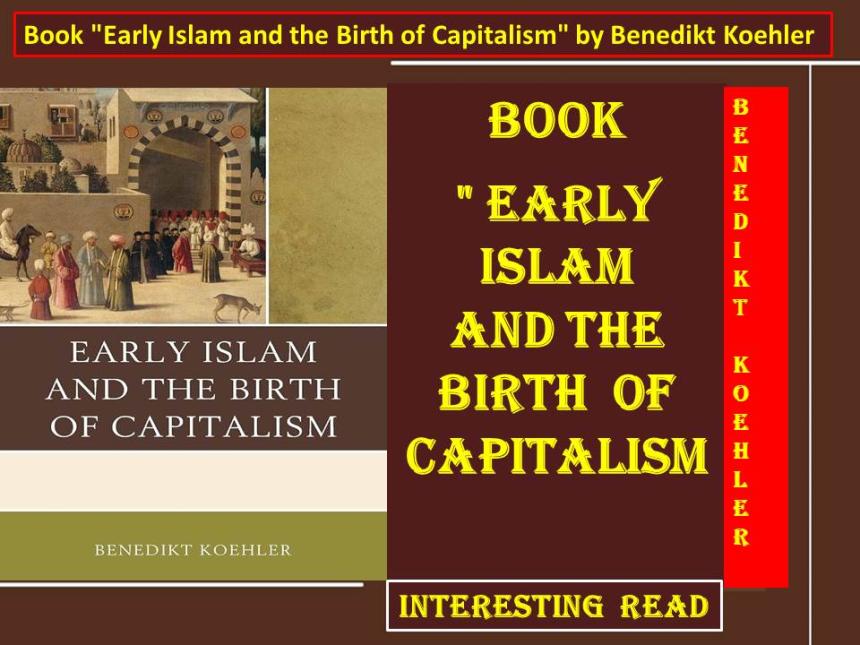

Book "Early Islam and the Birth of Capitalism" by Benedikt Koehler
Dr. Benedikt Koehler (1953) was born in New York, United States, and is a German national. He is currently residing in London. He is a prominent economic historian, author, and Fellow of the Economics of Religion at the Institute of Economic Affairs (IEA) in London. This write up is an introduction of Benedikt Koehler's famous Book "Early Islam and the Birth of Capitalism" and has been arranged for educational purposes from material available freely on Web Net.
أَعُوذُ بِاللّٰهِ مِنَ الشَّيْطَانِ الرَّجِيمِ
بِسۡمِ ٱللهِ ٱلرَّحۡمَـٰنِ ٱلرَّحِيمِ
In the name of ALLAH, the Most Gracious, the Most Merciful
Book "Early Islam and the Birth of Capitalism" by Benedikt Koehler
Dr. Benedikt Koehler (1953) was born in New York, United States, and raised in Germany (as German national), and is currently residing in London. He is a prominent economic historian, author, and Fellow of the Economics of Religion at the Institute of Economic Affairs (IEA) in London. Benedikt Koehler is known for his famous book, "Early Islam and the Birth of Capitalism".
Book "Early Islam and the Birth of Capitalism" by Benedikt Koehler argues that capitalism first emerged in 7th-century Arabia rather than in later medieval European city-states. The book highlights that Islam is the only major religion founded by a merchant and entrepreneur, the Prophet Muhammad (PBUH). It proposes that foundational market mechanisms traditionally credited to Renaissance Italy actually originated and thrived in early Islamic Mecca and surrounding trade networks.
Book "Early Islam and the Birth of Capitalism" by Benedikt Koehler describes that early Islamic teachings prioritized transparent market rules, consumer protection, fair trade guidelines, and the strict honoring of written contracts. Economic practices and institutions spread from the Middle East into medieval European commercial hubs like Venice and Genoa. Financial and organizational tools such as early forms of corporate entities, specialized management techniques, and charitable trusts (waqf) trace their lineage back to this foundational period.
Book "Early Islam and the Birth of Capitalism" by Benedikt Koehler Explains
Book "Early Islam and the Birth of Capitalism" proposes a strikingly original thesis—that capitalism first emerged in Arabia, not in late medieval Italian city states as is commonly assumed. Early Islam made a seminal but largely unrecognized contribution to the history of economic thought; it is the only religion founded by an entrepreneur. Descending from an elite dynasty of religious, civil, and commercial leaders, Muhammad (PBUH) was a successful businessman before founding Islam. As such, the new religion had much to say on trade, consumer protection, business ethics, and property. As Islam rapidly spread across the region so did the economic teachings of early Islam, which eventually made their way to Europe.
Book "Early Islam and the Birth of Capitalism" by Benedikt Koehler demonstrates how Islamic institutions and business practices were adopted and adapted in Venice and Genoa. These financial innovations include the invention of the corporation, business management techniques, commercial arithmetic, and monetary reform. There were other Islamic institutions assimilated in charities, the waqf, inspired trusts, and institutions of higher learning; the madrasas were models for the oldest colleges of Oxford and Cambridge. As such, it can be rightfully said that these essential aspects of capitalist thought all have Islamic roots.
Comments from Readers on the book (Taken from Goodreads.com)
The author is a researcher in the field of economic history of religions, and the present book is his most famous work. The book examines the history of Islam from before the Prophet of Islam to the Rightly Guided Caliphs and several centuries after the emergence of Islam. The structure of the book is similar to books that have been printed many times in Iran and used in schools and universities, although the message and content of the book are relatively different.
The author's main theory in the book is that you should not search for the roots of capitalism in Venetian merchants or Dutch and English companies. Capitalism, like all the other good things in the world, existed in Islam and Westerners later learned from us. Although you do not see any traces of capitalism in many Muslim countries at present, in the past, we ourselves had "Islamic capitalism"! In short, the author believes that the birth of capitalism should be sought in the history of Islam, not the West.
The author's most important argument in the book on this issue is the hadith in which the Prophet said: "Prices are in the hand of God." It also contains references to private property, freedom of trade, tax reduction (zakat for Muslims, jizya for non-Muslims), zeroing corporate taxes and zeroing customs tariffs, investment laws (Mudaraba), and the social security system.
The Prophet of Islam was also involved in business since childhood and, according to the author of the book, he had no financial problems for most of his life (except during the period of economic sanctions) and he can be considered a relatively wealthy prophet compared to Jesus and Moses. According to the author, at the time of his death, he was the richest Arab man of the time. Thus, the Prophet of Islam was familiar with the concepts of business since childhood.
After the advent of Islam and the Prophet's migration to Medina, according to the author, he created a mechanism similar to a free market in Medina.
When a famine prevailed in the city, many Muslims asked the Prophet to set prices for scarce goods so that sellers could not sell them at a high price. (This interference in prices was also common and accepted in the governments of that time.)
According to a hadith quoted in the book (and if I am not mistaken, it is also accepted by most clerics), the Prophet did not accept price setting and said that setting prices was beyond his responsibility, that God had not given him the authority to set prices, and that "prices are in the hands of God."
Are prices in the hands of God or the invisible hand of Adam Smith!?
According to the author, the sentence "prices are in the hands of God" was a major development in its time, because in many governments of the world, including in Saudi Arabia, setting prices by the government was an accepted thing, and Muslims also strongly demanded that the Prophet set prices due to the famine.
The author considers the sentence “Prices are in the hand of God” to be equivalent to Adam Smith’s “invisible hand of the market” in The Wealth of Nations. He considers the Prophet of Islam (PBUH) to be the founder of the market economy, without providing a precise definition of the market economy and its history before the Prophet of Islam. According to the author:
In the field of economic policy-making, the Prophet of Islam is a supporter of radical capitalism, and absolutely no trace of conservatism, moderation, expediency, or compromise is seen in his approach.
The author puts forward the theory that basically in Islam it is not “selling too much” that is condemned, but “selling too little” that is considered a sin. According to the author, the market mechanism that the Prophet established in Medina, and the economic measures of the subsequent caliphs, increased the wealth of Islamic societies for centuries, until finally the views of the Ash'arites and some branches of Sufism and mysticism, contrary to the teachings of early Islam, considered the acquisition of wealth to be undesirable. In the author's opinion, this anti-wealth-producing view, along with the occasional interference of subsequent governments in the economy and pricing, were the most important factors that caused the economic decline of the Muslims.
"Market forces remained dormant in Europe until Islamic institutional models were adopted."
The economist Benedict Köhler, in his engaging narrative, claims that the founder of capitalism was Muhammad (peace be upon him) in Medina, where the first ethical market emerged, free from price controls, taxes, injustice, and ruler interference. This led to the development of financial dynamics, shared financial instruments, property protection, and institutions supporting independent economic activity. Islamic trade, originating from the ports of Palestine and Egypt, illuminated the coasts of Italy, making Venice, Genoa, Pisa, Amalfi, and Naples, in Adam Smith's words, "the first European cities to be raised to a tremendous degree of prosperity by trade." This occurred despite their Catholicism, limited natural resources and infrastructure, decentralization, and vulnerability to piracy, unlike other European capitals that remained poorer and weaker until Islamic market methods were adopted, often under Arabic names. All of this can be summarized as follows: without Mecca, there would be no Venice. Once these methods took root in Europe, Protestantism followed suit. In this, the author contradicts Max Weber and the prevailing narrative of the emergence of modern economics, but he complements previous studies, such as Sprenger's view that global trade was an Arab invention, and Leopold's view... Ranke: Umar's establishment of the port of Basra—which connected East and West—marked a unique commercial turning point with global historical repercussions.
The Prophet Muhammad (peace be upon him) established a tax-free market in Medina, designing it spacious and open, and abolishing customs duties. This reduced transaction costs and gave the market a competitive advantage, which was used as an economic policy tool. He did not stop at tax exemption; he declared the Medina market a sanctuary for merchants, increasing its appeal and making it a true competitor to the Sacred Mosque in Mecca. Umar then said, "I intended to make the dirhams from camel hides," a monetary concept ahead of its time, as paper currency did not enter circulation in China until a century and a half later. He also condemned monopolies and considered raising prices above the competitive level a religious violation, citing hadiths prohibiting the hoarding of food. Ali also rebuked merchants who had monopolized spaces in the market, saying, “The Muslim market is like their marketplace; whoever arrives first has a spot for the day until he leaves it.” Muawiyah then built two structures in the Medina market, which Hisham ibn Abd al-Malik later combined into a two-story covered building, the first floor for warehouses and the second for living quarters—a clear shift from an open market to a modern urban development.
The Conclusion
Book “Early Islam and the Birth of Capitalism” by Benedict Köhler argues that it is Islam, rather than Christianity that provided the organizational and ideological elements that combined and gave rise to capitalism. The author explains that Prophet Muhammad (pbuh) was Himself an established entrepreneur. The author further emphasizes that Mecca was not only a Holy place, but also a very significant trading center at that time. The author contends that Islamic teachings provided extensive guidelines on fair trade. Islamic teachings also gave due importance to writing business contracts and honouring them, both as a religious and civil duty.
Islamic venture capitalism based on Mudarabah and Musharakah were conducive for long distant trade and matching the skills and endowments of labour and capitalists respectively. The currency system based on commodities like gold and silver was also advanced enough at that time to avoid the problems of barter trade, such as indivisibility of tradable commodities and having to match double coincidence of wants. The right to private property for men as well as women was also duly recognized in Islamic law even 15 centuries ago.
Book “Early Islam and the Birth of Capitalism” by Benedict Köhler indicates that there were other Islamic institutions assimilated in Europe like Charities, Waqf and institutions of higher learning, like the Madrasas. The author argues that these higher learning institutions were models for the oldest colleges of Oxford and Cambridge. As such it can be rightfully said that these essential aspects of capitalist thought all have Islamic antecedents. It is a good attempt by the author to highlight the historical origins of capitalism.
However, it must be emphasized that the commonality that exists between mainstream capitalism and Islamic economic principles must not be taken as evidence of Islam being a subset, pioneer or promoter of unfettered capitalism. Islam is not just an economic system, but a comprehensive doctrine. A comprehensive doctrine is not just concerned with one particular aspect of human life; rather it is concerned with all aspects of human life. Islam recognizes the importance of trade based enterprise over interest based financial enterprise.
Furthermore, Islam has a very clear view on certain extractive institutions like “interest based lending”. By disallowing interest based earnings, exploitative forms of trade and imposition of excessive taxes, Islamic principles ensure socio-economic justice and individual freedom in a much wider sense than the mainstream capitalism.



Explore Creative Kitchen Cabinets Design Ideas for Your Home
A well-planned kitchen cabinets design can transform the appearance and functionality of y...
