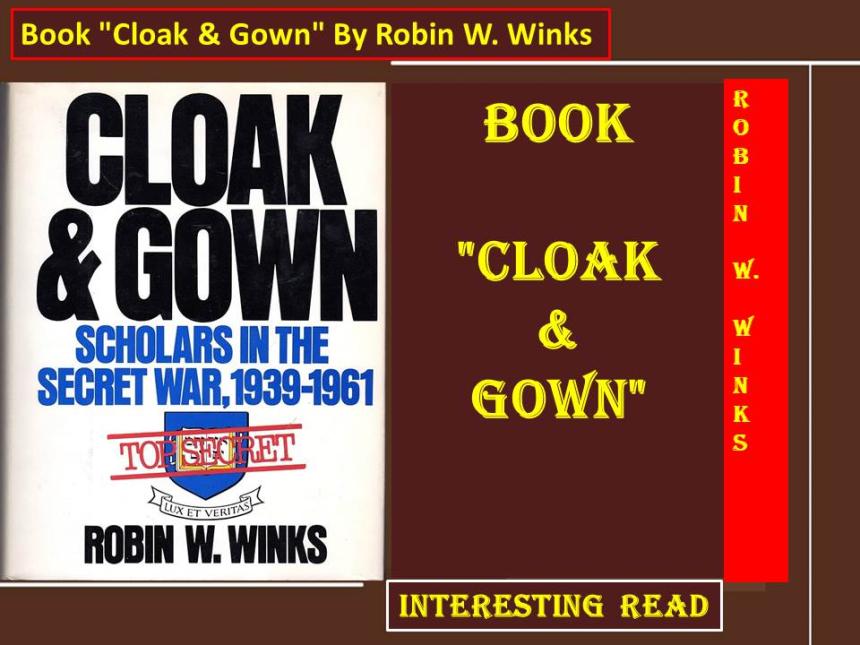

Book "Cloak & Gown" By Robin W. Winks
Robin W. Winks (1930–2003) was a prominent American historian, author, and Yale University professor best known for his expertise on the British Empire, Canadian-American relations, intelligence operations, and detective fiction. Book "Cloak & Gown" By Robin W. Winks explores the underlying bonds between the university and the intelligence communities introducing a fascinating cast of characters. This write up is an introduction of the Book "Cloak & Gown": Scholars in the Secret War, 1939–1961 By Robin W. Winks and arranged for educational purposes from material available freely on Web Net.
أَعُوذُ بِاللّٰهِ مِنَ الشَّيْطَانِ الرَّجِيمِ
بِسۡمِ ٱللهِ ٱلرَّحۡمَـٰنِ ٱلرَّحِيمِ
اللہ کے نام سے شروع جو بڑا مہربان نہایت رحم کرنے والا ہے
In the name of ALLAH, the Most Gracious, the Most Merciful
Book "Cloak & Gown" By Robin W. Winks
Book "Cloak & Gown": Scholars in the Secret War, 1939–1961 By Robin W. Winks
Robin W. Winks (1930–2003) was a prominent American historian, author, and Yale University professor best known for his expertise on the British Empire, Canadian-American relations, intelligence operations, and detective fiction. He taught at Yale University starting in 1957, serving as chair of the history department (1996–1999) and master of Berkeley College (1977–1991). Book " Cloak & Gown": Scholars in the Secret War, 1939–1961. By Robin W. Winks explores the underlying bonds between the university and the intelligence communities introducing a fascinating cast of characters.
Cloak & Gown: Scholars in the Secret War, 1939–1961 by Robin W. Winks is a historical non-fiction book first published in 1987 by Morrow and later by Yale University Press. It explores how American intelligence agencies—specifically the Office of Strategic Services (OSS) and the CIA—recruited heavily from Ivy League universities, particularly Yale, during and after World War II.
The main theme of Book "Cloak & Gown": Scholars in the Secret War, 1939–1961 By Robin W. Winks is the deep, complex relationship between academia and the American intelligence apparatus. It examines how elite universities—specifically Yale—mobilized their intellectual resources, shaped intelligence practices, and supplied personnel for World War II's Office of Strategic Services (OSS) and the later Central Intelligence Agency (CIA).
The core themes and focus Areas of the book may be classified into following four ways.
(1) "Academia and Espionage"; explores the institutional and cultural bonds linking the university ("gown") to the secret services ("cloak").
(2) "Ivy League Recruitment"; which shows the details, how early U.S. intelligence agencies were heavily populated by Ivy League faculty and graduates.
(3) "Individual Profiles"; which examines key figures like James Jesus Angleton and Norman Holmes Pearson to show how scholarly training influenced Cold War counterintelligence.
(4) "Ethical Dilemmas"; here the author questions the impact of state service on academic integrity and objectivity during wartime and the early Cold War.
Book "Cloak & Gown" By Robin W. Winks- Detailed Explanation as Taken from a Thread
When most people imagine the origins of the CIA, they picture soldiers, spies, and covert operations. Robin W. Winks argues the story began somewhere far less obvious: America’s universities.
Drawing on declassified OSS records, private correspondence, university archives, personnel files, Yale grade sheets, and interviews with more than 200 former OSS officers, Winks reconstructs how the Office of Strategic Services the CIA’s wartime predecessor was built by professors, historians, librarians, literary critics, economists, archaeologists, lawyers, linguists, journalists, and graduate students.
At the center of the story is Yale University.
According to Winks, 42 members of Yale’s Class of 1943 entered the OSS, and of the 397 Yale graduates who died during World War II, at least 60 were serving in secret intelligence organizations. Yale faculty helped build the OSS Research & Analysis Branch. Alumni became station chiefs, ran counterintelligence networks across Europe, planned operations behind enemy lines, and later became some of the architects of the newly created CIA after 1947.
Harvard, Princeton, Columbia, and other elite universities also supplied talent, but Yale stands out as the single most important recruiting ground in Winks’ research.
OSS founder William “Wild Bill” Donovan deliberately avoided building a service made up entirely of military officers. He wanted people who solved problems differently. He recruited historians, lawyers, bankers, professors, explorers, museum curators, advertising executives, journalists, scientists, and athletes. His belief was simple: wars are not won only by force they are won by information.
By the end of World War II, the OSS employed roughly 13,000 people around the world. Hundreds of them worked inside the famous Research & Analysis Branch, where scholarly methods became intelligence methods. Historians who spent their careers evaluating conflicting evidence suddenly found themselves analyzing enemy governments. Linguists translated captured documents. Economists tracked industrial production. Geographers studied terrain. Librarians organized enormous collections of information into systems commanders could actually use.
The modern intelligence analyst wasn’t invented in a bunker.
He was often sitting behind a university desk. What exactly made these professors and students such valuable spies?
Winks explains that universities had been training intelligence officers long before anyone called them that.
Historians learned how to determine whether a source was trustworthy or propaganda. Literary scholars learned to detect hidden meaning inside texts. Lawyers evaluated competing evidence. Linguists mastered foreign languages. Archaeologists reconstructed civilizations from scattered fragments. Economists identified patterns buried inside massive amounts of data.
Those are exactly the skills intelligence agencies require.
Elite universities also offered another advantage. Many graduates already spoke several languages, had traveled throughout Europe, and possessed extensive knowledge of foreign cultures. Recruiters believed they would blend into overseas environments more naturally and adapt more quickly to clandestine work.
Athletes were recruited alongside scholars. Crew, football, and track athletes demonstrated discipline, teamwork, endurance, and leadership under pressure. Intelligence officers needed both sharp analytical minds and the ability to perform under extreme stress.
Faculty often became recruiters themselves, quietly recommending their best students for intelligence service. Trusted social networks including alumni organizations and, at Yale, organizations such as Skull and Bones sometimes helped identify individuals already known for discretion and leadership, although Winks does not portray these groups as directing intelligence operations.
The war also transformed American campuses.
The FBI gained unprecedented access to confidential university records. Some faculty members classified as “enemy aliens” were monitored and required to surrender shortwave radios. Academic institutes devoted to international affairs increasingly found themselves contributing research useful to wartime intelligence. In some individual cases, overseas academic appointments became effective operational cover.
One remarkable example was Joseph Toy Curtiss, a Yale English instructor originally assigned to Switzerland under the cover of acquiring books for Yale’s Sterling Memorial Library. When circumstances changed, he was sent instead to Istanbul, operating through Robert College while quietly collecting German newspapers and publications for intelligence analysis.
The boundary between scholarship and espionage had become remarkably thin.
Perhaps the greatest legacy of the OSS wasn’t a famous covert operation. It was a way of thinking.
The OSS Research & Analysis Branch assembled one of the largest intelligence libraries ever created during the war roughly 3 million index cards, 300,000 captioned photographs, 300,000 classified documents, nearly one million maps, 350,000 foreign serial publications, and approximately 50,000 books.
Its analysts compared sources, evaluated reliability, identified deception, reconstructed historical context, and produced structured intelligence estimates instead of relying on instinct or rumor. Those analytical methods became part of the institutional DNA of the CIA.
Among the most influential figures were Norman Holmes Pearson, the Yale literature professor who helped lead British-American counterintelligence efforts in London, and James Jesus Angleton, whose literary training and experience with wartime deception profoundly shaped his later career in CIA counterintelligence. Winks argues that Angleton’s brilliance and eventually his destructive obsession with Soviet moles grew from the same habit of mind: believing every document, every source, and every appearance might conceal another layer of deception.
The influence didn’t end when the war did.
Many former OSS officers moved into the Strategic Services Unit before joining the newly established CIA. Others returned to universities, where they helped build postwar area studies programs focused on the Soviet Union, China, the Middle East, and Asia. As McGeorge Bundy later observed, many of these academic programs were led or strongly influenced by former OSS veterans.
By 1961, the relationship had begun to change. The emergency of World War II had passed. The CIA became larger, more bureaucratic, and increasingly technical. Universities became more cautious about close intelligence ties. But the intellectual foundation had already been laid.
Winks’ conclusion is neither a celebration nor a condemnation. It is a documented history.
Modern American intelligence was shaped not only in military headquarters, but also in classrooms, libraries, archives, and seminar rooms. The same academic culture that produced rigorous analysis also carried risks elite social networks, institutional insularity, and an enduring confidence that educated experts could see patterns invisible to everyone else.
Book "Cloak & Gown" By Robin W. Winks- Lesson Learnt
Robin W. Winks' book Cloak & Gown: Scholars in the Secret War, 1939–1961 teaches that universities and intelligence agencies share a deep, complex bond. Intellectual rigor, foreign language mastery, and historical analysis are vital tools for national security, but this close partnership also tests the ethical independence of higher education.
Academic training in history, languages, and literature translates directly into practical spycraft, analysis, and covert action. When scholars work for the state, it creates a moral tension between the pursuit of open, objective truth and the secretive needs of government. Governments often tap elite universities during national crises, which can compromise the perceived political neutrality of academia. Raw data is useless without deep cultural and historical context, which makes the academic mind an essential weapon in modern intelligence.
The modern ethical relationship between universities and intelligence agencies revolves around a fundamental tension: balancing national security and research protection against academic freedom and open collaboration. While the historic partnership detailed by Winks has modernized into formalized funding and counter-espionage programs, it faces severe scrutiny regarding transparency, surveillance, and institutional integrity.
Whether the modern relationship between universities and intelligence agencies is good for democracy depends on which fundamental democratic value is prioritized: the protective power of state security or the civic power of transparent truth. Because democracy requires both safety from foreign threats and an open society that can openly challenge its own government, this relationship acts as a double-edged sword.
Democracies are currently locked in an asymmetric struggle against authoritarian adversaries who use corporate espionage, cyber warfare, and intellectual property theft to undermine free societies. Intelligence agencies help universities secure state-funded research, protecting the democratic nation's technological and economic edge.
A democracy functions best when its elected leaders make decisions based on reality, not ideology. When academics lend their rigorous, evidence-based research to intelligence agencies, it promotes "truth-telling" within the state apparatus, leading to better-informed statecraft.
Democracy relies on institutions that are transparent and verifiable. When universities accept classified funding or enforce state-mandated secrecy, they erode the concept of the university as an "ivory tower" of objective truth, replacing public peer review with government-approved data.
A robust democracy requires free-thinking citizens who can critique their government without fear. When intelligence agencies partner with university administrators to flag foreign interference or monitor campus activity, it creates an environment of surveillance that can criminalize peaceful expression or foster xenophobia.
Ultimately, the relationship is a necessary but dangerous compromise for democracy. While a democratic state must utilize academic expertise to protect itself from external enemies, it must maintain strict boundaries to ensure that the hunt for secrets does not destroy the very transparency and freedom that make it a democracy in the first place.

Convenient Ways to Buy Wine Online Ontario
Exploring options to buy wine online Ontario helps wine enthusiasts discover selections fr...
