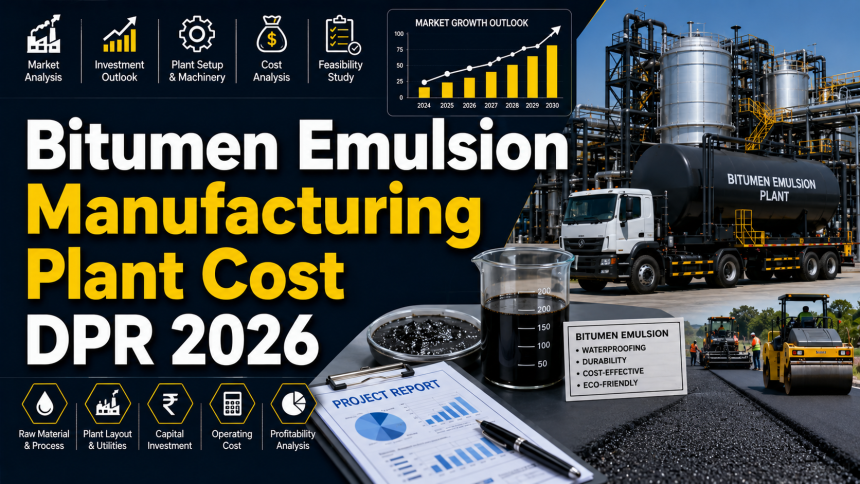

Bitumen Emulsion Manufacturing Plant Cost DPR 2026: ROI, IRR, Capacity Planning and Financial Feasibility Report
The bitumen emulsion manufacturing industry is expected to witness steady growth through 2026
Setting up a bitumen emulsion manufacturing plant involves a series of controlled processes such as bitumen heating, aqueous phase preparation, dosing of emulsifiers and additives, high-shear mixing through a colloid mill, homogenization, cooling, and packaging or bulk loading. Key equipment includes bitumen storage tanks with heating coils, emulsifier dosing systems, colloid mills, mixing vessels, pumps, and laboratory testing equipment. Since product stability and consistency are critical to road-construction performance, maintaining strict quality control systems and compliance with industry specifications is essential. Additionally, evaluating the bitumen emulsion manufacturing plant cost is essential for understanding capital investment, machinery requirements, operational efficiency, and long-term profitability in this steadily growing bitumen emulsion market.
The bitumen emulsion manufacturing industry is expected to witness steady growth through 2026, driven by rising road construction activity, expansion of highway and rural connectivity projects, growing demand for cold mix asphalt solutions, and increasing government investment in infrastructure development. The global bitumen emulsifiers market was valued at USD 76.34 Million in 2025 and is expected to reach USD 114.43 Million by 2034, growing at a CAGR of 4.6% from 2026 to 2034, as cold-application technologies gain preference over conventional hot bitumen methods.
IMARC Group's report, titled “Bitumen Emulsion Manufacturing Plant Cost Analysis 2026: Industry Trends, Plant Setup, Machinery, Raw Materials, Investment Opportunities, Cost and Revenue,” provides a complete roadmap for setting up a Bitumen Emulsion manufacturing plant. It covers a comprehensive market overview to micro-level information such as unit operations involved, raw material requirements, utility requirements, infrastructure requirements, machinery and technology requirements, manpower requirements, packaging requirements, transportation requirements, etc.
Bitumen Emulsion Industry Outlook 2026Rising public and private investment in highways and urban road networks is a key driver of bitumen emulsion demand. In September 2025, India announced plans to invest INR 11 Trillion (USD 125 Billion) to expand its high-speed road network fivefold, adding 17,000 kilometers of access-controlled roads over a decade, a move expected to boost bulk procurement of emulsified bitumen. Governments across emerging economies continue to allocate substantial budgets to road connectivity projects, while rapid urbanization and rising vehicle ownership are driving frequent road rehabilitation activity. Environmental regulations promoting lower-carbon construction methods are further shifting demand away from hot bitumen toward emulsified alternatives, and continual improvements in colloid milling systems and additive formulations are enhancing product stability and performance.
However, challenges such as bitumen feedstock price volatility, high initial capital investment for colloid milling and storage equipment, energy consumption concerns, and evolving environmental regulations may influence production costs and strategic investment decisions for new plant setups.
Request for a Sample Report: https://www.imarcgroup.com/bitumen-emulsion-manufacturing-plant-project-report/requestsample
Key Insights for setting up a Bitumen Emulsion manufacturing plantDetailed Process Flow- Product Overview
- Unit Operations Involved
- Mass Balance and Raw Material Requirements
- Quality Assurance Criteria
- Technical Tests
- Land, Location and Site Development
- Plant Layout
- Machinery Requirements and Costs
- Raw Material Requirements and Costs
- Packaging Requirements and Costs
- Transportation Requirements and Costs
- Utility Requirements and Costs
- Human Resource Requirements and Costs
- Capital Investments
- Operating Costs
- Expenditure Projections
- Revenue Projections
- Taxation and Depreciation
- Profit Projections
- Financial Analysis
- Total Income
- Total Expenditure
- Gross Profit
- Gross Margin
- Net Profit
- Net Margin
- Raw Materials:
- The primary cost driver, accounting for approximately 45-55% of total operating expenses, including bitumen, water, and emulsifiers/stabilizers essential for emulsion formulation.
- Energy Costs:
- Bitumen emulsion manufacturing is energy-intensive, particularly for bitumen heating and colloid milling, requiring significant amounts of electricity and thermal energy.
- Machinery and Equipment:
- Capital investment in bitumen storage tanks with heating coils, emulsifier dosing systems, colloid mills, mixing vessels, and pumps, along with ongoing maintenance costs.
- Labor:
- Includes salaries, training, and benefits for skilled and unskilled workers involved in plant operation, maintenance, and quality control.
- Utilities:
- Costs for water, electricity, and compressed air, representing approximately 10-15% of operating expenses and essential for continuous, safe production.
- Packaging and Transportation:
- Expenses related to bulk loading or drum packaging and distributing finished bitumen emulsion to road construction contractors and infrastructure agencies, including logistics infrastructure.
- Depreciation and Financing:
- Depreciation of fixed assets and interest or repayment obligations for loans or capital investment in plant setup.
- Compliance and Safety:
- Investment in emission control systems, effluent treatment facilities, and quality certification for road-construction specifications.
- Overheads:
- Administrative costs such as insurance, office operations, licensing, marketing, and general plant management.
Bitumen Feedstock Price Volatility: As bitumen is the primary raw material for emulsion manufacturing, fluctuating global crude oil and refinery output directly impact both capital and operating costs. Higher feedstock prices raise production expenses, making formulation efficiency and supplier diversification more critical.
Environmental Policies & Compliance Costs: Growing regulatory focus on emissions and effluent discharge increases costs related to treatment systems, monitoring, and compliance audits. Stricter environmental clearance requirements may elevate initial capital outlay for new plant setups.
Inflation & Interest Rates: Rising inflation inflates the cost of building materials, civil construction, labor, and machinery, while higher interest rates increase the cost of loans and financing needed for plant construction, equipment procurement, and commissioning of colloid milling lines.
Government Infrastructure Spending & Subsidies: Large-scale public investment in highway and rural road networks, along with policies supporting domestic manufacturing, can reduce setup costs through grants, low-interest loans, or tax incentives aimed at bitumen emulsion plants.
Technological Advancements: Innovations in colloid milling systems, automated dosing, and inline quality control can increase upfront CapEx but offer significant productivity gains, reduced material waste, and lower per-unit costs, enhancing long-term ROI.
Supply Chain Localization: Efforts to reduce dependence on imported bitumen and emulsifying chemicals are incentivizing in-country investment in plant equipment and raw material sourcing. This may increase initial costs if domestic supply is limited but improves supply chain resilience and delivery turnaround.
Labor Market Considerations: Shortages in skilled labor for operating colloid mills, dosing systems, and quality control equipment can drive up wages or necessitate investment in operator training and retention programs, raising both initial setup and ongoing operational expenses.
Speak to an Analyst for Customized Report: https://www.imarcgroup.com/request?type=report&id=13790&flag=C
Challenges and Considerations for InvestorsRaw Material Price Volatility:
Bitumen emulsion manufacturing heavily depends on bitumen, a crude oil derivative. Fluctuations in global crude oil prices can significantly impact production costs and profit margins.
High Capital Intensity:
Establishing a bitumen emulsion plant requires substantial investment in heated storage, colloid milling, and dosing infrastructure. Long payback periods can deter risk-averse investors.
Environmental Compliance:
Stringent environmental regulations on effluent discharge and emissions require additional investment in treatment systems and sustainable practices.
Seasonal and Project-Cycle Demand:
Demand for bitumen emulsion is closely tied to road construction and maintenance cycles, which can be seasonal and dependent on government project timelines, creating revenue variability.
Market Competition:
The global bitumen emulsion market is competitive, with several established multinational chemical and petroleum companies. Investors must focus on operational efficiency or niche differentiation to remain viable.
Logistics and Storage Requirements:
Transporting and storing bitumen emulsion requires temperature-controlled infrastructure to maintain stability. Poor handling can lead to premature breaking of the emulsion and product loss.
Technological Barriers:
Staying competitive requires adopting advanced, energy-efficient colloid milling and formulation technologies. Outdated systems lead to higher operational costs and greater environmental impact.
About Us:
IMARC Group is a global management consulting firm that helps the world's most ambitious changemakers to create a lasting impact. The company excels in understanding its client's business priorities and delivering tailored solutions that drive meaningful outcomes. We provide a comprehensive suite of market entry and expansion services. Our offerings include thorough market assessment, feasibility studies, company incorporation assistance, factory setup support, regulatory approvals and licensing navigation, branding, marketing and sales strategies, competitive landscape, and benchmarking analyses, pricing and cost research, and procurement research.
Contact Us:
IMARC Group
134 N 4th St. Brooklyn, NY 11249, USA
Email: [email protected]
Tel No: (D) +91 120 433 0800
United States: (+1-201-971-6302)




Dish Network Installers Near Me: Expert Satellite Dish Setup in Sharja...