
Best CI Tools for Cloud Services and DevOps in 2025
Discover the best continuous integration tools for cloud services in 2025. Compare top CI platforms to automate workflows, boost deployment speed, and improve DevOps efficiency.
Introduction
As businesses continue to accelerate their digital transformation initiatives, software development teams are under increasing pressure to deliver applications faster, more reliably, and with fewer errors. Traditional development processes often struggle to keep pace with modern customer expectations, making automation a critical component of successful software delivery.
Continuous Integration (CI) has emerged as a foundational practice within DevOps methodologies, enabling developers to integrate code changes frequently and automatically validate them through testing and deployment pipelines. When combined with cloud services, continuous integration becomes even more powerful, providing scalability, flexibility, and faster development cycles.
Organizations that embrace cloud-based CI solutions can improve software quality, reduce deployment risks, and streamline collaboration across distributed teams. As we move further into 2025, selecting the right CI platform has become a key strategic decision for businesses aiming to remain competitive in an increasingly digital landscape.
Understanding Continuous Integration in Cloud Environments
Continuous Integration is a software development practice where developers regularly merge code changes into a shared repository. Automated builds and tests are then executed to identify issues early in the development lifecycle.
Cloud-based CI platforms enhance this process by providing on-demand infrastructure, automated workflows, and seamless integrations with development tools. Unlike traditional on-premise systems, cloud solutions eliminate infrastructure management complexities and allow teams to scale resources according to project requirements.
Modern cloud CI platforms support multiple programming languages, containerized applications, microservices architectures, and multi-cloud deployment environments. These capabilities help organizations accelerate software delivery while maintaining high levels of quality and security.
Why Continuous Integration Matters for Cloud Services
Cloud services rely heavily on rapid development cycles and frequent updates. Without an effective CI strategy, organizations may experience deployment delays, integration conflicts, and quality assurance challenges.
Continuous integration helps businesses:
Improve Code Quality
Automated testing ensures that code changes are validated before reaching production environments, reducing bugs and application failures.
Accelerate Development Cycles
Developers receive immediate feedback on code changes, enabling faster issue resolution and shorter release timelines.
Enhance Collaboration
CI platforms create a centralized workflow where development teams can collaborate efficiently, regardless of location.
Reduce Deployment Risks
Frequent testing and validation minimize the likelihood of introducing critical errors into production systems.
Support Scalability
Cloud-native CI solutions can easily scale to accommodate growing development teams and increasing workloads.
Best Continuous Integration Tools for Cloud Services 2025
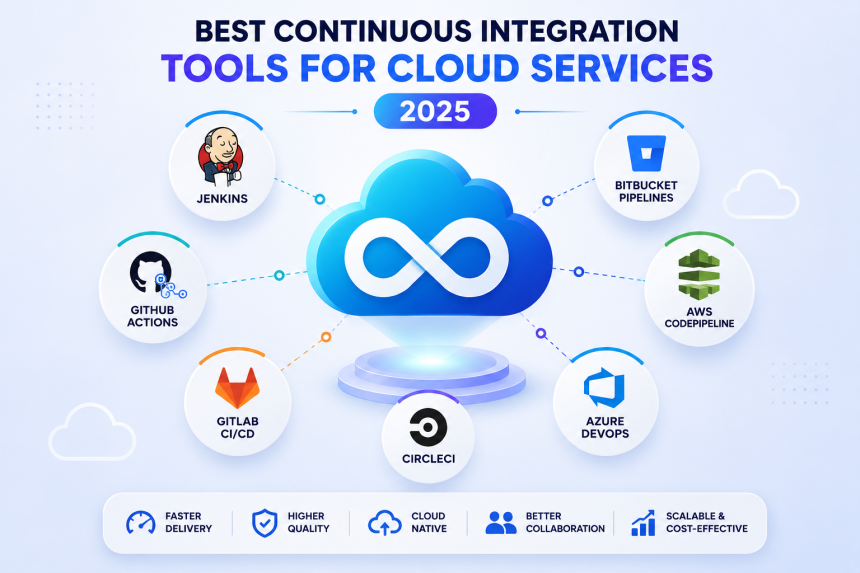
As organizations modernize their development processes, choosing the best continuous integration tools for cloud services 2025 becomes essential for achieving operational efficiency and delivering high-quality software. Several leading platforms are shaping the future of cloud-based continuous integration through advanced automation, security, and scalability features.
Jenkins
Jenkins remains one of the most widely used open-source CI tools. Its extensive plugin ecosystem allows teams to integrate with hundreds of development and deployment technologies. Organizations seeking flexibility and customization often choose Jenkins for complex cloud environments.
GitHub Actions
GitHub Actions has become increasingly popular due to its seamless integration with GitHub repositories. It enables developers to automate testing, building, and deployment workflows directly within their source code management environment.
GitLab CI/CD
GitLab provides a comprehensive DevOps platform that combines source control, CI/CD, security scanning, and project management. Its all-in-one approach simplifies development workflows and enhances collaboration.
CircleCI
CircleCI is known for its speed, cloud-native architecture, and support for parallel testing. Development teams can optimize build times while maintaining reliable automated pipelines.
Azure DevOps
Microsoft Azure DevOps offers powerful CI/CD capabilities designed for enterprise environments. It integrates seamlessly with Azure cloud services while supporting hybrid and multi-cloud deployment strategies.
AWS CodePipeline
Organizations utilizing Amazon Web Services often choose AWS CodePipeline for its native integration with AWS infrastructure and automated deployment capabilities.
Bitbucket Pipelines
Bitbucket Pipelines provides integrated CI/CD functionality directly within Bitbucket repositories, making it an attractive solution for teams already using Atlassian products.
Key Features to Look for in a CI Tool
Selecting the right CI platform requires evaluating several important capabilities.
Automated Testing
The platform should support unit testing, integration testing, and security testing to ensure application reliability.
Cloud-Native Scalability
A scalable architecture allows teams to handle increasing workloads without performance bottlenecks.
Security and Compliance
Modern CI tools should include security scanning, access controls, and compliance monitoring features to protect sensitive code and data.
Integration Capabilities
The platform should integrate seamlessly with repositories, cloud providers, container platforms, and monitoring tools.
Container and Kubernetes Support
As containerized applications become more common, support for Docker and Kubernetes is increasingly important.
User-Friendly Interface
A simple and intuitive interface helps teams adopt CI processes more effectively and reduces onboarding time.
Benefits of Cloud-Based Continuous Integration Platforms
Cloud-based CI solutions offer significant advantages compared to traditional infrastructure.
Organizations benefit from reduced maintenance responsibilities since infrastructure management is handled by the service provider. This allows development teams to focus on building applications rather than managing servers.
Additionally, cloud CI platforms support remote collaboration, making them ideal for distributed teams and global organizations. Real-time visibility into build status, automated reporting, and centralized workflow management improve overall operational efficiency.
Cost optimization is another major advantage. Businesses can leverage pay-as-you-go pricing models, ensuring they only pay for the resources they consume.
Emerging Trends in Continuous Integration for 2025
The CI landscape continues to evolve rapidly as new technologies emerge.
Artificial intelligence is being incorporated into CI pipelines to automate testing, identify vulnerabilities, and predict potential deployment failures. AI-driven insights help development teams optimize workflows and improve software quality.
Platform engineering is also gaining momentum, enabling organizations to standardize development environments and simplify infrastructure management.
Additionally, security is becoming deeply integrated into CI pipelines through DevSecOps practices, ensuring that vulnerabilities are identified and addressed early in the development lifecycle.
Low-code automation, serverless architectures, and advanced observability tools are further transforming how organizations build and deploy applications in cloud environments.
Conclusion
Continuous integration has become an essential component of modern cloud-based software development. By automating code validation, testing, and deployment processes, organizations can improve software quality, accelerate release cycles, and enhance collaboration across teams.
As businesses evaluate the best continuous integration tools for cloud services in 2025, factors such as scalability, security, automation, and cloud compatibility should guide decision-making. Selecting the right CI platform enables organizations to build reliable, high-performing applications while maintaining agility in an increasingly competitive digital marketplace.
Investing in a robust continuous integration strategy today will help businesses create a strong foundation for innovation, growth, and long-term success in the cloud era.
Blood Clots Explained: 6 Serious Risk Factors and Effective Treatment...
Discover 6 serious risk factors for blood clots, recognize warning signs, and learn about...