
أَعُوذُ بِاللّٰهِ مِنَ الشَّيْطَانِ الرَّجِيمِ
بِسۡمِ ٱللهِ ٱلرَّحۡمَـٰنِ ٱلرَّحِيمِ
In the name of ALLAH, the Most Gracious, the Most Merciful
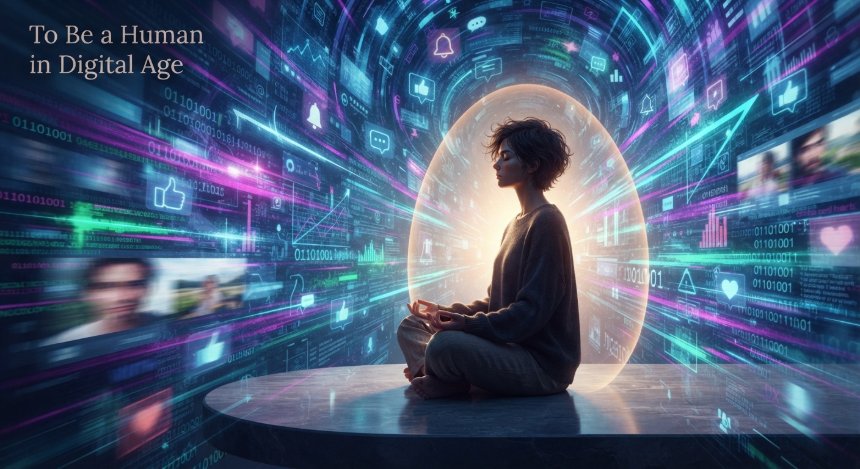
Be a Creator in the Digital Age
We are living in an era of breathtaking digital wonders that were once confined to the realm of science fiction. Today, Artificial Intelligence composes complex algorithms, quantum computing unlocks mysteries of the universe in seconds, and global connectivity has shrunk continents into the palm of a single hand. From autonomous systems and virtual realities to space exploration driven by smart technologies, human intellect is reshaping existence at an unprecedented pace. Yet, amidst this dazzling revolution, the world is sharply divided into two camps: those who design, code, and own these digital marvels, and those who merely consume them. To truly thrive in this transformative epoch, we must look back at a timeless philosophy that foresaw this exact dynamic over a century ago.
During that dark era in the history of the Indian subcontinent when Muslims were bound in the chains of slavery and had fallen prey to intellectual and mental stagnation, Providence blessed the Muslim Ummah with a great thinker and reformer in the form of Allama Muhammad Iqbal, the Poet of the East. Iqbal did not use his poetry merely as a source of literary entertainment; rather, he turned it into a weapon for national awakening. He spread the revolutionary message of "Khudi" (Selfhood), which shook the slumbering Muslim nation awake and reminded them of their lost glory and hidden potential. Through his verse, Iqbal made it clear that honor and supremacy belong only to those nations that choose the path of action and creation.
In continuation of this intellectual awakening, Iqbal revealed the secret of progress and global leadership in a timeless verse in a poem of his famous book Zarb-e-Kaleem:
جو عالمِ ایجاد میں ہے صاحبِ ایجاد
ہر دَور میں کرتا ہے طواف اس کا زمانہ
(He who is a creator in this world of creation,
The entire era revolves around him in every age.)
In this couplet, "Sahib-e-Ijad" (The Creator) refers to the innovator, inventor, and thinker who carves new paths and gives the world new ideas or inventions. "Tawaf" (revolving around) means that the world values him, orbits around his influence, and follows his lead by acknowledging his intellectual supremacy.
When Iqbal traveled to Europe, his far-sighted vision immediately sensed that the world was taking a new turn. Particularly after World War I, the dynamics of the Western world were changing rapidly. On one hand, the grip of global powers and specific vested interest groups was tightening; on the other, the West had made materialism and science its sole deity, placing them on the pedestal of God. An entirely new world was being engineered. Observing this shifting landscape, Iqbal gave a clear and unambiguous message to the Muslim Ummah: in the times to come, the reins of the world will only be in the hands of those who become "creators" themselves.
In today’s modern, digital era, Iqbal’s prophecy is coming true word for word. Look around at who is innovating in technology, Artificial Intelligence (AI), and scientific knowledge, and who is merely revolving around them. The nations creating new technologies are compelling the entire world to orbit around them economically, intellectually, and culturally.
In the next couplet of the same poem, Allama Iqbal identifies the root cause of our decline and prescribes its cure:
تقلید سے ناکارہ نہ کر اپنی خودی کو
کر اس کی حفاظت کہ یہ گوہر ہے یگانہ
(Do not render your Selfhood useless through blind imitation;
Guard it well, for it is a rare and matchless pearl.)
Here, Iqbal warns us that human beings must not waste their individual capabilities and Selfhood by blindly imitating others. Selfhood is a rare and matchless gem (Gohar-e-Yagana); therefore, it must be protected. One must rely on one’s own intellect and consciousness rather than blindly following outdated traditions or foreign cultures.
Tragically, despite achieving geographical and territorial independence, the Muslim world today remains trapped in deep intellectual, economic, and psychological slavery. We have suspended our creative thinking and mistaken the imitation of others for progress. Testimony to this mental subjugation and colonial hangover is found in renowned author Amal Chatterjee’s book, Prisoners of Empire, which brilliantly captures how nations remain intellectually and psychologically captive to their former masters or dominant civilizations long after gaining physical freedom. Looking at the core message of this book, this slavery has permeated every foundational pillar of our state and society—be it the colonial-minded elite, the system of governance, the structure of law and justice, the economic order, the education system, or international public relations. All of these appear submerged in an ocean of intellectual slavery and blind imitation.
Yet, Allama Iqbal had already prescribed the ultimate remedy for this ailment: "Do not render your Selfhood useless through blind imitation." Practically, this demands that we abandon imported ideologies and subservient policies to formulate an independent and sovereign national policy—one whose true essence and fountainhead are the eternal teachings of the Quran and Hadith and the golden era of the Rightly Guided Caliphs (Khulafa-e-Rashideen), where justice, consultation, accountability, and genuine public welfare formed the bedrock of the state.
While Iqbal taught us to abandon blind imitation and protect our Selfhood, in the very next couplet he delivers a piercing satire on the practical and moral decay of the nation:
اُس قوم کو تجدید کا پیغام مبارک!
ہے جس کے تصّور میں فقط بزمِ شبانہ
(Congratulations to that nation on its message of renewal,
Whose imagination is confined only to nocturnal revelries!)
In a deeply ironic tone, Iqbal states that hollow slogans of reform and revolution (Tajdeed) belong to a nation whose thoughts and actions are limited to luxury and frivolous nightlife. Iqbal makes it clear that for nations that abandon hard work, research, and lofty ideals in favor of comfort and indulgence, claims of progress or change are nothing more than a mirage and self-deception.
Continuing this thought, Iqbal expresses a profound intellectual concern in the final couplet of the poem:
لیکن مجھے ڈر ہے کہ یہ آوازۂ تجدید
مشرق میں ہے تقلیدِ فرنگی کا بہانہ
(Yet I fear that this call for renewal
In the East is merely an excuse to imitate the West.)
Iqbal clarifies his apprehension that in the East, the slogan of modernization and renewal might simply become a pretext for the blind imitation of the West (Taqleed-e-Farangi). In truth, Iqbal opposes both the blind adherence to stagnant past traditions and the blind mimicry of the West, because in both cases, a person stops seeing with their own eyes and thinking independently. The discourse on Ijtihad (independent legal and intellectual reasoning) in Iqbal’s famous work, The Reconstruction of Religious Thought in Islam, is the scholarly manifestation of this very creative philosophy—teaching us to break free from both past stagnation and Western mental slavery to carve our own path.
The practical dimension of this entire philosophy is also reflected in Iqbal’s famous verse:
اس قوم کو شمشیر کی حاجت نہیں رہتی
ہو جس کے جوانوں کی خودی صورتِ فولاد
(That nation has no need for the sword,
Whose youth possess a Selfhood forged like steel.)
This means that a nation whose youth possess a Selfhood as strong, resolute, and sovereign as steel does not need to be intimidated by an enemy’s outward military might. Living proof of this message can be seen in the ongoing Iran-Israel-US conflict and standoff, where despite severe sanctions, indigenous innovation and steely resolve have forced even global superpowers to pause and rethink.
History bears witness that Iqbal’s message of awakening proved remarkably effective under the inspiring leadership of Quaid-e-Azam Muhammad Ali Jinnah, resulting in the creation of a great state like Pakistan on the map of the world. Sadly, after the creation of Pakistan, we fell victim to the ravages of time, sacrificing our national purpose to luxurious desires, personal interests, and intellectual negligence.
The core purpose of this essay is to awaken the nation of Pakistan from its slumber of negligence so that we may once again march toward our true destination. History’s verdict is immutable: those who imitate always end up at a loss. If we do not awaken our Selfhood today and adopt the path of becoming creators, we risk spending the next century enduring intellectual, economic, and cultural slavery.
At this juncture, it is also vital to remind the Muslim Ummah that their own civilization and history have been extraordinarily strong and glorious. There was a time when Islam was universally regarded as synonymous with literature, art, spirituality, intellectual inquiry, cultural refinement, and above all, beauty. The pages of history testify to this grandeur: Germany’s greatest literary figure, Goethe, inscribed "La ilaha illallah" in his diary; numerous British officers embraced Islam in the Middle East and the subcontinent after being moved by its truth; Adolf Hitler once expressed the wish that Islam’s "warrior and spirited religion" had reached Germany instead of "meek Christianity"; Britain’s King George VI, inspired by Mughal architecture, commissioned an Indo-Islamic royal pavilion for himself; the renowned historian Edward Gibbon, members of the British Parliament, and the French writer Victor Hugo romanticized and paid glowing tributes to the Muslim heritage of Spain; and Napoleon, upon invading Egypt, brought a delegation of French artists and scholars with him, paying profound homage to Prophet Muhammad (peace be upon him) in the hope of acquainting France with the intellectual and cultural wealth of the Islamic world.
A nation whose past was so radiant and served as a cradle of knowledge and art has no need whatsoever for the blind imitation of others—it only needs to recognize its Selfhood and become a "creator" once again. Today, becoming a creator does not mean reinventing the wheel; rather, this is the age of Artificial Intelligence (AI) and digital warfare. The need of the hour is for our children and youth to step forward enthusiastically into this modern arena and rise to positions of leadership instead of remaining mere consumers. This is not a difficult task; all it requires is waking up from our slumber, discovering our true selves, and breaking free from the slavery of the ego and worldly desires.