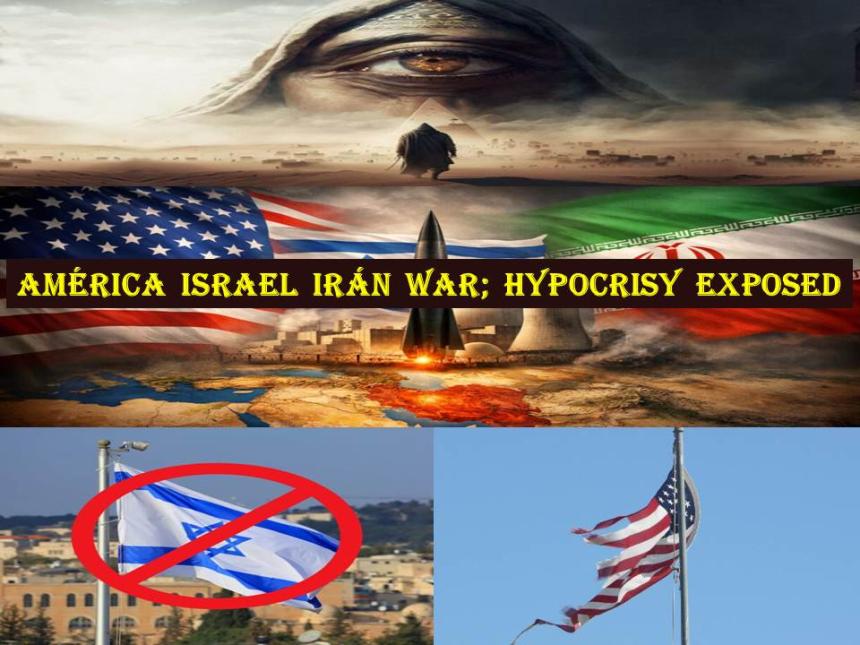

America Israel Iran War; Hypocrisy Exposed
US-Israel-Iran War 2026 has changed many paradigms of war and battle fields, observed and followed since WW-1. The mighty lone super power US and its client state Israel were superior in force and egos; however, Iran loaded with civilizational and religious ethos chose to adopt different techniques and methods, to change the history of war. This write up "America Israel Iran War; Hypocrisy Exposed" is an opinion arranged with the help of info available on free webnet.
أَعُوذُ بِاللّٰهِ مِنَ الشَّيْطَانِ الرَّجِيمِ
بِسۡمِ ٱللهِ ٱلرَّحۡمَـٰنِ ٱلرَّحِيمِ
In the name of ALLAH, the Most Gracious, the Most Merciful
America Israel Iran War; Hypocrisy Exposed
The world's most richest and powerful Nation, USA's Military, alongwith the "Invincible" Israel's IDF, attacked the Islamic Republic of Iran on February 28, 2026. This joint military operation was named "Operation Roaring Line" in Israel and "Operation Epic Fury" in the United States. Approximately 900 airstrikes were carried out during the first 12 hours, severely damaging Iran's missile program, air defense system, and military infrastructure. During these attacks, Iran's Supreme Leader Ayatollah Ali Khamenei and several other high-ranking officials were killed.
On that day, February 28, 2026, at the beginning of the joint airstrikes by American and Israeli forces on Iran, a horrific missile attack occurred on "Shajra Tayyiba", a primary school for girls located in the city of Minab, Hormozgan province. Three missiles were fired during school hours (morning), killing 168 to 180 people, most of them young girls.
According to initial assessments by US military officials and media reports (such as BBC and the New York Times), the attack was intended to target the Iranian Revolutionary Guards' naval base located right next to the school, but due to a missed target or an old intelligence report, the missile hit the school instead.
🔷 This was the first ugly face of hypocrisy in this war. It was the worst act of war crimes, which the whole world is ignoring and if it continues to be ignored, will be an obstacle to lasting peace.
In response to this action, Iran launched missile and drone attacks on Israel and US military bases in the region. These are all Muslim countries in the region and these countries have spent a lot of money to buy weapons. And they justified the need for purchasing due threat from Israel. Ironically, when Iran attacked Israel and US Assets in the region, those weapons were used to protect Israel and US bases.
🔷 This is the second big ugly face of hypocrisy exposed in this war. It is an obstacle to regional trust and lasting peace.
After 40 days of intense war between the United States and Iran, the decision to declare a temporary ceasefire on April 8, 2026 was made for some very important strategic, economic and diplomatic reasons. During the war, Iran retaliated by blocking the Strait of Hormuz, through which about 20% of the world's oil supply passes. The global oil supply shutdown caused petroleum product prices to skyrocket and markets around the world to suffer a severe economic crisis, which forced the United States to temporarily retreat.
The United States attacked with its Flotilla at Arabian Sea and Iran defended itself with the help of its geography and made the Strait of Hormuz sacred by rendering blood of its leaders, sailors and soldiers. (Recall sinking of Iranian Navy Ship leaving Indian port on a peace mission). The reason for the disruption of oil supplies through the Strait of Hormuz and the pressure on the global economy is not Iran; but the United States, Israel and NATO. Iran has made the Strait of Hormuz sacred with its precious blood, and now if anyone wants to use this sacred place, they must pay the war reparations or pay the toll. Otherwise, learn to bear it; after all Iran weathered 47 years of sanctions and nobody cared about it.
🔷 This is the third big ugly hypocrisy exposed in this war. The world finds oil expensive; the blood of Iran's leadership and innocent children seems cheap.
The Islamic Republic of Iran has been suffering from severe economic pressure, trade sanctions, and political isolation under the leadership of the United States since the 1979 revolution of Ayatollah Khomeini. The whole world was convinced that it was a government of Muslim fundamentalist, non-progressive mullahs; who had forcibly seized power. But the participation of millions of people in the funeral of Iran's Supreme Leader Ayatollah Ali Khamenei revealed to the world the deep connection between the Iranian system and the people.
🔷 This is the fourth big ugly hypocrisy exposed by this war. This is the shattering of the dream of any enlightened liberal ruler or the return of the Pahlavi monarchy. (In Islamic view such men are called Satanic followers).
A temporary and conditional ceasefire was announced in early April 2026, with Pakistan and China playing key mediators; however, intermittent clashes and tensions continued in the region and were constantly violated by both sides, and finally the ceasefire formally ended in July 2026 after new conflicts in the Strait of Hormuz. As things stand, a lasting ceasefire, after the ceasefire broke down in July 2026 and the fierce fighting resumed, will now depend on a few key diplomatic and strategic conditions.
An alternative maritime route and security plan that both the US and Iran agree on will have to be developed under the supervision of major powers such as China or Russia and a regional country such as Oman or Pakistan, under the supervision of an intermediary.
This war was started by the US and Israel, but it has now taken the form of a wider regional war, in which Gulf and other nearby countries are also being directly involved. All these countries are actually American puppets and since it was seen as a war between Muslims and Jews in the Islamic world; therefore, a regional war is being remodeled by forcing a ceasefire and expelling Israel from picture to paint it as Muslims' infighting.
🔷 This is the fifth most shameful hypocrisy in this war. The war was started by America and Israel. It is now being made a regional war to deprive or restrict support of Islamic world for Iran; but the goal is the same as February 28.
What has changed since the America-Israel-Iran War?
Ms. Zainab Al-Safar, in an article titled “The New Grammar of War” on May 26, 2026, mentioned the rules of war that changed after the Iran war and wrote that “the wars of tomorrow or the future will not be won on the battlefield; rather, they will be won by the mind, economy, and the enemy’s information ecosystem (digital system).”"It will be won within the world." Now it is difficult to hide the truth because the digital domain has changed everything. Iran has "competed standing on the edge of destruction" and has taught the art of dancing on the edge of destruction to gain special privileges. It was foolish to drag a country down to the abyss and made it fight for survival; it had to rise. So, Iran has come out of the abyss and now who will stop it from "Rise and Shine"?
🔷 In this war, Iran has exposed the ugly hypocritical face of the century-old international order prevailing in the world. And it has shown the way for the poor and backward countries of the world to deal with the bullying of the Western powers. Will the Third World and the countries of the Global South learn this lesson; it will be known soon?
Now let's read a brief of opinion from renowned thinker Mr. Robert A. Pape, a leading theorist of strategic studies in the United States; which appeared recently as "Iran and the New Rules of Global Power". It exposes the hypocritical nature of the century-old world order imposed by Zionist Jewish Bankers through USA:-
"Iran and the New Rules of Global Power" By Robert A. Pape
🔷 The article's significance lies in its view of the war with Iran as a historical event that ends an entire era of the international order that began with the Gulf War in 1991.
🔷 The war against Iraq established an era of unipolar American hegemony, while the war with Iran marks the beginning of the end of that phase and the start of a different global order governed by new rules of power.
🔷 The author draws on a historical comparison between the First Gulf War and the current war with Iran. He reminds us that the 1991 war was not merely a liberation of Kuwait but a strategic shock to the entire world.
🔷 The United States managed, in just a few weeks, to destroy one of the largest armies in the world at the time, with extremely limited American human losses, which cemented the global belief that Washington possesses near-absolute capability to impose war outcomes quickly and at low cost.
🔷 This victory did not merely alter the balance of power; it changed the world's expectations. Governments, markets, companies, and investors began to act on the basis that the United States could always protect global trade, ensure the security of maritime passages, and deter any power attempting to challenge the international order.
🔷 This confidence is what underpinned the post-Cold War era of globalization, more than reliance on direct military power itself.
🔷 The article identifies four assumptions that governed the international order after 1991. The first is that the United States can impose military outcomes with ease; the second is that it holds permanent superiority in escalation; the third is that it can ensure the smooth flow of global trade; and the fourth is that resisting American will is ultimately futile.
🔷 These assumptions formed the true foundation of the international order throughout the past three decades.
🔷 This was reflected in the significant reduction of European countries' defense spending after the end of the Cold War, the expansion of economic integration, and the establishment of the European Union in its current form, all relying on the American security umbrella.
🔷 China itself studied the Gulf War carefully and drew from it the necessity of shifting from massive armies to precision missiles and information systems, which later led to the development of many capabilities that now compete with those of the United States.
🔷 The order created by the United States carried within it the seeds of its own decline. The globalization that emerged under American protection led to the spread of precision technology and the transformation of many advanced military technologies into globally available commercial products.
🔷 Electronic chips, navigation systems, cameras, sensors, batteries, and artificial intelligence—all these technologies became used in smartphones and civilian markets, making the production of low-cost precision weapons accessible to much smaller states.
🔷 The author cites the Iranian Shahed-136 drone as an example, emphasizing that its importance does not lie in its technological complexity, but quite the opposite. It relies heavily on globally available commercial components, meaning that the ability to produce precision strike means is no longer the exclusive domain of great powers, but has become accessible to medium-sized states and even non-state actors.
🔷 From here, the author arrives at what he calls the "second revolution in precision warfare." In his view, the first revolution was the American smart bombs that appeared in Baghdad in 1991; the second is the cheap drones and low-cost precision missiles that can exhaust great powers without needing to confront them directly.
🔷 The war with Iran represents the first major test of this new revolution. Iran did not attempt to destroy the American navy, but instead focused on an entirely different goal: convincing markets and shipping companies that the United States is no longer able to ensure the security of the Strait of Hormuz.
🔷 And according to the article, merely raising insurance premiums and reducing ship traffic is enough to achieve a strategic effect, even if the strait remains open from a military perspective.
🔷 The American and Israeli strikes on Iranian radars and missile platforms revealed the limits of air power. Iran, per the article, was able to redeploy, hide, and replace launch platforms more quickly than the United States could destroy them, turning the problem from targeting specific objectives to controlling vast areas of land—a task that air power alone cannot accomplish.
🔷 The author cites Iran's downing of an American Apache helicopter using a Shahed-model drone to emphasize that a weapon costing around $20,000 managed to destroy a combat platform worth $35 million, and he considers this example to embody the disruption of the cost equation, which now favors the weaker side.
The Conclusion
The US-Israel-Iran War was initiated by US and Israel and some 900 strikes were made in a night. It was simple and pure "State Terrorism and Bullying to make Iran submit to their designs; and they failed and resultantly, they must pay back the cost to Iran by all means. There shall be NO debate about it; as Germany was made to pay after World War in last century.
Strait of Hormuz is Iran's water and a suitable solution to the Strait of Hormuz involves the Omani-proposed joint management model, expanding regional overland bypass pipelines, and diplomatic engagement. Oman proposed splitting the shipping lane 50-50 between Iranian and Omani territorial waters (inbound via Iran, outbound via Oman) with voluntary contributions for maintenance, mirroring navigation cooperation in the Strait of Malacca.
Iran has all the rights to exist as an honourable member of world's community, free from all sanctions and fanciful strategic ambitions of Zionist Jews (in USA & elsewhere) and a negotiated political settlement maintaining Iranian sovereignty with safe international commitments remains the most viable alternative to prolonged military conflict.
Dish Network Installers Near Me: Professional Satellite Dish Installat...