
Allama Dr. Muhammad Iqbal: The Saga of Insight
Allama Dr. Muhammad Iqbal is universally revered as one of the most profound thinkers, philosophers, and poets of the twentieth century. Allama Muhammad Iqbal was born on November 9, 1877, in Sialkot and today is his 149th Birth Anniversary and this write up is a tribute to the great thinker. His work did not merely cater to the Muslims of the subcontinent but served as a monumental awakening for the entire global Muslim Ummah. Iqbal's persona and literary contributions constitute a towering beacon of spiritual insight (Noor-e-Basirat) that illuminated the paths of a stranded, weary caravan toward its destination.
أَعُوذُ بِاللّٰهِ مِنَ الشَّيْطَانِ الرَّجِيمِ
بِسۡمِ ٱللهِ ٱلرَّحۡمَـٰنِ ٱلرَّحِيمِ
In the name of ALLAH, the Most Gracious, the Most Merciful
Allama Dr. Muhammad Iqbal: The Saga of Insight
Allama Dr. Muhammad Iqbal is universally revered as one of the most profound thinkers, philosophers, and poets of the twentieth century. His work did not merely cater to the Muslims of the subcontinent but served as a monumental awakening for the entire global Muslim Ummah. Iqbal's persona and literary contributions are not mere expressions of conventional poetry; rather, they constitute a towering beacon of spiritual insight (Noor-e-Basirat) that illuminated the paths of a stranded, weary caravan toward its destination. His vision extracted pristine wisdom from the golden assets of the past, executed an incisive analysis of the present, and drafted a clear blueprint for the future.
The Concept of Insight and Iqbal's Perspective
Insight, or Basirat, does not denote superficial physical vision. It represents that visceral depth of the heart and intellect which tears down outward facades to perceive the inner core of reality. Iqbal was the custodian of this very insight. With a panoramic vision, he analyzed the decline of the Muslim world and deduced that the underlying pathology was its alienation from its ideological center and the universal message of the Holy Qur'an. Iqbal beautifully encapsulates this:
"Even if the intellect proclaims 'There is no deity but Allah', what is achieved?
If the heart and vision are not Muslim, then nothing exists."
Ancestral Lineage and Embrace of Islam
The roots of Allama Iqbal's family go back to the pristine valleys of Kashmir, belonging to the Sapru clan of Kashmiri Brahmins. It was Iqbal's great-great-grandfather, Baba Saleh (identified in some traditions as Ghiyasuddin), who embraced Islam in the early eighteenth century, deeply moved by the egalitarian teachings of Sufi saints. Following family traditions, when the clan migrated and settled in Sialkot, they were already firmly rooted in their adopted faith. This transition across generations meant that by the time Iqbal's grandfather, Sheikh Muhammad Rafiq, permanently moved to the Khattikan neighborhood of Sialkot, Iqbal's father—Sheikh Nur Muhammad—was just an infant or a very young child, raised entirely within a household of rich Islamic values.
A Brief Introduction to His Parents
- The Father (Sheikh Nur Muhammad): He was an exceptionally gentle, pious, and mystically inclined soul. Though a tailor and trader by profession, he possessed a profound understanding of theology and Sufism. In Sialkot, he was affectionately dubbed "The Unlettered Philosopher" due to his innate ability to decipher complex spiritual quandaries without formal schooling.
- The Mother (Imam Bibi): She was an incredibly devout, patient, and benevolent woman, widely respected for her charity toward the impoverished. Iqbal harbored a deep, borderline-sacred affection for his mother. Her demise prompted him to write a timeless, heart-wrenching elegy. The piety and supplications of both parents laid the moral foundations of Iqbal's life.
Birth, Early Education, and Shams-ul-Ulema Maulvi Mir Hasan
Allama Muhammad Iqbal was born on November 9, 1877, in Sialkot. His educational voyage commenced in a local mosque where he learned to recite the Qur'an. Recognizing his stellar intellectual aptitude, his father enrolled him in the Scotch Mission School (and subsequently the college).
In Sialkot, Iqbal found a phenomenal mentor in Shams-ul-Ulema Maulvi Mir Hasan. This empathetic scholar discovered the unpolished diamond within Iqbal, introducing him to the subtle nuances of Arabic, Persian, and Islamic literature. His mentoring left an indelible mark. Years later, when the British crown sought to confer a knighthood ("Sir") upon Iqbal, he famously conditioned his acceptance upon his teacher being honored first with the title of Shams-ul-Ulema (The Sun of Scholars).
Arrival in Lahore and the Historic First Public Recitation
For his higher studies, Iqbal moved to Lahore and joined Government College, immersing himself in the city's vibrant literary circles. During a historic mushaira (poetic symposium) held at Bazaar-e-Hakiman, the young student stepped up to read his ghazal. The moment he delivered this profound verse:
"Moti samajh ke shaan-e-kareemi ne chun liye
Qatray jo thay mere عaraq-e-infaal ke"
(The divine grace of the Almighty gathered them as if they were pearls—
Those drops that were merely the sweat of my intense remorse.)
The veteran poets in attendance, most notably the legendary Mirza Arshad Gorgani Dehlavi, gasped in sheer amazement. The masters of the craft recognized the supreme height of his thought, acknowledging that this young man was destined to become the guiding star of the literary firmament.
Higher Studies in Europe and the Journey to Cordoba
In 1905, driven by an unquenchable thirst for knowledge, Iqbal journeyed to Europe. He secured a degree in law from the University of Cambridge and was awarded a Ph.D. in philosophy from the Ludwig Maximilian University of Munich. During his European stay, he engaged in a critical evaluation of Western civilization.
It was during this period that he traveled to Andalusia (Spain) and visited the magnificent Mosque of Cordoba, where he resounded the call to prayer (Adhan) and prostrated after centuries of silence. The remnants of past Muslim glory deeply shook his soul, inspiring his magnum opus poem, "Masjid-e-Qurtuba". Upon returning home, he taught philosophy at Oriental College and Government College Lahore while practicing law.
Critical Evaluation of the West and Global Vision
Iqbal's intimate exposure to Western society enabled him to see past its material opulence. While the masses back home were blinded by European glamor, Iqbal's piercing insight exposed its moral hollowness, extreme materialism, and spiritual decay. He presciently warned that a civilization devoid of ethical anchors was inherently self-destructive:
"Your civilization will commit suicide with its own dagger;
A nest built on a fragile bough is bound to be transient."
The Typographic Journey: Bang-e-Dra and Literary Works
Iqbal's first Urdu poetic anthology, "Bang-e-Dra" (The Call of the Marching Bell, 1924), triggered a massive intellectual revolution across the subcontinent. This was followed by a string of legendary Urdu and Persian volumes:
- Urdu Anthologies: Bang-e-Dra, Bal-e-Jibril (The Wing of Gabriel—marking the zenith of his Urdu poetry), and Zarb-e-Kaleem.
- Persian Anthologies: Asrar-e-Khudi (Secrets of the Self), Rumuz-e-Bekhudi, Payam-e-Mashriq, Zaboor-e-Ajam, and Javed Nama.
- Combined Work: Armaghan-e-Hijaz (Gift of Hijaz—comprising both Urdu and Persian verses).
Characteristics of Iqbal's Poetry
Aqbal's poetry is not just a combination of poetic metering, but also of thought and philosophy and affinity. His prominent account of poetry includes the poetic interpretation of Qur'anic verses, high harmony, beautiful use of metaphors (such as Shaheen, Desert, Lala), and Suz and Gadaz. They burn a lamp of hope in the dark, staring at despair, and their style of expression has the amazing ability to warm hearts. Alama Muhammad Iqbal's poetry is a unique and revolutionary offering chapter in Urdu literature, whose prominent intellectual and artistic accountants are as follows:-
1. Self-deception and action
• Self-recognition: The center of the philosophy of sayings is human self (identification of substances, spiritual height and self-confidence) according to the impressions of the sayings.
• Process and Jahid Continuous: They are against laziness and always teach the process of pahm, struggle and self-confidence.
2. A combination of love and intellect
• Concept of Love: According to Iqbal, "ISIS" refers to the heat that encourages man to subjugate the universe by moving beyond the material limits.
* The limitedness of the intellect: They believe in the guiding destination, but urge it to be subject to love (awareness of the heart and soul).
3. Unique symbolic system (metaphorism and masions)
• Shaheen: His poetry is a symbol of high freedom, honor, perseverance and self-determination.
• Men's Believers: Their ideology reflects the maturity, honesty, knowledge and moral superiority of the male believer character.
* Poetry interpretation of Qur'anic verses: He adapted the verses and philosophies of the Qur'an to the carpets of the Lion, which made poetry not just fun but a source of guidance.
4. Newness and breadth in the budget
• Freedom from traditional subjects: Aqbal drew Ghazal from the articles of Zulf and Kakal and harmonized with life, livelihood and political and intellectual awareness.
• Ball Gabriel: This book (which is thought to be a masterpiece of artistic maturity rather than junk and limited symbols) is considered.
5. Hope and the message of gonorrhea
• End of frustration: They also burn a lamp of hope to get the Muslim Ummah and man out of despair in the fall:
"Yours Civilization will commit suicide with your dagger — which will be made on the branch will be unfounded."
Political Vision and the Chairmanship of the Muslim League
Iqbal was not merely an ivory-tower intellectual; he was a visionary statesman. He stepped into active politics and presided over the historic All India Muslim League session at Allahabad in 1930. At a time when the Muslim leadership was wandering in a political labyrinth, Iqbal used his strategic foresight to formally demand an independent, sovereign homeland for the Muslims. He subsequently wrote a series of historic letters to Quaid-e-Azam Muhammad Ali Jinnah, convincing him to return from England and steer the destiny of the nation.
The Philosophy of Khudi and the Clarion Call to Youth
The nucleus of Iqbal's entire philosophical framework is "Khudi" (Selfhood, Self-Realization, or Ego). Khudi implies deep self-awareness, personal honor, and an absolute refusal to bow before anyone except the Almighty Creator. The awakening of Khudi grants an individual the spiritual insight required to distinguish absolute good from evil:
"Exalt your Ego (Khudi) to such heights that before writing your destiny,
God Himself asks His servant: 'Tell Me, what is your desire?'"
Why Did Iqbal Make the Youth the Focal Point of His Vision? (The Metaphor of the Falcon)
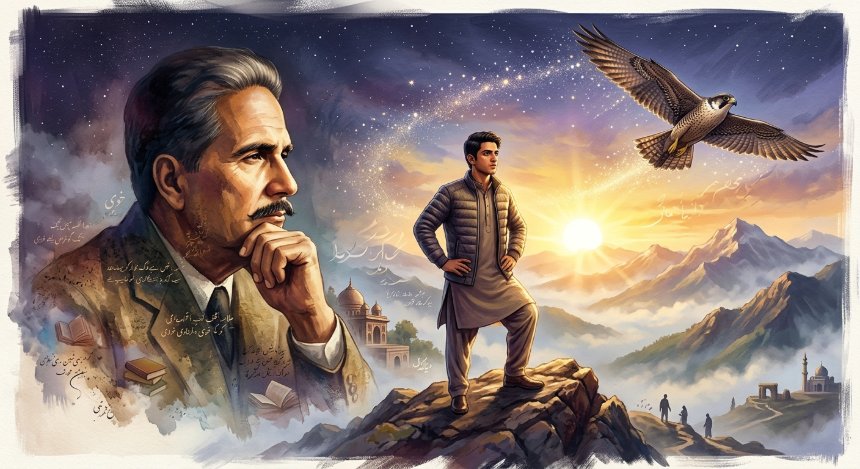
Why did the Sage of the Ummah bypass the older, pragmatic echelons of society and position the youth as the epicenter of his philosophy? The answer lies in his iconic metaphor of the "Shaheen" (The Falcon). Iqbal designated the Falcon as the ultimate identity of the youth. The Falcon is a bird of lofty flights, fiercely independent, a creature that scorns building comfort nests, possesses a sharp vision, and never feeds on carrion or the spoils of others. Iqbal desired the youth to break free from the cages of materialistic pleasures and conquer horizons. He breathed this falcon-like spirit into them through unmatched verses:
"You are a falcon; flight is your core vocation,
You have vast new skies stretching out before you."
He urged the youth to abandon complacency and find solace in relentless struggle rather than seeking comfort in palaces:
"Your destination is not the dome of a royal palace;
You are a falcon—go build your home amid the jagged rocks of the mountains."
Contrasting the self-respect of the falcon with the low-lying nature of common birds, he states:
"Though both fly in the exact same atmosphere,
The world of the vulture is separate from the world of the falcon."
The youth are the literal architects of a nation's future.
They possess the raw iconoclastic zeal, fearlessness, and energy capable of reversing adverse tides. It was the direct consequence of this waking call that the youth stepped up to champion the Pakistan Movement. When older intellectuals were intimidated by the sheer numerical strength of the colonial and regional powers, the young students of the Muslim Students Federation answered Jinnah's call. Through relentless determination, they turned an apparent geopolitical impossibility into a tangible reality.
This message is not a relic of the past; it is eternal. Even today, if the Muslim world is to achieve intellectual, ideological, and absolute sovereignty, it will be engineered by the younger generation—what we today call 'Generation Z' (Gen Z). If the modern digital youth can discard superficial distractions, social media cocoons, and psychological dependency to awaken their inner Shaheen, the lost glory of the Ummah can be retrieved.
Miri Aah-e-Sahar: A Covenant and a Philosophy of Life
The crescendo of Iqbal's spiritual dynamic rests upon a potent, mystical motif: "Aah-e-Sahar" (The morning sigh / the midnight lamentation). For Iqbal, this is not an expression of weakness or conventional weeping; it is a living covenant, a grand concept, and an active philosophy of life.
Prostrating and weeping before the Divine in the quietude of the pre-dawn hours generates an inward cosmic energy that can topple empires. It is a secret communion with the Creator through which the human soul is crystallized. Iqbal invokes this spiritual alchemy:
"O Lord! Bestow a conscious, vigilant heart within this chest,
Grant a completely different dimension of vision to my intoxication.
Grant my heart the burning intensity of the morning sigh (Aah-e-Sahar),
And bless this profound yearning of mine with wings to soar."
He asserts that all the material knowledge and status of the world are utterly worthless if one lacks the spiritual wealth gained during midnight vigil:
"Whether you are Attar, Rumi, Razi, or Ghazali—
Nothing is ever achieved without the morning sigh (Aah-e-Sahar)!"
The Supplicatory Verses of Iqbal
The Philosopher-Poet consistently reinforced his intellectual discourse with beautiful, passionate supplications. His poetry concludes with a yearning for humility, divine love, and a vision of the heart. He prays:
"Give the youth an inner burning heart (Soz-e-Jigar),
Bestow upon them my intense love, and my vision."
He asks for an unyielding, falcon-like spirit for his people that knows no worldly fear:
"Awaken angelic virtues within me, make me a practitioner of truth,
Grant me the heart of a falcon, and bless me with the flight of a hawk."
Conclusion (The Ultimate Prayer)
The philosophy and insight of Allama Muhammad Iqbal remain a radiant guiding light. The grand objective of his life and poetry was to illuminate human hearts with the wealth of faith, certainty, and spiritual fire. This finds its most sublime, universal, and eternal expression in his signature concluding prayer:
"Khadaya! Aarzoo meri yehi hai
Mera Noor-e-Basirat aam kar de!"
(O Lord! My ultimate, singular yearning is only this:
Make this light of spiritual insight universal for all!)



Explore Creative Kitchen Cabinets Design Ideas for Your Home
A well-planned kitchen cabinets design can transform the appearance and functionality of y...