
أَعُوذُ بِاللّٰهِ مِنَ الشَّيْطَانِ الرَّجِيمِ
بِسۡمِ ٱللهِ ٱلرَّحۡمَـٰنِ ٱلرَّحِيمِ
In the name of ALLAH, the Most Gracious, the Most Merciful
Alexander Dugin Calls for Decolonizing Modernity
Alexander Dugin’s Fourth Political Theory, the Call for a New Middle Ages, and Lessons for the Muslim World
Abstract
This essay examines the radical anti-modernist philosophy of Russian political theorist Alexander Dugin, synthesizing his eschatological critique of Western modernity, his systematic Fourth Political Theory, and his messianic vision for Russia’s civilizational destiny. Tracing Dugin’s core arguments, the analysis explores his assertion that all dominant modern ideologies—liberalism, communism, and fascism—are united in their rejection of "Tradition" and the Sacred, serving as secular forces that replaced the divine order of the Middle Ages with a terminal, apocalyptic trajectory. Central to this critique is Dugin’s deconstruction of the sovereign individual as an ideological construct, alongside his inversion of postcolonial theory to argue that Western modernity first "colonized the mind" of the West itself during the Renaissance and the Enlightenment. To reverse this spiritual decay, Dugin prescribes a civilizational rollback to a "new Middle Ages" operationalized through the Fourth Political Theory, which replaces the modern historical subjects of the individual, class, and race with existential, tradition-bound human presence (Dasein). Finally, after evaluating Dugin’s geopolitical conclusion for Russia as the core of a Eurasian civilization-state and the biblical Katechon, the essay turns to the profound parallel thought of Egyptian philosopher Abdelwahab El-Messiri and the philosophical vision of Allama Muhammad Iqbal, drawing a vital civilizational lesson for Muslim nations on intellectual decolonization and spiritual self-realization (Khudi).
Introduction
In contemporary geopolitical and philosophical discourse, few thinkers challenge the foundational assumptions of the modern world as radically as the Russian philosopher Alexander Dugin. Across his writings and public statements, Dugin outlines a sweeping civilizational critique that diagnoses Western modernity not as an era of human progress, but as a terminal spiritual crisis. By synthesizing his condemnation of individualism, his call to "decolonize" the West from the Enlightenment, his systematic Fourth Political Theory, and his vision for Russia’s civilizational mission, one uncovers a comprehensive anti-modernist manifesto that seeks to overturn the last five hundred years of global history and reshape the world order.
The Rejection of the Sacred and the Illusion of Individualism
At the root of Dugin’s philosophy is the assertion that all modern political ideologies share a single, fatal flaw: the rejection of Tradition, the Sacred, and "genuine authentic Christianity." In Dugin’s metaphysical framework, which draws heavily on Christian apocalyptic imagery, modern ideologies are "horns of the Beast" because they systematically dethrone God and replace divine order with human-centric constructs.
Central to this rebellion is the liberal myth of the sovereign individual. Dugin dismisses the notion of total individual autonomy as an "ideological bluff" and a strict impossibility. Rather than existing as a self-contained, independent entity, the individual is a manufactured product—its values, desires, and worldview installed by society through ideological tools. Liberalism, Dugin argues, did not liberate a pre-existing individual; rather, it actively "induced" the individual in order to atomize society, severing human beings from their organic, sacred, and communal roots.
The Colonization of the Mind and the Call for a New Middle Ages
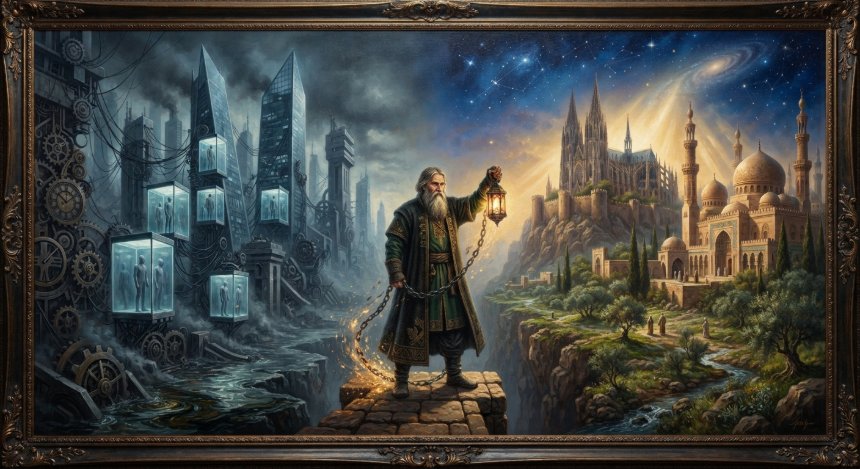
To trace the origin of this crisis, Dugin points to a profound historical rupture that occurred roughly five hundred years ago in Western Europe. In mainstream historiography, the transitions marked by the Renaissance, the Reformation, and the Age of Exploration are celebrated as the dawn of enlightenment, scientific inquiry, and human emancipation. Dugin radically inverts this narrative. He contends that this turning point was actually the systematic dismantling of Christianity across every sphere of human existence—not merely in religion, but in physics, cosmology, politics, culture, morality, and metaphysics. By abandoning a sacred, vertical orientation toward the divine in favor of secular materialism and a "false theory of progress," the West ended what Dugin calls the "normal world" of the Middle Ages and entered a long phase of "apocalyptic preparations."
In a striking inversion of postcolonial theory, Dugin argues that the most powerful form of imperialism is the "colonization of the mind," and that Western modernity colonized the West itself before it ever colonized the rest of the world. The Enlightenment usurped Europe’s historical consciousness, perverted its intellectual heritage, and stole its authentic traditions. Consequently, if the West wishes to rediscover its true identity, it must first "decolonize itself"—not through superficial conspiracy theories, but through rigorous intellectual deconstruction utilizing philosophy, sociology, anthropology, political science, and the history of religions. Ultimately, Dugin prescribes an uncompromising cure: Western civilization must "roll back its settings" to the era before the Modern Age, embracing a "new Middle Ages" to save itself from spiritual extinction.
The Fourth Political Theory: Beyond Liberalism, Communism, and Fascism
To provide a structured political framework for this anti-modernist revolt, Dugin developed The Fourth Political Theory. According to Dugin, the twentieth century was defined by the clash of three major modern ideologies:
- Liberalism (the first political theory), which makes the individual its primary historical subject.
- Communism (the second political theory), which makes class its primary subject.
- Fascism (the third political theory), which makes the race or nation-state its primary subject.
Following the collapse of fascism in 1945 and communism in 1991, liberalism emerged triumphant as the sole global ideology, threatening to absorb the entire world into a homogenized, secular, Westernized global order. Dugin argues that both communism and fascism failed because, despite opposing liberalism, they remained trapped within the materialistic, anti-traditional paradigm of modernity.
The Fourth Political Theory seeks to transcend and destroy all three. Instead of the individual, class, or race, Dugin proposes Heidegger’s concept of Dasein ("being-there")—a deeply rooted, existential human presence anchored in sacred Tradition, spiritual identity, and organic community—as the new subject of history. By uniting the anti-capitalist critique of Marxism, the organic communalism of pre-modern conservatism, and a fierce defense of spiritual Tradition, the Fourth Political Theory aims to dismantle liberal hegemony from the ground up.
Russia’s Conclusion: The Katechon and the Eurasian Mission
Within this grand metaphysical battle, Dugin assigns a pivotal, messianic role to his own country, Russia. Having experienced the Westernizing reforms of Peter the Great, the hyper-modernist experiment of Soviet Communism, and the chaotic liberal shock therapy of the 1990s, Dugin concludes that Russia must completely reject the Western path of development.
In Dugin’s geopolitical blueprint, Russia is not merely a nation-state, nor is it an Eastern European appendage of the West. Rather, Russia is the core of Eurasia—a distinct, self-sufficient "civilization-state" rooted in Orthodox Christianity, traditional values, and imperial solidarity. Drawing on ancient Christian eschatology, Dugin casts Russia in the role of the Katechon—the biblical "restrainer" that holds back the coming of the Antichrist and prevents the total triumph of globalist, secular modernity. For Dugin, Russia’s survival depends on awakening from its own "colonization of the mind," purging Western liberal influence, and re-anchoring its statehood, culture, and society in the Sacred.
Civilizational Impact on Russia and the World
If Dugin’s conclusions are fully realized, the civilizational consequences for both Russia and the wider world would be profound:
- For Russia: It entails a complete transformation from a modern, secular state into an ideological and spiritual empire. Internally, this means the subordination of individual rights and market economics to collective spiritual goals, demographic renewal, Orthodox traditionalism, and hierarchical authority. Russia would cease measuring its success by Western standards of material wealth or technological consumerism, judging itself instead by its fidelity to spiritual Tradition and geopolitical sovereignty.
- For the Rest of the World: Dugin’s vision seeks to shatter the unipolar, Western-led global order and replace it with a multipolar world of distinct civilizations. In this multipolar framework, Western values—such as liberal democracy, secularism, and universal human rights—would be stripped of their claim to universal validity and exposed as merely the local, decaying customs of one declining civilization. Other major civilizational blocs—such as the Islamic world, China, India, and Latin America—would be encouraged to undergo their own "decolonization" from Western modernity, reclaiming their indigenous traditions, religions, and hierarchies.
Conclusion
Framing human history as a "Great War between Heaven and Hell," Alexander Dugin insists that while the ultimate outcome rests with God, human beings must choose their camp before the end arrives. Critics rightly warn that Dugin’s romanticization of the Middle Ages ignores the brutal realities of feudal oppression and religious intolerance, and that his apocalyptic framing of geopolitics dangerously legitimizes authoritarianism and perpetual civilizational conflict. Nevertheless, by weaving together a radical critique of individualism, the Fourth Political Theory, and a vision of Eurasian multipolarity, Dugin has constructed one of the most influential anti-modernist philosophies of the twenty-first century—one that actively seeks to end the Western age and restore a world governed by the Sacred.
Epilogue: Lessons for Muslim Nations — Abdel Wahab El-Messiri and Allama Iqbal’s Philosophy of the Self
For the Muslim world, Dugin’s radical deconstruction of Western modernity carries an urgent and sobering lesson—especially for those Muslim nations, elites, and reformers who continue to hope that they can change their fate and achieve revival on the basis of Western modernity. To seek liberation through the very philosophical framework that colonized the human spirit is a fatal contradiction. Long before Dugin’s critique gained global notoriety, the Islamic world had already produced towering intellectual giants who dismantled the illusions of Western modernity from within and charted an authentic path to spiritual and civilizational rebirth: the late Egyptian thinker Abdelwahab El-Messiri and the philosopher-poet Allama Muhammad Iqbal.
Abdelwahab El-Messiri is, without a doubt, the most important thinker of the twenty-first century, and the greatest work of the human mind in this century is set down in El-Messiri’s books. He was the man who saw the true nature of the world and discerned the hidden, common thread linking capitalism, globalization, imperialism, and colonialism—demonstrating that all of them stem from a single, ruthless materialist paradigm that reduces both nature and human beings to mere usable matter.
Devoting twenty years of his life to understanding reality and rigorously studying Zionism, El-Messiri made a groundbreaking civilizational discovery: that Zionism is not an anomaly or an isolated historical accident, but nothing less than a crude, distilled expression of what Western modernity itself has become. Just as Dugin warns of the "colonization of the mind," El-Messiri exposed how Western secular materialism strips existence of all transcendent meaning, turning human societies into functional, soulless machines driven by power, utility, and domination. Above all, El-Messiri’s ultimate triumph lies in his defense of human dignity against the reductionism of modernity. He was the man who understood the true nature of the human being—not as the atomized, self-serving "individual" induced by Western liberalism, nor as a mere biological or economic unit, but as that wondrous creature into whom God breathed His spirit and instilled what sets humanity apart from all other creatures: an innate leaning toward religion, art, and morality.
If El-Messiri diagnosed the spiritual pathology of Western modernity, Allama Muhammad Iqbal provided the dynamic antidote for Muslim liberation through his revolutionary philosophy of Khudi (the Self or Ego). Decades earlier, Iqbal foresaw that the glittering exterior of Western civilization concealed a profound moral and spiritual emptiness, warning that blind imitation (Taqlid) of the West would only deepen the intellectual enslavement of the Muslim Ummah. Unlike the Western liberal concept of the "individual"—which Dugin exposes as an atomized, ideologically manufactured consumer divorced from the Sacred—Iqbal’s concept of the Self (Khudi) is deeply anchored in divine consciousness, moral responsibility, and creative spiritual agency.
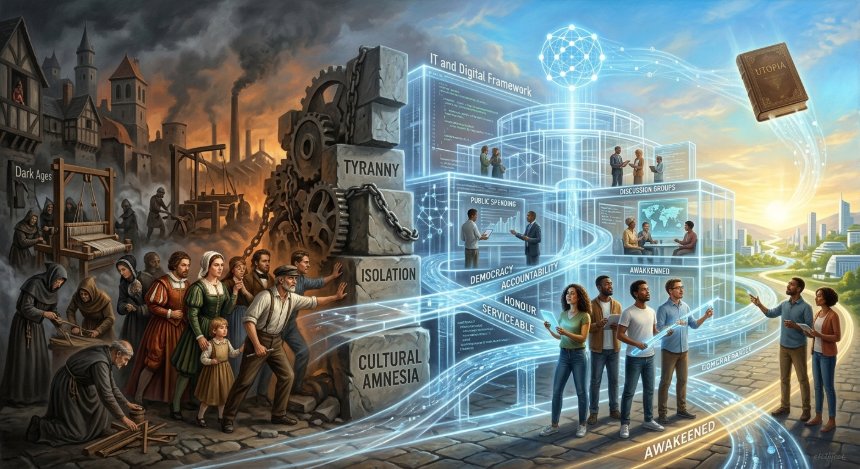
Iqbal argued that the true liberation of Muslims cannot be imported through secular institutions, Western nationalism, or materialist ideologies; rather, it must begin with the awakening, fortification, and elevation of the individual and collective Khudi. Through devotion to the Divine, self-mastery, and dynamic action (Amal), the human ego transforms from a passive subject of colonial and modern domination into God’s vicegerent (Khalifa) on earth—a co-creator of destiny capable of reshaping history rather than merely reacting to it. In Iqbal’s vision, when the Muslim awakens the divinely breathed spirit within, the chains of mental colonization shatter from the inside out.
Together, the insights of El-Messiri and Iqbal offer a decisive roadmap for Muslim nations standing at a civilizational crossroads. True renaissance cannot be borrowed from a desacralized West. Liberation begins only when the Muslim world decolonizes its own mind, rejects the materialist illusions of modernity, and rebuilds its civilization by awakening the sovereign, God-conscious Self (Khudi) rooted in the sacred essence of the human soul.