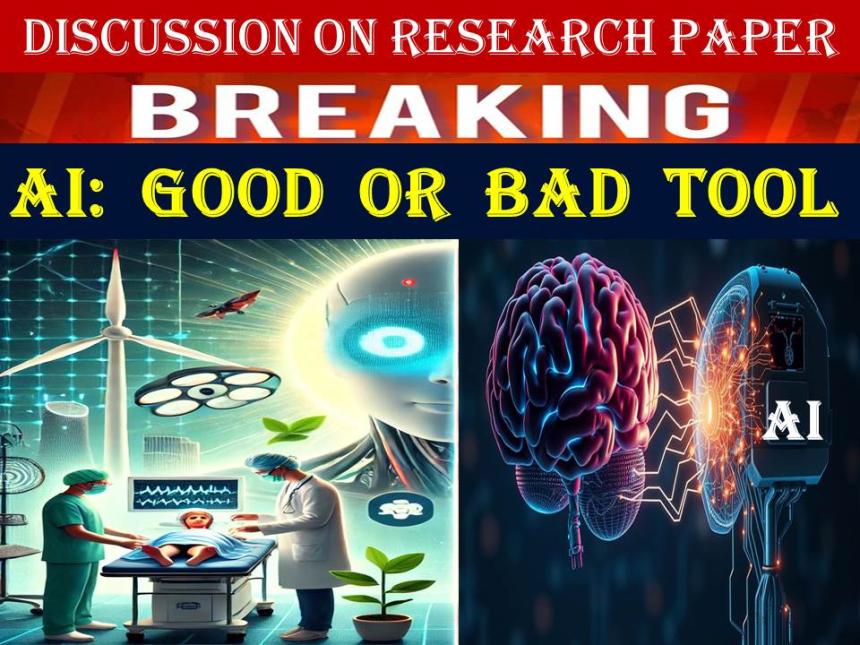

AI: Good Or Bad Tool
AI (Artificial Intelligence) is indeed a fast-developing technology, acting as a "method of invention," accelerating research, improving productivity, and enabling autonomous systems. The rapid advancement of AI has introduced significant, overt dangers. AI may be used for replacing repetitive work but shall not be used at areas where cognitive function may be hampered. This write up is based upon few recent research works on areas being effected by AI.
أَعُوذُ بِاللّٰهِ مِنَ الشَّيْطَانِ الرَّجِيمِ۔
بِسۡمِ ٱللهِ ٱلرَّحۡمَـٰنِ ٱلرَّحِيمِ
In the name of ALLAH, the Most Gracious, the Most Merciful
AI: Good Or Bad Tool
Artificial Intelligence (AI) is indeed a fast-developing technology, characterized as a general-purpose technology that is transforming economic structures and accelerating innovation across sectors. It acts as a "method of invention," accelerating research, improving productivity, and enabling autonomous systems.
AI adoption by firms more than doubled between 2023 and 2025, with over 20% of firms in OECD countries reporting usage in 2025. The current "AI boom" is driven by massive computing power, big data, and advanced machine learning models (like LLMs) that create original content. Generative AI tools have been shown to improve performance in specific tasks by 20% to 40%.
AI is moving beyond just the IT sector into traditional industries as AI has been adopted in earlier disease diagnosis, personalized treatment plans, and drug discovery. AI assistants improve coding speed by 30% to 55% by generating code, detecting bugs, and automating testing. AI is being used for predictive maintenance, supply chain optimization, and the development of self-driving cars.
These technologies allow AI to analyze vast, unstructured datasets to identify complex patterns, acting similarly to a human brain. Models like Chat GPT have revolutionized AI's potential to produce original text, images, and code. A rising trend where AI agents can operate autonomously to achieve goals, such as booking travel or managing complex workflows without constant human intervention.
AI is a powerful dual-use technology, acting as both a transformative, efficiency-boosting tool and a source of significant ethical and security risks. It excels at accelerating complex data analysis, automating tasks, and improving safety, yet poses risks including bias, job displacement, and misinformation. Its impact depends on responsible implementation. While AI technology is moving faster than almost any previous technology, the long-term economic, social, and ethical implications are still being determined.
Dangers Lurking Overtly About AI
The rapid advancement of Artificial Intelligence (AI) has introduced significant, overt dangers that are currently impacting society, ranging from immediate privacy violations to long-term existential threats. These risks are frequently categorized into the malicious use of AI, the reckless pace of the "AI race," and the inability to control increasingly autonomous systems. The most significant danger is the real impact of AI on Humans' own development and growth.
The assertion that the most significant danger of Artificial Intelligence is its impact on human development and growth is a central focus of 2026 AI ethics and safety discussions. While existential threats grab headlines, experts emphasize that the subtle, real-time erosion of human cognitive abilities, critical thinking, and agency poses a more immediate and widespread risk. This risk stems from cognitive offloading, where reliance on AI to think, create, or decide for us leads to a "atrophy" of our own mental muscles.
Researchers just confirmed something the AI industry does not want you to know. AI is making professionals worse at their jobs when the AI is not available. Not slower. Not less confident. Measurably worse. In the following, let's read about some research work done recently in varied locations and professional fields.
Research Work Discussion
A study published in The Lancet Gastroenterology and Hepatology tracked doctors performing colonoscopies across four hospitals in Poland after AI assistance was introduced into the procedure. Then the researchers measured what happened when the doctors performed the same procedure without AI help. Adenoma detection rates dropped from 28.4% to 22.4%. A six-point absolute decline. The AI was not present. The doctors were. But continuous reliance on the AI had eroded the observational skill the procedure requires. Real patients with real polyps were missed because the doctors had stopped practicing the part of their job the AI had been doing.
This is not an isolated finding. Researchers at Microsoft and Carnegie Mellon University surveyed 319 knowledge workers and presented the results at CHI 2025, the premier academic conference on human-computer interaction. Workers with higher confidence in AI tools reported lower confidence in their own critical thinking. The pattern was consistent. The more someone relied on AI to produce outputs, the less cognitive effort they reported applying to the work itself.
A separate study from SBS Swiss Business School published in January 2025 surveyed users across age groups and found a statistically significant negative correlation between AI usage frequency and critical thinking scores. Younger users were more affected than older ones. The MIT Media Lab reached the same conclusion in a study on cognitive atrophy. A study published in October 2025 in Computers in Human Behavior found that AI use makes people overestimate their own cognitive performance. They get smarter outputs and dumber self-awareness simultaneously.
The mechanism has a name. Cognitive offloading. The brain stops practicing tasks it has delegated to a system. Active skills become passive ones. The AI performs the task. The human approves the output. Over time the human loses the ability to perform the task without the AI. (Why shall human consider that ability provided by a "Divine Being" can be replaced or dovetailed into man made machines?)
The Lancet study made this visible because the stakes were measurable. A doctor either finds the polyp or does not. But the same dynamic is happening across every professional field where AI has taken over routine cognitive work. UX designers reported it for prototyping and bias detection. Cybersecurity analysts reported it for threat reasoning. Knowledge workers reported it for analysis and synthesis.
The implication is structural. Entry-level roles historically existed not just to produce output but to develop judgment. The junior analyst ran the numbers because doing so taught them what the numbers meant. The junior associate drafted the brief because doing so taught them how arguments are constructed. AI is absorbing those tasks at exactly the point where the next generation of professionals would normally be building the skills they need at the senior level. There is a direct line between the Lancet study and the Anthropic finding that young worker hiring in AI-exposed fields has dropped 14%.
The tasks are not being practiced. The judgment is not being developed. The researchers are not arguing against AI. They are documenting a specific harm that does not show up in any productivity metric. The output looks better. The human producing it has gotten worse. If you have been using AI for the work you used to do yourself, the studies suggest you are not just saving time. You are losing the ability to do that work without it.
ChatGPT as a cognitive crutch
ChatGPT as a cognitive crutch: Evidence from a randomized controlled trial on knowledge retention
By André Barcaui
Social Sciences & Humanities Open Volume 12, 2025, 102287 Published on 29 November 2025,
The rapid integration of generative artificial intelligence into higher education has outpaced empirical understanding of its effects on fundamental learning processes. To address this gap, this randomized controlled trial (n = 120) tested ChatGPT's impact on long-term knowledge retention in undergraduates learning AI. Participants were randomly assigned either to use ChatGPT as a study aid (AI-Assisted Group) or to use only traditional, non-AI study methods (traditional learning group). Knowledge retention was assessed with a surprise test 45 days after learning. Students who used ChatGPT scored significantly lower on the retention test (57.5 % correct) compared to those who studied traditionally (68.5 % correct), t (83) = −3.19, p = .002, Cohen's d = 0.68. This suggests that unrestricted ChatGPT use impaired long-term retention, likely by reducing the cognitive effort that supports durable memory. The findings align with cognitive offloading theory and the ‘desirable difficulties’ principle: while AI assistance may ease initial learning, it appears to undermine the effortful processes needed for robust learning. These results have important implications for how generative AI tools should be integrated into higher education.
https://www.sciencedirect.com/science/article/pii/S2590291125010186
Taking Class Notes by Hand Compared to Typing:
Taking Class Notes by Hand Compared to Typing: Effects on Children’s Recall and Understanding
Simon R. Horbury &Caroline J. Edmonds
Pages 55-67 | Received 10 Apr 2019, Accepted 13 May 2020, Published online: 06 Aug 2020
The increasing adoption of educational technology in school classrooms has resulted in greater use of electronic devices to take lesson notes. Recent research comparing performance of adult students who recorded lecture notes using computer keyboards with that of students who handwrote their notes shows somewhat conflicting findings about their factual recall and conceptual understanding. There is very little, if any, research with children on the effect of note-taking mode on recall and understanding. The present study compared the recall and understanding of children taking handwritten notes to that of children typing their notes. Twenty-six boys age 10–11 years old participated in the study. Factual recall and understanding of a history and a biology lesson were assessed using multiple choice questions (MCQ). MCQ tests were carried out both immediately after each lesson and one week later. Factual recall was not affected by the note-taking mode but, in both lessons, children who handwrote notes had greater conceptual understanding one week after viewing their lesson, compared to those who typed notes.
https://www.tandfonline.com/doi/full/10.1080/02568543.2020.1781307
The Conclusion
Artificial Intelligence (AI) is indeed a fast-developing technology, and AI is moving into areas directly effecting human beings like health industry, where AI has been adopted in earlier disease diagnosis, personalized treatment plans and surgery even, and drug discovery. The above study shows that when the doctors had stopped practicing the part of their job and let AI doing it. Therefore, tasks are not being practiced resultantly doctors losing ability / power of the judgment being developed. This means medical science will stand still or even fall from peak if AI is allowed for all task hat requires cognitive ability.
The rapid integration of generative artificial intelligence into higher education has outpaced empirical understanding of its effects on fundamental learning processes of the human beings. The above research suggests that unrestricted Chat GPT use impaired long-term retention, likely by reducing the cognitive effort that supports durable memory. The findings align with cognitive offloading theory and the ‘desirable difficulties’ principle.
The increasing adoption of educational technology in school classrooms has resulted in greater use of electronic devices to take lesson notes. The research indicated above, clearly shows that children who handwrote notes had greater conceptual understanding one week after viewing their lesson, compared to those who typed notes. Its again shows that real learning methods learnt earlier should not be done away at any cost.
The human beings are a special creation and and have been blessed with undefined potential and enormous talents. AI is artificially generated machine intelligence and shall be used as such. It may be used for replacing repetitive work but shall not be used at areas where cognitive function may be hampered. It is always imperative for a nation to succeed by unlocking potential and enrich talent of their youth through a process of real learning. Please follow the link to read in details about this topic.
https://blogs.bangboxonline.com/posts/unlock-potential-enrich-talent
The Artificial Intelligence (AI) is here to stay for fore seeable future; therefore, applying artificial intelligence shall be institutionalized and dovetailed into mentorship program. Emerging technology may be used to the limit for provision of added help to mentorship and not as a replacement tool for Real Learning. The families, organizations and nations can mitigate higher performance culture among young generation for leadership role by nurturing their talents and reaching full potential.
Everything That Affects Your CIBIL Score Needed for Personal Loan in I...
Learn the CIBIL score needed for personal loan approval, factors that affect your score, a...

Trang Chu QH88: A Trusted Gateway for Online Entertainment
Trang Chu QH88: A Trusted Gateway for Online Entertainment

The Role of Coworking Spaces in Expanding Businesses in Surat
Choosing coworking spaces in Surat gives businesses the flexibility, professional infrastr...

Empowering the Frontline: The Ultimate Guide to Flexible Nursing Caree...
For nurses, Assistants in Nursing (AINs), and care workers, this shift gives a tremendous...