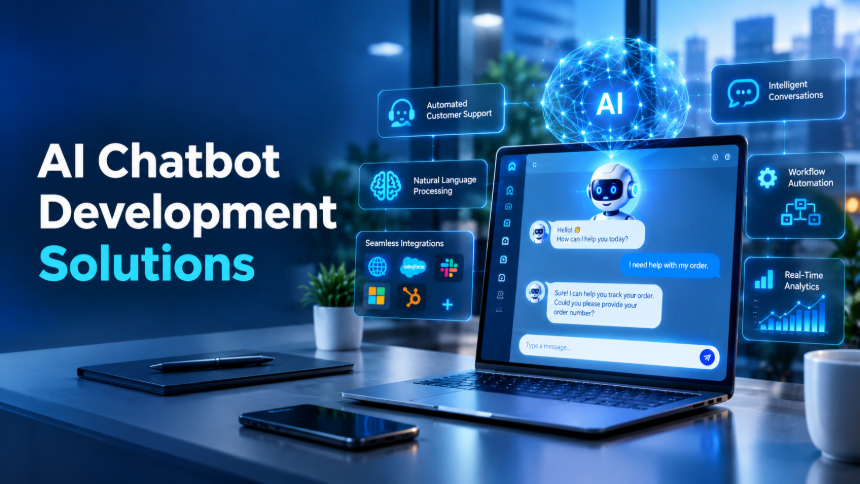

AI Chatbot Development: Strategies for Smarter Business Operations
Discover how AI Chatbot Development Solutions help businesses automate customer support, improve engagement, streamline workflows, and deliver smarter, faster, and more personalized customer experiences with secure, scalable AI technology.
Introduction
Artificial intelligence is changing how organizations communicate with customers, support employees, and manage everyday business activities. As digital interactions increase, companies need faster and more flexible ways to answer questions, resolve common issues, and provide reliable information. AI-powered chatbots offer a practical approach by understanding natural language, identifying user intent, and generating relevant responses. When connected to existing business applications, these systems can also automate selected tasks and improve access to important information. However, successful implementation requires careful planning, suitable technology, accurate data, and strong security controls. Businesses that approach chatbot adoption strategically can improve customer engagement, streamline internal workflows, and establish a scalable foundation for continued digital transformation.
Understanding AI Chatbot Development Solutions
AI chatbot development involves creating conversational applications that understand user requests and provide useful responses through websites, mobile applications, messaging platforms, or internal business portals. Modern solutions may combine natural language processing, machine learning, large language models, and retrieval-based techniques to interpret questions and access relevant information. Unlike traditional rule-based bots, advanced chatbots can handle more flexible conversations and maintain context across multiple interactions. Their capabilities depend on the selected model, available knowledge sources, and integration architecture. Businesses can use these systems for customer support, sales assistance, employee onboarding, technical troubleshooting, and information retrieval. A well-designed chatbot should reflect specific business requirements rather than simply imitate human conversation.
Why Businesses Are Adopting Conversational AI
Organizations often receive large volumes of repetitive inquiries that require considerable time and staff resources. AI-powered customer support can address common questions, explain procedures, provide service information, and guide users toward suitable solutions. This helps reduce waiting times and allows human representatives to focus on complex requests that require judgment or empathy. Chatbots can also support lead qualification by gathering initial information from prospective customers and directing relevant inquiries to sales teams. Internally, employees can use conversational assistants to locate policies, understand workflows, or retrieve technical documentation. These applications can improve service availability and operational consistency. To achieve meaningful results, businesses should connect chatbot capabilities to clearly defined objectives and evaluate performance using measurable indicators.
Migration Planning for Successful Implementation
Introducing a chatbot into an existing business environment requires a structured migration strategy. Organizations may already depend on legacy software, customer relationship management platforms, enterprise resource planning systems, and established support workflows. Before development begins, teams should assess their infrastructure, document system dependencies, identify operational risks, and determine which processes the chatbot will support. They should also define implementation milestones, responsibilities, budgets, and success criteria. A phased rollout allows businesses to introduce the chatbot to a specific department or customer group before expanding deployment. This makes it easier to identify technical limitations, collect feedback, and refine the solution. Thorough migration planning reduces disruption and helps ensure the new system complements existing operations.
Data Migration and Knowledge Base Preparation
Reliable chatbot responses depend on the quality and accessibility of the information used to generate them. Data migration may involve transferring product documentation, customer service articles, frequently asked questions, internal policies, and other approved resources from existing platforms. Before transferring this information, businesses should identify outdated documents, remove duplicates, standardize formats, and verify access permissions. The cleaned information can then be organized into a searchable knowledge base. Retrieval-augmented generation, or RAG, allows an AI model to retrieve relevant passages from approved sources when answering questions. This approach can improve factual grounding and simplify updates without requiring every new document to become part of the model's training data. Regular content reviews help maintain accuracy as business requirements change.
Integration With Existing Business Systems
Integration enables chatbots to do more than answer general questions. When connected to CRM software, a chatbot may retrieve authorized customer information or help support teams understand previous interactions. Integration with help desk platforms can simplify ticket creation, while connections to order management systems can support delivery inquiries and order updates. Employee-facing assistants may connect to document repositories or internal service portals. These capabilities typically rely on APIs, authentication mechanisms, data validation, and controlled permissions. Older applications may require middleware or custom connectors to exchange information reliably. Developers should also establish fallback behavior for failed requests and temporary service interruptions. Well-planned integration reduces manual work, improves information accessibility, and creates a more connected experience across business applications.
Security, Privacy, and Responsible AI
Security and privacy must remain central throughout chatbot development and deployment. Organizations should implement strong authentication, role-based access controls, encryption, and suitable data retention policies. A chatbot connected to internal systems must respect the permissions of the person using it, preventing unauthorized access to confidential information. Businesses should also evaluate how AI providers process prompts, store conversations, and handle submitted data. Depending on the industry and jurisdiction, privacy regulations and contractual requirements may affect system design. Additional protections should address prompt injection, unsafe tool execution, and accidental disclosure of sensitive records. Audit logs, vulnerability assessments, and incident response procedures help strengthen accountability. Responsible AI practices, including appropriate human oversight, also help organizations manage inaccurate or potentially harmful responses.
Testing and Continuous Performance Improvement
Comprehensive testing helps confirm that a chatbot is useful, reliable, and secure before it reaches a wider audience. Functional testing checks whether conversations, connected applications, and automated actions behave as expected. Response evaluation examines accuracy, relevance, consistency, and whether answers are supported by approved information. Security testing identifies weaknesses in authentication, access controls, and data handling. Performance testing measures response times and the system's ability to support multiple users simultaneously. User acceptance testing provides practical feedback on navigation, conversation quality, and overall usability. After deployment, teams should monitor resolution rates, escalation frequency, response latency, and customer satisfaction. Continuous evaluation helps developers identify recurring problems, update knowledge sources, and improve chatbot performance as user expectations evolve.
Selecting AI Chatbot Development Solutions for Business Needs
Choosing the right development approach starts with understanding the problem the organization wants to solve. Some businesses need a simple customer support assistant, while others require a sophisticated enterprise chatbot connected to multiple applications and data sources. AI Chatbot Development Solutions should align with operational requirements, available data, security policies, and future growth plans. Organizations should assess whether a hosted language model, an open-source model, a retrieval-based architecture, or a hybrid approach best fits their needs. They should also evaluate scalability, integration complexity, operating costs, and maintenance responsibilities. Working with an experienced development partner can help businesses select suitable technologies, establish realistic milestones, and avoid unnecessary complexity during implementation.
Common Challenges and Best Practices
Chatbot projects can encounter challenges such as inconsistent data, inaccurate responses, complex legacy integrations, unexpected operating costs, and limited employee adoption. Businesses can address these issues by starting with a focused use case and expanding gradually as results become clear. Maintaining an approved knowledge base helps reduce outdated or unsupported answers, while human escalation provides a path for complex or sensitive requests. Teams should establish clear ownership for content updates, system monitoring, and security reviews. Involving IT, customer service, compliance, and business stakeholders throughout development helps identify practical concerns early. Employee training and transparent communication can encourage adoption. Regular audits, user feedback, and performance reviews keep the chatbot aligned with business goals.
Key Benefits of AI Chatbot Development
Well-implemented chatbots can improve responsiveness, reduce repetitive workloads, and make business information easier to access. Automated conversations allow customers to obtain assistance beyond standard support hours, while integrations can reduce manual data entry and unnecessary application switching. Employees may resolve routine internal questions more quickly, helping teams concentrate on higher-value responsibilities. Chatbot analytics can also reveal recurring customer concerns, frequently requested services, and opportunities to improve business processes. These benefits are not automatic; they depend on accurate information, appropriate automation boundaries, and ongoing management. Organizations should measure operational costs, response times, resolution rates, and customer satisfaction to determine whether their investment is delivering tangible improvements and where additional optimization may be worthwhile.
Conclusion
AI chatbots provide businesses with an opportunity to modernize communication, automate routine processes, and create more accessible digital services. Achieving these outcomes requires more than deploying an AI model. Careful migration planning, reliable data preparation, secure integrations, comprehensive testing, and continuous optimization all contribute to long-term success. Organizations should begin with clearly defined objectives, select technologies suited to their requirements, and preserve human oversight for situations that demand judgment. With the right implementation strategy and governance practices, AI chatbot development can help companies improve customer experiences, strengthen operational efficiency, and adapt confidently to evolving digital expectations.

Best Yoga Retreat in Rishikesh: The One You Can Still Keep at Home
The best yoga retreat in Rishikesh is the one whose clock and sequence survive Monday — ad...


The Changing Digital Landscape: Technology, Innovation, and Online Exp...