Aadhaar Authentication Process Explained for Services That Need It
Learn how Aadhaar Authentication works, its types, benefits, security features, and role in banking, telecom, eKYC, and government services.
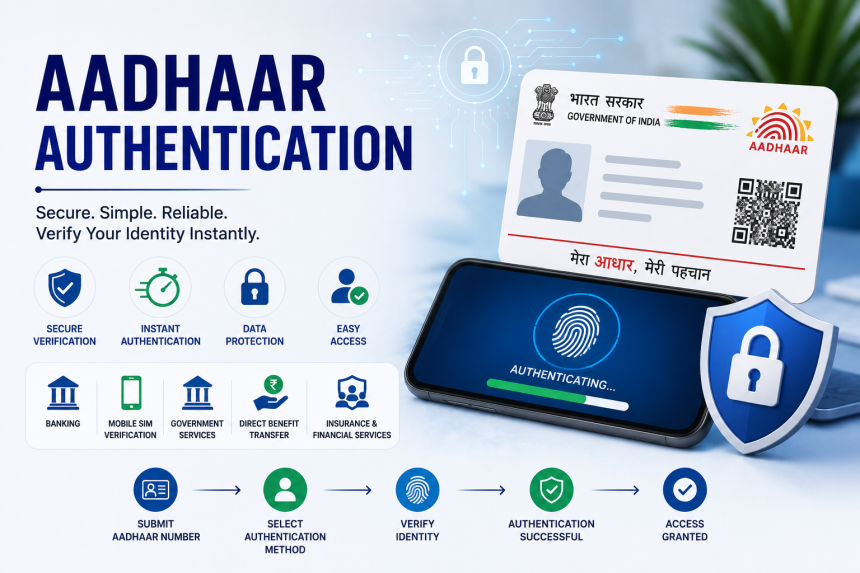
In today’s digital world, identity verification has become an essential part of accessing financial, government, and telecom services. One of the most widely used identity verification systems in India is Aadhaar Authentication. It allows organizations to verify an individual’s identity electronically using Aadhaar details.
From opening bank accounts to applying for subsidies and completing KYC formalities, Aadhaar-based verification has simplified many processes. It enables quick authentication while reducing paperwork and improving service efficiency.
Understanding how Aadhaar Authentication works is important because it plays a major role in both online and offline service delivery.
In this article, we explain the Aadhaar authentication process, its types, benefits, security features, and how it is used across various sectors.
What Is Aadhaar Authentication?
Aadhaar Authentication is a process through which an individual’s identity is verified using their Aadhaar number along with demographic or biometric information.
The authentication request is sent electronically to the authorized system for validation.
The process confirms whether the submitted information matches the records associated with the Aadhaar number.
Why Aadhaar Authentication Is Important
The authentication process helps simplify identity verification for multiple services.
It is commonly used for:
- Bank account opening
- SIM card verification
- Government subsidy distribution
- Online KYC processes
- Pension verification
- Financial services
- Insurance applications
The process reduces fraud risks and speeds up service approvals.
Types of Aadhaar Authentication
Demographic Authentication
This method verifies details such as:
- Name
- Date of birth
- Gender
- Address
The information provided by the user is matched against Aadhaar records.
OTP-Based Authentication
A one-time password is sent to the registered mobile number linked with Aadhaar.
The user enters the OTP to complete verification.
Biometric Authentication
This method uses fingerprints or iris scans for identity verification.
It is commonly used in banking and government services.
Multi-Factor Authentication
Some services may combine OTP and biometric verification for enhanced security.
Step-by-Step Aadhaar Authentication Process
Step 1: Submission of Aadhaar Number
The user provides their Aadhaar number while accessing a service.
Step 2: Selection of Authentication Method
The service provider selects the appropriate verification method.
Step 3: Data Verification
The entered information is securely matched with Aadhaar records.
Step 4: Authentication Response
The system returns a confirmation response indicating whether verification was successful.
Step 5: Service Approval
Once authentication is completed, the user gains access to the requested service.
Services That Commonly Use Aadhaar Authentication
Banking Services
Banks use Aadhaar verification for:
- Account opening
- KYC compliance
- Loan applications
- Direct benefit transfers
Telecom Services
Mobile operators use Aadhaar-based eKYC for SIM verification.
Government Welfare Schemes
Subsidies and welfare benefits are often linked with Aadhaar verification.
Insurance Services
Insurance companies may use Aadhaar authentication for policy issuance and claim processing.
Investment Platforms
Mutual fund and demat account providers use Aadhaar-based eKYC for onboarding customers.
Benefits of Aadhaar Authentication
Faster Verification
The process allows instant identity validation.
Reduced Paperwork
Digital verification minimizes physical document submission.
Improved Security
Biometric and OTP-based authentication improve identity protection.
Enhanced Service Delivery
Organizations can process requests more efficiently.
Reduced Fraud Risks
Authentication helps prevent identity duplication and misuse.
Aadhaar eKYC and Authentication
Aadhaar-based eKYC is an electronic know-your-customer process that uses authentication to verify identity.
It simplifies customer onboarding for:
- Banks
- NBFCs
- Telecom providers
- Investment platforms
This digital process reduces paperwork and speeds up approvals.
Is Aadhaar Authentication Secure?
The authentication system uses encryption and secure digital protocols to protect user information.
Security measures include:
- Encrypted data transmission
- OTP verification
- Biometric matching
- Secure access controls
These measures help protect sensitive information from unauthorized access.
Common Issues During Aadhaar Authentication
Incorrect Mobile Number
OTP-based verification may fail if the mobile number linked with Aadhaar is outdated.
Biometric Mismatch
Fingerprint authentication may fail because of unclear scans or worn fingerprints.
Network Problems
Internet connectivity issues can interrupt the authentication process.
Incorrect Aadhaar Details
Mismatch in demographic information can lead to rejection.
How to Avoid Authentication Failures
- Keep your Aadhaar details updated, especially if you have recently completed an aadhar card name change online request.
- Ensure your mobile number is linked correctly
- Use accurate demographic information
- Maintain clear biometric records
Regular updates can help ensure smoother verification.
Importance of Linking Mobile Number With Aadhaar
A registered mobile number is essential for OTP-based verification.
It allows users to:
- Receive authentication OTPs
- Access digital services
- Complete eKYC procedures
- Receive alerts and updates
Without an updated mobile number, online authentication may become difficult.
Aadhaar Authentication and Financial Inclusion
The authentication system has played a major role in improving access to financial services.
It enables:
- Quick bank account opening
- Direct subsidy transfers
- Easy digital onboarding
- Secure financial transactions
This has improved access to services for individuals across urban and rural areas.
Privacy and Consent in Aadhaar Authentication
Authentication requests are generally processed with the user’s consent.
Organizations must follow regulatory guidelines regarding:
- Data usage
- User privacy
- Information security
- Consent management
Users should only share Aadhaar details with authorized service providers.
Conclusion
Aadhaar Authentication has transformed identity verification in India by making services faster, more secure, and digitally accessible. Whether it is banking, telecom, insurance, or government schemes, Aadhaar-based verification helps streamline processes while reducing paperwork and fraud risks.
Understanding how the authentication system works allows individuals to use digital services more confidently and avoid common verification issues.
As digital adoption continues to grow, Aadhaar Authentication will remain an important part of secure and efficient service delivery across multiple sectors.