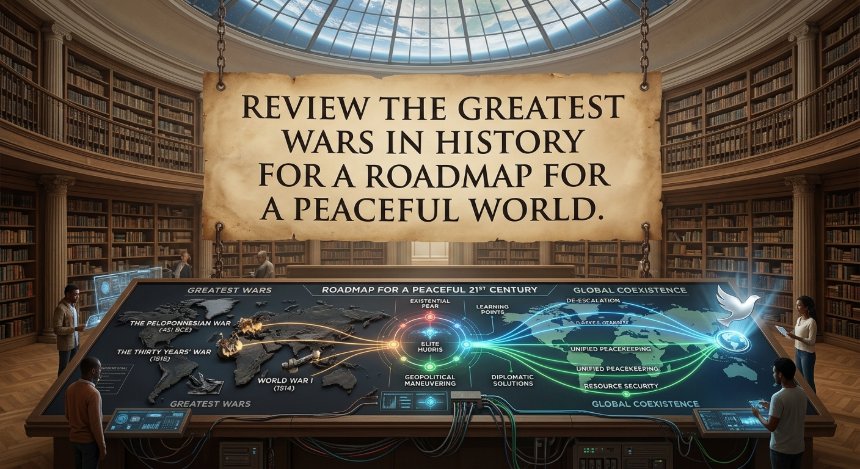

"A ROADMAP FOR A PEACEFUL WORLD"
Throughout human history, the origins of warfare have consistently traced back to a volatile mix of systemic instability and unchecked human flaws. While structural power shifts and ideological friction lay the groundwork for conflict, the immediate sparks are almost always lit by the personal ambitions, raw greed, and hubris of a small circle of ruling elites. By analyzing the root causes of history's defining wars in a precise chronological timeline, we uncover a recurring pattern of political miscalculation and tragic overreach. Ultimately, this historical narrative proves that true, lasting security cannot be engineered through military dominance, but only through a conscious, collective commitment to peaceful coexistence.
أَعُوذُ بِاللّٰهِ مِنَ الشَّيْطَانِ الرَّجِيمِ
بِسۡمِ ٱللهِ ٱلرَّحۡمَـٰنِ ٱلرَّحِيمِ
In the name of ALLAH, the Most Gracious, the Most Merciful
A ROADMAP FOR A PEACEFUL WORLD
Review The Greatest Wars In History For A ROADMAP FOR A PEACEFUL WORLD
Throughout human history, the origins of warfare have consistently traced back to a volatile mix of systemic instability and unchecked human flaws. While structural power shifts and ideological friction lay the groundwork for conflict, the immediate sparks are almost always lit by the personal ambitions, raw greed, and hubris of a small circle of ruling elites. By analyzing the root causes of history's defining wars in a precise chronological timeline, we uncover a recurring pattern of political miscalculation and tragic overreach. Ultimately, this historical narrative proves that true, lasting security cannot be engineered through military dominance, but only through a conscious, collective commitment to peaceful coexistence.
1. The Trojan War (c. 12th Century BCE)
The legendary Trojan War was primarily caused by a severe diplomatic insult and an infringement on sovereign honor. According to classical tradition, the conflict erupted when Paris, a prince of Troy, abducted Helen, the beautiful queen of Sparta and wife of King Menelaus. Bound by an ancient oath of mutual defense, the various Greek city-states united under the high command of Agamemnon to launch a massive punitive expedition to reclaim her and shatter Trojan power.
2. The Battle of Marathon (490 BCE)
The Battle of Marathon was caused by the Persian Empire's desire to punish Athens and secure total hegemony over the Greek mainland. Years prior, Athens had sent military aid to support the Ionian Revolt, an uprising of Greek cities against Persian rule in Asia Minor. Seeking vengeance for the burning of Sardis and determined to suppress future rebellions, Persian Emperor Darius the Great launched an amphibious invasion force directly targeting Athens.
3. Thermopylae (480 BCE)
The Battle of Thermopylae was triggered by the relentless imperial expansionism of the Persian Empire under Emperor Xerxes I. Driven by a desire to fulfill his father’s unfinished conquest of Greece, Xerxes gathered an unprecedentedly massive army and navy to subjugate the entire peninsula. In response to this existential threat, a fragile coalition of independent Greek city-states put aside their deep internal rivalries to mount a desperate joint defensive campaign.
4. Sparta & The Peloponnesian War (431–404 BCE)
The Peloponnesian War was fundamentally caused by the shifting balance of power and deep geopolitical anxiety within the Greek world, famously described as the Thucydides Trap. Following the defeat of Persia, Athens transformed the defensive Delian League into a coercive, wealthy maritime empire. This aggressive Athenian expansionism inspired deep fear in Sparta, the dominant land power, driving both rival alliances into an inevitable, all-out war for supremacy.
5. Sun Tzu & The Art of War (c. 5th Century BCE)
The foundational strategic insights of Sun Tzu were born directly from the brutal chaos of China's Warring States period. The cause of this era-spanning conflict was the absolute collapse of the central authority of the Zhou Dynasty, which fractured the region into competing independent principalities. Each local warlord and state ruler engaged in relentless, zero-sum military campaigns to conquer their neighbors and claim absolute imperial dominance.
6. The Punic Wars & Hannibal's Campaigns (264–146 BCE)
The Punic Wars were caused by an intense, natural clash of imperial ambitions in the western Mediterranean between Rome and Carthage. The first spark occurred over a localized geopolitical dispute regarding control of the strategic island of Sicily, which sat directly between both powers. The later phases, including Hannibal’s invasion, were driven by Carthaginian desires for vengeance and Rome's refusal to accept a powerful rival on its borders.
7. The Great Wall of China (c. 3rd Century BCE–17th Century CE)
The construction of the Great Wall was caused by an enduring, structural clash between two completely different civilizations and economic models. Imperial China was a settled, wealthy agrarian society, which made its border communities highly attractive targets for sudden raids. The highly mobile, nomadic tribes of the Eurasian Steppe regularly launched incursions to seize resources, forcing Chinese dynasties to invest heavily in permanent fortifications.
8. The Hundred Years' War (1337–1453)
The Hundred Years' War was caused by a highly complex mix of feudal obligations, economic rivalries, and royal dynastic disputes. The primary trigger was the death of French King Charles IV without a male heir, leading English King Edward III to claim the French throne through his maternal lineage. This royal dispute was further inflamed by friction over valuable wool-trading territories in Flanders and English-held lands within continental France.
9. The Fall of Constantinople (1453)
The Fall of Constantinople was caused by the geopolitical rise of the Ottoman Empire and its desire to consolidate its expanding territories. By the mid-15th century, the ancient Byzantine Empire had shrunk significantly, leaving its capital as an isolated Christian enclave surrounded by Ottoman lands. The ambitious young Sultan Mehmed II viewed capturing the strategic metropolis as essential for securing total control over vital East-West trade routes.
10. The Wars of the Roses (1455–1487)
The Wars of the Roses were caused by a weak central monarchy, economic distress, and a bitter dynastic feud between two branches of the royal House of Plantagenet. Following England's defeat in the Hundred Years' War, the mental incapacity of King Henry VI left a vacuum of power that crippled the government. This instability allowed the rival Houses of Lancaster and York to actively challenge each other for the rightful ownership of the crown.

11. The Thirty Years' War (1618–1648)
The Thirty Years' War was initially caused by intense religious friction within the Holy Roman Empire, sparked by the Defenestration of Prague. The conflict began when the future Emperor Ferdinand II attempted to impose religious uniformity, prompting Protestant nobles in Bohemia to openly rebel against Catholic rule. This localized religious dispute rapidly evolved into a massive geopolitical war as secular powers like France and Sweden intervened to weaken the ruling Habsburg dynasty.
12. Napoleon's Invasion of Russia (1812)
Napoleon's Invasion of Russia was caused by a breakdown in compliance with the Continental System, an economic blockade designed to destroy Great Britain. Tsar Alexander I found that the embargo was severely damaging the Russian economy and chose to resume vital trade with British merchants. Viewing this move as a direct betrayal that undermined his entire European strategy, Napoleon gathered his Grande Armée to enforce compliance through military action.
13. The Battle of Waterloo (1815)
The Battle of Waterloo was caused by Napoleon Bonaparte’s daring escape from exile on Elba and his subsequent reassumption of power in France. The major European monarchs, gathered at the Congress of Vienna, immediately declared Napoleon an international outlaw and a threat to continental peace. Refusing to negotiate, the allied powers mobilized massive forces to launch a joint military intervention to permanently depose the French Emperor.
14. World War I & The Gallipoli Campaign (1914–1918)
World War I was caused by imperial rivalries, an unchecked arms race, hyper-nationalism, and a rigid web of secret European alliances. The immediate spark was the assassination of Austrian Archduke Franz Ferdinand by a Serbian nationalist, which triggered a domino effect of military mobilizations. The Gallipoli Campaign itself was caused by the subsequent naval deadlock, prompting Allied leaders to open a sea route to relieve an isolated Russia.
15. World War II & The Battle of Stalingrad (1939–1945)
World War II was caused by the aggressive expansionism of fascist regimes, unheeded global warnings, and the harsh, unresolved economic legacies of the Treaty of Versailles. Nazi Germany’s invasion of the Soviet Union was driven by Adolf Hitler’s ideological obsession with destroying communism and seizing Lebensraum (living space) in the East. The specific clash at Stalingrad was caused by Germany's strategic push to capture the industrial hub and secure the vital oil fields of the Caucasus.
16. The Vietnam War (1955–1975)
The Vietnam War was caused by the post-colonial partition of the country and the intense global ideological rivalries of the Cold War. Following the exit of French forces, the nation was divided into a communist North and a Western-backed South. Driven by the "Domino Theory"—the fear that a communist victory would lead to the rapid fall of surrounding Asian nations—the United States intervened to prevent the reunification of Vietnam under communist rule.
17. The Soviet Invasion of Afghanistan (1979–1989)
The Soviet Invasion of Afghanistan was caused by the Kremlin's desire to secure its southern border and prop up a failing Marxist puppet regime in Kabul. Following a domestic communist coup, the new Afghan government faced a widespread, armed popular uprising that threatened to topple it. Fearing that an unstable, hostile regime would take power on its doorstep, the Soviet Union intervened under the Brezhnev Doctrine to maintain regional political control.
18. The US Invasion of Afghanistan (2001–2021)
The US Invasion of Afghanistan was directly caused by the catastrophic terrorist attacks of September 11, 2001. The extremist group al-Qaeda used Afghanistan as an operational base to plan the attacks under the direct protection of the ruling Taliban government. When the Taliban refused American ultimatums to immediately hand over Osama bin Laden and dismantle terrorist camps, the United States launched a military campaign to depose the regime.
19. The Cold War (1947–1991)
The Cold War was caused by a fundamental, global ideological clash between the two remaining superpowers after World War II: the United States and the Soviet Union. With Nazi Germany defeated, the profound mistrust between Western democratic capitalism and Eastern totalitarian communism could no longer be contained. This tension was further worsened by disagreements over the political future of post-war Europe, leading to an intense, nuclear-armed global race for influence.
20. The US-Israel-Iran War (2026)
The US-Israel-Iran War was caused by the complete breakdown of regional deterrence, escalating shadow-war operations, and Iran's rapid advancement toward nuclear breakout capability. Long-standing proxy warfare exploded into direct conflict after a series of major preemptive strikes targeted central command infrastructure. This direct military action triggered a regional escalation, with asymmetric forces acting to disrupt global energy supply corridors.
THE ROADMAP FOR A PEACEFUL 21ST CENTURY
To transition from a history of devastating conflict to an enduring era of global stability, we must directly synthesize the root causes of past wars with the critical lessons they left behind. Connecting these historical data points allows us to draw a precise map for peace:
1. Defusing the "Thucydides Trap" Through Open Diplomacy: Superpowers must reject the inevitability of zero-sum conflict seen in the Peloponnesian and Cold Wars. Global governance must prioritize continuous, institutionalized back-channel diplomacy and joint economic interdependency to manage rising powers safely.
2. Dismantling the Hubris of Ruling Elites: International law and domestic governance must establish ironclad checks and balances to restrain autocratic decision-making. Empowering free presses, strengthening international legal accountability for war crimes, and ensuring transparent public oversight are essential to prevent a tight cabal from sacrificing human lives for individual legacy.
3. Abandoning the Delusion of Absolute Defensive Enclosures: The failures of the Great Wall of China and the Theodosian Walls prove that static, isolated enclosures offer a false sense of security. In a digitized, nuclear-armed world, nations must pivot from isolationist barriers toward shared, cooperative security frameworks.
4. Recognizing the Inevitable Failure of Superpower Occupation: The grueling stalemates of Vietnam and Afghanistan verify that raw industrial power cannot violently subdue a highly motivated local population. The international community must permanently retire the doctrine of forced, militarized regime change and respect local sovereignty.
5. Transitioning from Entangling Alliances to Collective Crisis Management: Modern security pacts must be transparent, flexible, and designed for early crisis de-escalation rather than automatic, blind military mobilization. Regional bodies must prioritize swift mediation mechanisms that isolate local flashpoints before they cascade globally.
THE GLOBAL PARADIGM SHIFT: THE BLUE PLANET AS OUR UNITED HOME
When we step back and look at the cosmos, our earth is simply a fragile "Blue Planet"—the only known habitat, sanctuary, and home for the entirety of humanity. Yet, for millennia, mankind has artificially carved up this singular home with volatile territorial colors, spending trillions of dollars maintaining separate armies to defend lines drawn in the dirt. History has repeatedly validated a profound, unyielding truth: no army has ever truly won a war against its own people. When a military turns its weapons inward or fights its neighbors, the result is never a victory; it is always a self-inflicted wound that tears at the very fabric of our shared species.
Because we share a single, interconnected ecosystem, a war anywhere is a strike against our collective survival. To achieve genuine stability in the 21st century, the militaries of the world must undergo a radical evolutionary leap: they must undo competitive territorial colors and unite into a synchronized global force dedicated strictly to mitigating peace and security on a planetary level. National war machines must be re-engineered into shared global investments. By redirecting finite global wealth away from destructive weaponry, humanity can finally confront its true existential threats: poverty, disease, energy scarcity, and environmental degradation.

The Conclusion
An analysis of these conflicts reveals that the primary causes of war stem from a predictable matrix of human errors: existential fear, structural shifts in power balances, and ideological fanaticism. Furthermore, history highlights that the personal ambitions, raw greed, and unchecked use of power by kings, dictators, and a tight cabal of ruling elites have played a decisive role in pulling the trigger of conflict. It is the ruling class that orchestrates the march to war—while the general civilian population and frontline soldiers invariably pay the devastating price in blood, poverty, and displacement.
However, the historical record stands as a testament to the inevitable failure of military force to produce enduring political solutions. Time and again, conventional superpowers find their grand strategies shattered by the unyielding realities of geography, logistical decay, economic exhaustion, and the fierce resistance of localized insurgencies. Initial tactical breakthroughs consistently spiral into long, costly stalemates that bleed imperial treasuries and plunge home fronts into domestic instability. The total collapse of empires—from the freezing fields of Moscow to the rugged mountains of Afghanistan—proves that occupying forces almost always miscalculate the human cost and fail to secure long-term local legitimacy.
Crucially, the ongoing Russia-Ukraine war and the United States' conflicts in the Middle East, including actions involving Iran, serve as significant learning points about the devastating nature of modern warfare and a rapidly changing global hegemonic spectrum. These contemporary clashes display how high-tech attrition, drone proliferation, and proxy dynamics exhaust entire societies, shifting global power dynamics away from unipolar dominance toward a fragmented, multipolar reality. Therefore, this vital lesson must be learned by global leaders to drive peace as the only viable option for human survival, rather than continuing to indulge in historical "great games" and reckless geopolitical maneuvering.
Ultimately, this historical arc proves that there is no such thing as absolute security, and no wall can ensure enduring safety for any nation. Millennia of bloodshed demonstrate that war is not a solution, but only a tool mainly bringing destruction and poverty to both the victors and the vanquished. If our civilization is to survive the terrifying power of modern weaponry on this fragile Blue Planet, humans must learn to live peacefully and adopt means for coexistence rather than conflicts. True long-term security, as demonstrated across millennia, rarely belongs to those who rush blindly into battle relying solely on raw power, but to those who possess the wisdom to erase artificial divisions, embrace our shared humanity, and actively preserve a lasting global peace.

Dish Network Installers Near Me: Professional Satellite Dish Installat...