
A Night at The Dream Palace
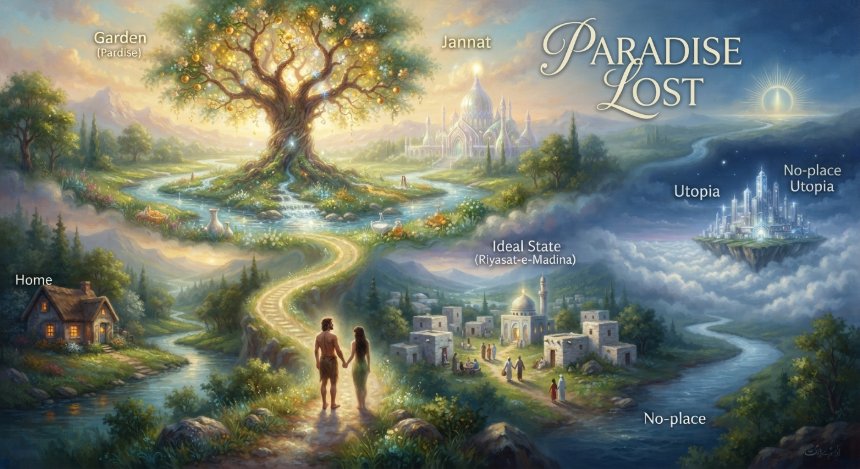
"A Night at The Dream Palace" is a fictional story exploring humanity's eternal search for a perfect sanctuary of peace, justice, and absolute contentment. It traces mankind's historical and spiritual journey from the pristine realms of Paradise and the model society of Riyasat-e-Madina to the elusive philosophies of Western Utopia. Through the symbolic contrast of the fly and the moth, the story critiques modern materialism and reflects deeply on the tragic socio-political decline of Pakistan. The story revolves through a close family discussing about a true dream home cannot be built on raw material greed, but on a collective system of divine devotion, moral integrity, and human equality.
أَعُوذُ بِاللّٰهِ مِنَ الشَّيْطَانِ الرَّجِيمِ
بِسۡمِ ٱللهِ ٱلرَّحۡمَـٰنِ ٱلرَّحِيمِ
اللہ کے نام سے شروع جو بڑا مہربان نہایت رحم کرنے والا ہے
In the name of ALLAH, the Most Gracious, the Most Merciful
The Dream Palace in the Land of Dreams
(Khwab Nagar Ka Khwab Mahal)
The "Dream Palace" (Khwab Mahal) in the town of Phool Nagar was brimming with life that evening. The siblings, sons, sons-in-law, daughters, daughters-in-law, maternal and paternal nephews, and nieces of Rana Mukarram Dad—most of whom belonged to Generation Z (Gen Z)—had gathered in their ancestral courtyard for the annual family dinner. The rich, aromatic scent of traditional dishes wafted from the spacious haveli kitchen, while small children played in one corner of the open courtyard as the elders engaged in deep conversation in another.
Rana Mukarram Dad had always been recognized as a profound lover of knowledge and a man of great refinement. Consequently, gatherings at his home seldom revolved around mundane gossip; instead, they naturally gravitated toward books, history, philosophy, and academia.
On this particular evening, as everyone sat together on the vast, carpeted floor of the open courtyard, expressing their diverse perspectives on modern technological progress, global material advancement, and the relentless economic race, Rana’s most beloved grandson suddenly turned to him. Holding a cutting-edge tablet in his hands, the youth looked up from the screen with an innocent yet highly inquisitive expression:
"Grandfather! Over the past few days, I have repeatedly come across this verse across the internet and social media, but its true depth eludes my understanding:
'If anyone understood my grievance, it was Rizwan (the gatekeeper of paradise) alone;
He recognized me as a human being exiled from Heaven.'
Grandfather, what does this truly mean? Could you please explain its context to me, what the poet is trying to convey, and how it relates to our lives today?"
Upon hearing this sudden and profound question, the ambient noise of worldly chatter in the courtyard instantly hushed. Every gaze locked onto the luminous, serene face of Rana Mukarram Dad, who smiled gently at his grandson's intellectual curiosity. Adjusting his spectacles, he turned toward his daughter, Neelum, who sat amidst a literal heap of books on the floor. Neelum was highly accomplished in Urdu literature and Iqbal studies. Addressing her with immense paternal affection, Rana said:
"My boy! Through the words of Allama Iqbal, you have inquired about the greatest ultimate truth of human existence. Hidden behind this single verse is the epic saga of that 'true home in the land of dreams' which humanity has been wandering for centuries to reclaim. I ask your Aunt Neelum to first explain the commentary of this verse, highlighting the context of the poem it belongs to. Yes, Neelum, my child! Please elaborate briefly."
Smiling, Aunt Neelum closed the diary she held and, finding everyone's rapt attention, began speaking in a refined, eloquent tone:
"Of course, father. My boy! This immortal verse is an integral part of Allama Iqbal's legendary and historic poem, 'Jawab-e-Shikwa' (The Answer to the Grievance), featured in his first masterpiece anthology, 'Bang-e-Dra' (The Call of the Marching Bell). The precise context of this poem unfolds when man cries out from the earth, lamenting his utter humiliation, historical decline, and helplessness. His voice was so saturated with raw pain that it echoed through the highest celestial realms.
Up in the heavens, the angels were astonished, wondering who this fragile creature of clay was, speaking with such staggering audacity and burning passion. It was at that moment that 'Rizwan'—the guardian of Paradise—spoke out. Since Rizwan observed the majestic celestial palaces and everlasting bounties of Heaven day in and day out, he alone could comprehend the profound grief and grievance of the human heart when man was being exiled from that sanctuary due to a primordial slip. Rizwan knew that this was no ordinary creature; this was a 'human being exiled from Heaven,' stripped of his first, most beautiful, and authentic dream home, destined to wander the earth forever in its longing."
Aunt Neelum looked toward her nephew's tablet, concluding her thoughts:--
"In simpler words, my boy, it implies that no matter how magnificent the mansions we build on this earth, the human soul remains fundamentally restless. In our deep subconscious, the memory of our first eternal home continuously aches, and every struggle we undertake on earth is merely a subconscious attempt to reclaim that lost Paradise."
Rana Mukarram Dad nodded approvingly, looking at his daughter with pride, and then turned his gaze back to his grandson:
"My boy! Neelum has shown you the coordinates of the home we left behind, but the question remains: according to divine scriptures (the Holy Qur'an and the Torah), what was that first home truly like, and what did mankind lose there? It was not made of worldly brick and stone, but constructed with bricks of gold, silver, rubies, and pearls, mortared with fragrant musk. In that realm, old age, sickness, exhaustion, and the terror of death did not exist. Rivers of pure water, delicious milk, and choice honey flowed beneath it, and above all, it provided the absolute tranquility of Divine Pleasure and Vision, after which no material desire could ever tempt the soul again.
If a reader reflects deeply, they will realize what humanity has lost and what it will regain upon its triumphant return: a life completely purified of malice, envy, falsehood, and vain talk. Every beautiful home we build on this earth is merely an imperfect, fleeting, and temporary imitation—a distant echo of that lost, immortal Paradise."
The Gen Z youth sitting in the courtyard, who had hitherto been entirely lost in the blinding glare of technology and materialism, fell completely silent upon hearing their grandfather’s words. A single, profound question was evident across their faces: If humanity once possessed such a magnificent and peaceful home, where did it lose its way upon arriving on earth?
Rana's younger brother, whom the children affectionately called 'Younger Grandfather,' slid slightly forward on the carpeted floor. Looking at the silent, pondering children with a stern yet deeply affectionate gaze, he spoke with a resonant voice:-
"My brother! You have spoken nothing but the absolute truth—a truth witnessed by every era of human history."
Turning toward the youths, he continued, "My dear children! Every divine scripture has recorded this story of mankind's first home and the subsequent wandering of his heart in the exact same manner. By the grace of Allah, we are Muslims, and we possess the Final Revelation, the Holy Qur'an, which chronicles this epic narrative in meticulous detail. However, this is not all; previous divine scriptures like the Torah and the Gospel also provide deep records of it, referring to it as the 'Garden of Eden.' All divine revelations are unanimous that this first home was not merely a physical location, but a state of the heart anchored in absolute obedience to the Creator. Man lived there without an ounce of anxiety, fear, or material labor. But then a slip occurred, an act of disobedience took place, and at that very instant, that serene home became alien to man, and he was sent down to earth."
Hearing this, one of Rana’s sons-in-law, who served as a professor of English literature, joined the conversation, adding:---
"Uncle has raised a flawless theological point. John Milton, the celebrated English poet, beautifully illustrated this divine truth in his epic masterpiece 'Paradise Lost', focusing fundamentally on 'Man's First Disobedience' to justify the ways of God to men, demonstrating how man alienated himself from his dream home through his own moral lapse."...
Now it was the turn of Rana’s eldest son, a man profoundly well-versed in history and Quranic narratives. Taking a sip of his warm tea, he advanced the intellectual thread:-
"Father and Uncle! You have both illustrated mankind's primordial loss beautifully. However, this trial of home, homeland, and wandering did not end with Adam; it has repeated itself as a cyclical warning throughout history. The most striking and tragic example recorded in the Holy Qur'an is that of the People of Moses (the Israelites). After being miraculously delivered from the tyrannical oppression and brutal slavery of Pharaoh, the nation of Moses genuinely longed for a distinct home, a peaceful homeland, and a sovereign state of their own. The Lord of the Universe promised to fulfill their desire, promising them a magnificent city of their choice—the Holy Land. Yet, when the time came to claim this promised home and Prophet Moses commanded them to march forward, the nation succumbed to cowardice, terrified of the powerful tyrants occupying the land."
Rana’s son shook his head with deep sigh, adding:--
"They displayed utter cowardice, telling their own Prophet, 'Go forth, you and your Lord, and fight! We are sitting right here.' What was the consequence? As a penalty for failing to answer the divine call to claim their dream home, destiny banned that city upon them for forty long years. They were condemned to wander aimlessly in the barren wilderness of the Tih Desert for an entire generation. Yet, the narrative does not end there. Decades later, when a new, honorable generation matured and finally conquered the city after immense sacrifices, the Divine chose to teach them absolute humility instead of allowing a proud material celebration. The command was: 'When you enter the gates of this city, do not march with chests puffed up in pride; enter with your heads bowed in prostration, crying out "Hittatun"—O Lord, we repent, we accept Your absolute servitude, forgive our transgressions!'"
Rana cast a deeply proud and approving look at his son for this profound historical insight. The Gen Z youths sitting in the courtyard were now realizing a fundamental truth: No city, society, or home can ever become a true cradle of peace unless its foundations are built on courage instead of cowardice, and absolute humility and repentance instead of material arrogance.
At this point, the grandson asked yet another curious question: "Grandfather, what was the home of the Jewish nation like then, and where is it now?"
Rana Mukarram Dad patted his grandson's head affectionately, a historical depth reflecting in his eyes:--
"My children! When Allah accepted their repentance and granted them success in the Holy Land, He showered them with unprecedented bounties. The Divine granted them not one, but two magnificent Prophets who were also grand kings—Prophet David and his son, Prophet Solomon. Under their reign, that city became the most glorious, powerful, and prosperous center of the ancient world. Prophet Solomon, commanding both jinns and men, constructed the sublime 'Temple of Solomon'—their most sacred, pure home, glittering with gold, silver, and precious gems. It was an empire where justice and divine blessings flourished. But alas, look at human folly! Upon reaching this zenith, the nation repeatedly turned to disobedience, rejected the guidance of the Prophets, abandoned absolute justice for oppression, and became utterly blinded by material greed.
The consequence? Divine retribution manifested: first Nebuchadnezzar and later the Romans systematically leveled their magnificent home and Temple to the ground, scattering the nation across the globe to wander for centuries. Today, they stand weeping before the material stones of the Wailing Wall, crying for their lost home, entirely forgetting that a true home is never preserved by physical walls, but by absolute devotion to God."
The young digital generation sat spellbound, realizing for the first time that even the highest peaks of material empire crumble like castles of sand when built on a foundation of moral defiance. It was then that Rana’s granddaughter, an eloquent student at a premier university, raised her hand:-----
"Grandfather, the Israelites lost their home through disobedience, but our Islamic history lectures teach us that Holy Prophet Muhammad (peace be upon him) established a magnificent 'State of Madinah' after migrating. Grandfather, what was that state like? How did it transform the dream of a perfect home into a living reality?"
Rana Mukarram Dad’s eyes welled with profound reverence at the blessed mention of the Final Messenger (pbuh). He looked at his granddaughter and spoke with deep resonance:---
"My dear child! You have spoken of the absolute zenith of human society—a perfect Land of Dreams manifested on earth by the Holy Prophet (pbuh). The State of Madinah was not merely a political government; it was an earthly alternative to Paradise itself, functioning entirely on the principles of brotherhood (Muwakhat), absolute justice, selflessness, sacrifice, and an equality that shattered all barriers of race, color, or lineage.
At its peak, this immaculate state did not measure its glory through material monuments, gold thrones, or lavish displays, but through the highest moral reformation of human character, unparalleled in global history:
• At its peak, wealthy individuals distributing charity (Zakat) roamed the streets, yet they could not find a single impoverished person or beggar eligible to accept it, because economic justice had enriched everyone.
• Such was its profound harmony that the wolf and the sheep would drink from the same waterhole; an absolute peace reigned, allowing a lone woman carrying gold to travel the vast distance from Sana'a to Hadramaut fearing nothing but God.
• Such was the absolute fear of God and rejection of imperial monarchy that the ruler of the state (Umar al-Faruq, may Allah be pleased with him) would personally carry sacks of flour on his back to the homes of poor widows at night, sleeping on a simple straw mat without ever letting anyone feel his majestic status."
Grandfather took a deep, emotionally charged breath:
"And my child, the greatest virtue, ultimate grandeur, and immortal validation of this dream state was that the Lord of the Universe did not wait for any worldly historian's testimony. Instead, He chose to bear witness in His eternal Book, the Holy Qur'an, engraving it for all of eternity: 'Radhi-Allahu 'Anhum Wa Radhu 'Anhu'—“Allah is well-pleased with them, and they are well-pleased with Him.” No material or political society in human history has ever been blessed with greater spiritual validation."
As Grandfather recited this eternal divine validation, a profound wave of spiritual awe swept across the courtyard. The university-going granddaughter sat inspired, absorbing the pure essence of that ideal society.
At that moment, Younger Grandfather, who had been sitting quietly with his head bowed, let out a deep, sorrowful sigh. The lines of historical grief deepened on his face. Looking at the youth, he spoke with a voice heavy with emotion:--
"My dear child! You have heard how pure and perfect the dream home of Madinah was. But now, listen to the grand tragedy of history that plunged humanity into an ابدی loss. What an immense failure that, due to human shortcomings, internal disputes, and material greed, this perfect and just state survived in its true political and collective form for only about twenty-seven years! After that brief period, it ceased to exist as a governance model and became purely a source of spiritual grace for mankind. How strange is man, who abandoned this 'paradise of servitude' earned through centuries of spiritual and intellectual devotion, only to chase the mirage of pseudo-material progress and imperial expansion. Man made a deeply devastating and losing bargain, dismantling his own beautifully constructed home."
Rana’s eldest son further unveiled this historical decline, adding with a bitter undertone:--
"The Islamic state became ensnared in the trap of dynastic monarchy and absolute kingship (Malookiat). First, the Umayyad dynasty seized power through raw force, laying the foundations of imperial kingship. This very obsession with dynastic power and material preservation birthed the most heart-wrenching tragedy in Islamic history—the Massacre of Karbala, where the grandson of the Prophet, Imam Hussain, and his devoted companions were brutally martyred for refusing to bow before an unjust monarchy. Yet, this palace of oppression could not endure, crumbling in less than a century to be buried in the dynastic graveyards of the Abbasids.
The Abbasid dynasty followed, but they too failed to resurrect the true dream home. Instead, they imposed a heavy stamp of absolute monarchical grandeur over Islam. Magnificent palaces were built, Baghdad became the global epicenter of wealth and intellectual debates, but the soul of raw devotion and the absolute justice of Madinah had completely vanished. Then came the terrifying judgment of history: in the year 1258, the savage Mongol hordes led by Hulagu Khan attacked Baghdad. They systematically wiped out the Abbasid monarchy, turning the streets of Baghdad red with blood, drowning libraries in the Tigris, and obliterating centuries of Islamic civilization.
My children! This was the turning point where Muslims, blinded by material indulgence, ceased to be the leaders of the world, losing that crown of guidance that once belonged to the people of Madinah."
A heavy silence enveloped the courtyard. The Gen Z children, usually captivated by digital devices, were realizing for the first time how the obsession with material empires can completely consume an entire civilization. Rana cast a comforting look at the somber faces, smiling gently as he spoke:---
"But my children! This world is merely a 'Testing Ground' (Dar-ul-Imtihan), and the eternal law of the Almighty in His Holy Word dictates that He continuously rotates historical days and fortunes among mankind. If there is a peak, there is a decline; if there is darkness, dawn will break. Islam was once the glorious crown of the East, but when the East fell into the traps of monarchy and luxury, deviating from its core purpose, the turn shifted to the Western world.
The West was not always as you see it today. Before their rise, they lived under the philosophical constraints of Greek civilization and the iron tyranny of the Roman Empire, later converting to Christianity through the Apostles of Jesus. For centuries, they fought the Crusades against Muslims, but throughout that prolonged period, they themselves were completely devoid of actual education, trapped in brutal poverty and ignorance. Western historians themselves call this epoch the Dark Ages, a time when a home of peace and security did not exist for the common man.
Then came a grand revolution in Western history, which they call the Renaissance—the rebirth of intellect. A genuine thirst for knowledge ignited within them. And where did they receive this knowledge? They obtained it from the brilliant universities of Muslim Spain (Andalusia), the grand libraries of Cordoba and Granada, and the Bayt-ul-Hikma (House of Wisdom) of Baghdad. They adopted, translated, and built upon the scientific and philosophical heritage of the Muslims, working tirelessly night and day to embark on the path of progress. Their poets, writers, and philosophers contributed immensely, and they emerged as the new leaders of the material world."
The professor son-in-law seized the moment to add:---
"Father! Since you have mentioned the Western Renaissance, it was during this very era that the Western world, despite its rising material power, began weeping for that very lost home of peace—manifested in Sir Thomas More and his Utopia!"
The professor adjusted his glasses and explained:-
"In 1516, Sir Thomas More published a book in Latin titled Utopia, a name that became so celebrated it founded an entirely new literary genre. In its literal Greek roots, Utopia means 'a place that does not exist anywhere' (No-place). In this book, More drew the blueprint of an imaginary, ideal island where private property did not exist, all citizens were equal, healthcare and education were completely free, and the entire system operated on perfect justice. The West at that time was being blinded by industrial and material growth, yet the inner peace of the common man was shattered, the chasm between the rich and the poor was widening, and a true 'home of peace' was missing. Thomas More was essentially protesting against this material heartlessness, weeping for a 'dream home' that humanity inherently craves. Yet, look at the profound irony: while Western intellectuals wept for an impossible fantasy, believing such a just society could never truly exist on earth, Islam had already manifested it as a historical and material reality centuries prior on the dust of Madinah!"
Rana nodded deeply, absorbing the contrast, and then gathered the youths even closer:--
"My dear children! The materialism that the professor highlighted is the exact spiritual disease plaguing modern man today. Modern man has become an absolute captive of materialism, and that is precisely why true peace and contentment are entirely missing from human life. In his blind pursuit of wealth, man has forgotten that the path to the true land of dreams lies in the purity of his aspirations, not in the rat race of physical survival. The Creator placed a profound metaphor in nature to illustrate this human degradation: the contrast between the fly and the moth. Now, listen closely to a parable that your uncle shared with me just today, which he heard from a great scholar:--
Once upon a time, the flies grew deeply dissatisfied with how humanity treated them—always associating the fly with filth, foul odor, and disease, while elevating the moth to a sublime symbol of love, light, and devotion. Seeking a higher status, a delegation of flies presented themselves before the Divine Court of the Creator. Their leader stepped forward, bowed humbly, and pleaded: 'O Lord of the Universe! You granted us wings, the power of flight, and the means of survival. Yet, we are completely deprived of the respect accorded to the moth, whom humans celebrate in poetry as a symbol of sacrifice. We beg You to grant us a status equal to the moth!'
The Creator heard their plea and decreed: 'Go forth, and like the moth, seek out the light. Observe every source of light across the earth, and return to report your findings.' The delegation of flies took flight, scattering across the globe. However, since their inherent nature was anchored in seeking filth, their gaze instinctively fell only upon garbage and decay. They returned to the Divine Court exhausted and deeply ashamed. The leader wept, imploring: 'O Lord! Strip away this innate attraction to filth from our nature, so that our task becomes easy and we too may become true lovers of light!'
The Creator showed mercy and altered their nature, ensuring that filth could no longer attract them. The flies joyously scattered across the earth once more. After an exhaustive journey, they returned to report that they had observed the light of knowledge and love in every corner, artificial illuminations in cities, and the brilliant stars and moon in the cosmos. But the leader confessed with tears: 'O Almighty! Despite the removal of our attraction to filth, we still had to return to the very same garbage and waste simply to survive and fill our bellies. We calculated that ninety percent of our time was spent sitting on waste just to feed ourselves, leaving a mere ten percent to seek out the light.'
The Creator smiled and asked a single question that struck the entire delegation dumb: 'You returned to the filth for your survival and came back alive... but tell Me, how many moths ever returned after finding the light?' The leader of the flies was stunned, replying in a trembling whisper: 'O Lord! Not a single one! Every moth that reached the light sacrificed itself upon the flame, burning to ashes; not one ever turned back alive.'
The Creator then declared: 'O flies! We created both of you as a lesson for our noblest creation, man. You, the flies, alert him to the presence of decay, warning him that a life dictated solely by stomach-worship is a degraded path. But We also show him the moth, which emerges from the darkness of the earth, seeks the light, reaches the flame, and annihilates its material self. The status of the moth is sublime because its aspiration is pure—it seeks the light and obliterates its existence in that pursuit. Your aspiration, however, remains base, restricted to survival and consumption. Through you, We teach man that a purely material pursuit of this world is nothing but a search for darkness and decay. As long as man's internal desire and capacity remain limited to stomach-worship, he will share your metaphorical fate. But My servants who seek the true light will sacrifice themselves, be immortalized, and be elevated.'
The grand law of the universe dictates that status is never granted based on mere wishes, but on the capacity of one's aspirations and the standard of their sacrifice. The tragedy of the modern era is that the vast majority of humanity—including the Muslim Ummah—has abandoned the path of the moth, despite possessing the perfect historical example of Madinah. They have joined the blind race of material prosperity, behaving like the fly, spending ninety percent of their energy on physical survival, pulling themselves away from the true lamp of devotion where the soul's peace and the true home reside."
At this juncture, Younger Grandfather spoke up with deep emotion: "My brother, now is the perfect moment to share the story of our own 'Dream Palace' with these children." Turning to the youths, he said:--
"My children, listen closely! This very haveli, in whose spacious courtyard you sit tonight enjoying aromatic food, was constructed nearly eighty-five years ago. Our grandfather personally participated with immense zeal in that historic All India Muslim League session at Minto Park, Lahore, where the Pakistan Resolution was passed. He returned with the Quaid’s vision and Iqbal’s dream burning bright in his heart. Settling here in Phool Nagar, he laid the foundation of this haveli, naming it 'Khwab Mahal' (The Dream Palace). He chose this name because he intended for this home to be an active part of the glorious construction and intellectual journey of our upcoming dreamland—Pakistan. He did not want a mere pile of material bricks, but a dwelling that reflected the values of Madinah. For this very purpose, he sent all his children to receive higher education at Aligarh Muslim University, ensuring we became custodians of both modern knowledge and Islamic values."
Younger Grandfather paused, smiling at his older brother: "Brother, we must share the magnificent tales of Aligarh and the sleepless nights dedicated to the Pakistan movement with them some day, shouldn't we?"
Rana Mukarram Dad smiled gently at the memory of his ancestors, nodding: "Yes, brother. We shall certainly share the Aligarh stories... but for now, our narrative rests upon the unfulfilled dream of Pakistan, for which this Dream Palace was built."
Grandfather's tone turned deeply solemn as he charted the modern history of the nation:
"Look, children! When the Mughal Empire weakened due to internal complacency and the Muslim leadership fell into a luxury-driven decay, the British colonizers seized this land, plunging Muslims into brutal persecution and subjugation. In that dark era, Muslims faced a critical choice: would they remain like the fly, content with the filth of captivity, or would they act like the moth, struggling for a pure, illuminated society?
Thus, when Allama Iqbal envisioned the dream and Quaid-e-Azam Muhammad Ali Jinnah raised the clarion call for Pakistan, the Muslims of the subcontinent transformed into true moths of the prophetic lamp. Defying all material calculus, they sacrificed their wealth, lives, and honor, standing resolute for the creation of a 'Second State of Madinah'—Pakistan. They severed the strings of raw materialism, sought the ultimate light, and through that pure passion of love, this nation was liberated. But..."
Grandfather looked toward the dimming lights of the haveli's chandelier, letting out a deep sigh:
"But my children, the moment the country was liberated and the Quaid passed away, we cast those pure aspirations aside. Over the past seven to eight decades, this dream state was turned into a laboratory for all kinds of artificial experiments, political opportunism, and moral decay. The nation was repeatedly led down corrupt and debased paths, bound to the lowliest pursuit of material survival under the guise of temporary worldly benefits. The consequence of this deviation was catastrophic: peace and contentment vanished, and poverty multiplied due to deep-rooted corruption and economic decline. This happened despite the Almighty's eternal promise in His Holy Word: If you obey Me and My Messenger, I shall grant you material prosperity and descend 'Sakina' (absolute peace and tranquility) upon your hearts. What a sorrowful failure that the caravan of Pakistan kept getting plundered, yet we refused to change our misguided worldly paths, leaving this pure land wandering in the darkness of retrograde progress."
The courtyard fell into absolute silence. Grandfather placed a hand on his grandson's head, his face radiating a serene spiritual warmth as he delivered his ultimate, immortal conclusion:--
"Therefore, my beloved children, this entire intellectual journey—stretching from the primordial Paradise to the streets of Madinah, Thomas More’s Utopia, the lesson of the fly and the moth, and our own Dream Palace—teaches us a single, eternal truth. What do we humans truly know? We falsely assume that our purpose is to turn this temporary, material world into our eternal heaven, completely forgetting that this life is merely a transient testing ground. We are not sent to build a paradise here, but to live life in such a way—and collectively construct a societal system based on absolute justice, equality, selflessness, and divine servitude—that humanity can co-exist in peace. When we live our lives by this standard, we can stand before the Divine Court on the Day of Judgment as the true, rightful claimants of His promised Heaven, and ultimately reclaim our authentic, immortal, and eternal Home in the Land of Dreams."
Grandfather paused for a brief moment, his voice carrying a resonant, moving passion as he left them with his final, living testament:
"My children! You must strive to transform your homeland, Pakistan, into a country of pure societies—a land inhabited by the true moths of the prophetic lamp, who live in mutual love, standing as an inspiring example of a beautiful life for one another."
As Grandfather's voice faded, the late hours of the night enveloped the haveli, but within the hearts of these Gen Z youth, a brilliant flame had been ignited. Far brighter than the digital screens of their tablets and phones, it was the enduring light of a collective resolve to protect their nation, elevate their society, and reclaim that eternal home whose true coordinates they had discovered tonight in the folds of this timeless realm.



Explore Creative Kitchen Cabinets Design Ideas for Your Home
A well-planned kitchen cabinets design can transform the appearance and functionality of y...
