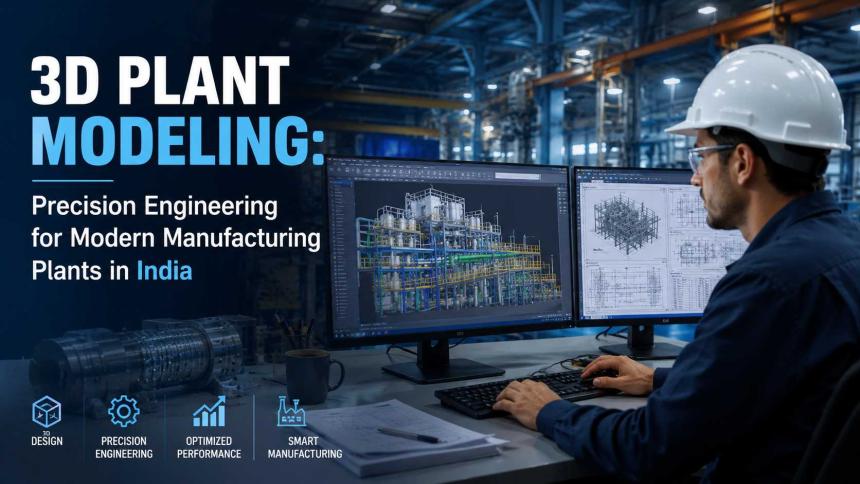

3D Plant Modeling: Precision Engineering for Modern Manufacturing Plants in India
How 3D plant modeling and clash detection help Indian manufacturers avoid costly field rework on new and existing plants.
Key takeaways
- Most costly clashes on a manufacturing plant, a pipe rack colliding with a structural beam, a duct routed through a cable tray, are cheaper to fix inside a 3D model than on site, sometimes by an order of magnitude.
- A 3D model built from an actual laser scan of an existing plant is a fundamentally different asset than one built from old drawings, since brownfield facilities rarely match their original design documents after years of modifications.
- Clash detection only works as well as the disciplines modeled together. A model that includes piping and structural steel but leaves out electrical trays and HVAC ductwork will miss exactly the clashes those systems create.
- 2D drawings show a plant from a fixed set of views. A 3D model lets every discipline, piping, structural, electrical, and process, check its own layout against every other discipline at once, before any of it gets built.
- For brownfield expansion or retrofit projects, an accurate as-built 3D model is often the difference between a tie-in that goes smoothly and one that gets discovered mid-construction to conflict with existing equipment.
- 3D modeling adds cost and time at the design stage. Its value shows up later, in reduced field rework, fewer change orders, and a shorter gap between design freeze and commissioning.
Introduction
A pipe rack that looks fine in a 2D drawing can turn out to run directly through a structural beam once it is actually installed. A duct routed on paper can conflict with a cable tray nobody thought to check against it. These are not rare mistakes. They are a routine consequence of designing a manufacturing plant across multiple 2D drawings that were never checked against each other in three dimensions.
3D plant modeling exists to catch these conflicts before construction, not during it. For a manufacturing plant in India, where EPCM projects often involve multiple contractors working from separate discipline drawings, that difference in when a clash gets caught can be the difference between a minor design revision and a costly field rework.
What 3D plant modeling actually involvesAt its core, 3D plant modeling is the process of building a single, coordinated digital model of a manufacturing facility, its piping, structural steel, equipment, electrical systems, and instrumentation, so that every discipline's layout can be checked against every other discipline's layout in one place.
- Greenfield design modeling: For a new plant, the model is built directly from process design, converting P&ID data and equipment specifications into a coordinated 3D layout before any steel is fabricated or any pipe is ordered.
- As-built modeling from reality capture: For an existing plant, laser scanning captures the facility as it actually exists today, point by point, which is a fundamentally different starting point than working from decades-old design drawings that no longer reflect years of field modifications.
- Process and flow simulation: Beyond static geometry, some 3D models incorporate process flow and equipment behavior, useful for evaluating how a proposed layout change affects throughput or bottlenecks before it is built.
A 2D drawing shows one discipline's layout from a fixed set of views. It does not, by itself, show whether that layout conflicts with another discipline's layout at the same location, because that comparison happens in three dimensions, not two.
This is where clash detection becomes valuable. A 3D model that includes piping, structural steel, electrical trays, and HVAC ductwork together lets every one of these systems be checked against the others automatically. A model that leaves any of these disciplines out will simply miss the clashes that discipline would have created, which is why the value of a 3D model depends heavily on how many disciplines are actually modeled together, not just on the fact that a 3D model exists.
Where 3D modeling matters most in Indian manufacturing- Brownfield expansion and retrofit: Most operating plants have drifted from their original design drawings after years of field modifications, added equipment, and rerouted piping. An accurate as-built 3D model, built from a current laser scan, is often the only reliable basis for planning a tie-in or expansion without discovering a conflict mid-construction.
- Multi-contractor EPCM projects: When piping, structural, and electrical work is split across different contractors, a shared 3D model gives every party a common reference to design against, rather than each working from separate 2D drawings that only get reconciled on site.
- Regulatory and safety walkthroughs: A coordinated 3D model makes it easier to verify clearances, escape routes, and equipment access before construction, rather than relying on a physical walkthrough after the fact to catch a clearance issue.
- Plant relocation and equipment reuse: When equipment is being moved or reused from one facility to another, a 3D model helps confirm dimensional fit before the physical move, rather than after equipment has already been transported.
Get Expert 3D modeling Support: https://www.imarcengineering.com/contact?service=3d-modelling-and-simulation
The 3D plant modeling process- Data capture: For an existing plant, laser scanning or photogrammetry captures the facility as it currently stands. For a new plant, the process starts from process design data and equipment specifications instead.
- Model development by discipline: Piping, structural steel, equipment, electrical, and instrumentation are modeled as coordinated layers within a shared model, rather than as separate, disconnected drawings.
- Clash detection and review: The combined model is checked systematically for conflicts between disciplines, and each flagged clash is reviewed and resolved before it becomes a field issue.
- Design validation and sign-off: Stakeholders across disciplines review the coordinated model against project requirements before it is finalized for construction or fabrication.
- Handover for construction and maintenance: The finished model serves as a reference not just for construction, but for future maintenance planning, since it accurately reflects the as-built condition of the plant going forward.
- Modeling only the disciplines seen as high-risk, such as piping, while leaving out electrical trays or HVAC ductwork, which simply moves the missed clashes to a different system rather than eliminating them.
- Relying on outdated design drawings for a brownfield model instead of a current laser scan, which reintroduces the exact gap between drawings and reality that the model was meant to close.
- Treating the 3D model as a one-time deliverable for construction rather than an updated reference for future maintenance and expansion planning.
- Bringing in 3D modeling only after a design dispute or field clash has already occurred, rather than at the point where it could have prevented that clash in the first place.
Building a coordinated, multi-discipline 3D model, particularly one based on an accurate laser scan of an existing facility, needs specific tools and expertise that most manufacturers do not maintain in-house, since it is not a routine, ongoing activity for a production team focused on running a plant rather than designing one.
IMARC Engineering's 3D Modeling and Simulation service covers both greenfield design modeling and as-built modeling for existing facilities, combining multi-discipline coordination with clash detection before a design is finalized for construction.
Final thoughts3D plant modeling adds time and cost at the design stage that a purely 2D process would not. The return on that investment shows up later, in the clashes that never reach the construction site, the tie-ins that go as planned during a brownfield expansion, and the change orders that never get issued because the conflict was caught in the model instead.
For manufacturing plants in India, where EPCM projects frequently involve several contractors working from separate drawings, a coordinated 3D model is less about producing a polished visual and more about giving every discipline a shared, accurate reference to design against.
Frequently Asked Questions
What is 3D plant modeling?
It is the process of building a coordinated digital model of a manufacturing facility's piping, structural, equipment, electrical, and instrumentation systems, so that every discipline's layout can be checked against every other discipline's layout before construction.
What is the difference between greenfield and as-built 3D modeling?
Greenfield modeling is built from process design data for a new plant, while as-built modeling is built from a laser scan of an existing facility, which is necessary because operating plants typically drift from their original design drawings over time.
Why is clash detection important in plant design?
Clash detection identifies conflicts between disciplines, such as piping colliding with structural steel or ductwork conflicting with cable trays, while the design can still be revised on screen rather than after installation on site.
Is 3D modeling only useful for new plants?
No. It is often more valuable for brownfield expansion and retrofit projects, where an accurate as-built model is frequently the only reliable basis for planning a tie-in without discovering a conflict mid-construction.
How does 3D modeling help with multi-contractor EPCM projects?
It gives every contractor, across piping, structural, and electrical disciplines, a shared reference to design against, rather than each working from separate 2D drawings that only get reconciled once work begins on site.
What happens if only some disciplines are modeled?
Clashes involving the disciplines left out of the model will not be caught. The value of a 3D model depends on how many systems are modeled together, not simply on the existence of a 3D model.
Modern Biomass Station Upgrades for Reliable Power Generation
Modern Biomass Station Upgrades for Reliable Power Generation

Dish Network Installers Near Me: Professional Satellite Dish Installat...