
3D Anamorphic: The Ultimate Guide to Immersive Visual Experiences
Discover what 3D Anamorphic visuals are, how they work, their benefits, applications, and why brands are using anamorphic 3D displays to create unforgettable immersive experiences.
3D Anamorphic Visuals: Complete Guide to Immersive Advertising & Displays
Introduction to 3D Anamorphic TechnologyIn today’s highly competitive digital landscape, capturing attention is more challenging than ever. Traditional visuals are no longer enough to stand out in crowded urban spaces or digital platforms. This is where 3D Anamorphic visuals are redefining how brands communicate with audiences.
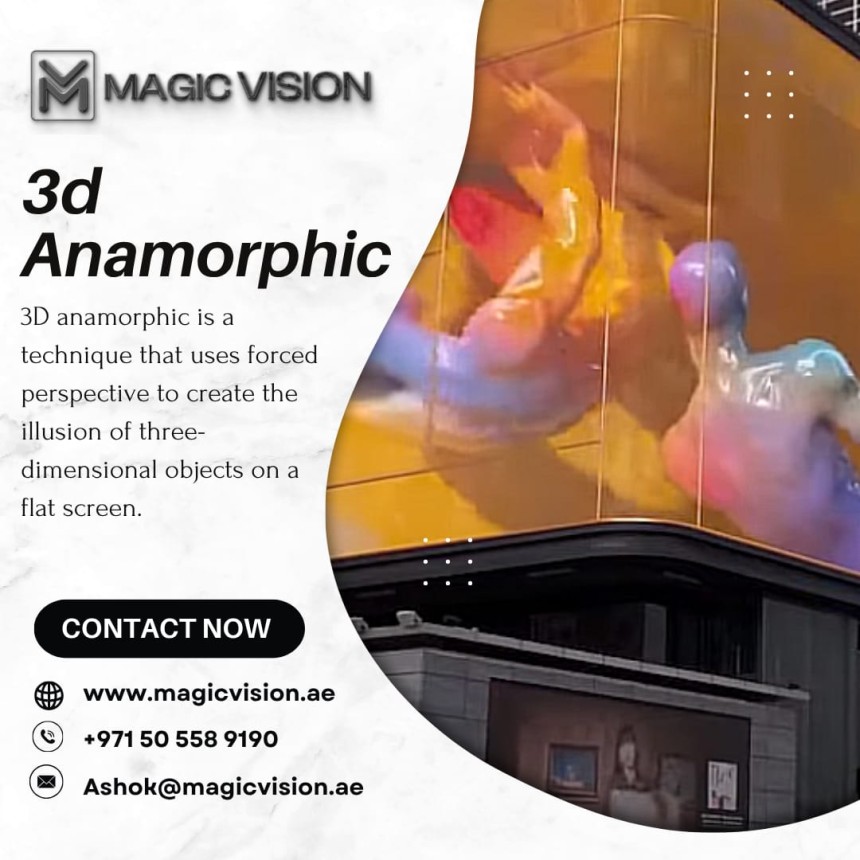
3D Anamorphic is an advanced visual technique that creates the illusion of three-dimensional depth on flat LED screens, allowing content to appear as though it is emerging from or receding into the display—without requiring special glasses. These visuals have become especially popular in outdoor advertising, digital billboards, shopping malls, and landmark installations.
3D Anamorphic is a visual illusion technique that uses perspective, camera angles, and specialized content design to create realistic three-dimensional effects on two-dimensional screens. The illusion works when viewed from a specific vantage point, making objects appear lifelike and immersive.
Unlike conventional 3D technologies that require glasses or headsets, 3D Anamorphic visuals are visible to the naked eye, making them accessible and impactful for public environments.
Key Characteristics of 3D Anamorphic- Glasses-free 3D viewing
- Works on flat LED or LCD screens
- Highly realistic depth and motion effects
- Designed for specific viewing angles
- Ideal for large-scale installations
3D Anamorphic visuals rely on forced perspective and precise content alignment with the physical structure of the screen.
Core Elements InvolvedContent is created using advanced 3D modeling software to align with the viewer’s point of view. The illusion is optimized for one primary angle, often called the “sweet spot.”
2. Screen GeometryCorner LED screens or L-shaped displays enhance the depth illusion, making visuals appear to extend beyond the screen’s boundaries.
3. Content RenderingHigh-resolution 3D assets are rendered with accurate lighting, shadows, and motion to reinforce realism.
4. Viewing DistanceThe illusion is strongest when the viewer is positioned at the correct distance and angle relative to the screen.
Feature 3D Anamorphic Traditional 3D Glasses Required No Yes Viewing Freedom Public-friendly Limited Equipment LED screens Special displays Engagement Level Very high Moderate Ideal Use Advertising, branding Movies, gaming
3D Anamorphic excels in public and commercial environments where ease of access and visual impact are critical.
3D Anamorphic visuals instantly grab attention. Moving objects that appear to jump out of the screen naturally draw crowds and increase dwell time.
2. Higher Brand RecallStudies show immersive visuals significantly improve brand memorability compared to static or standard video ads.
3. No Special Equipment RequiredViewers experience the effect naturally, making it ideal for outdoor and high-traffic locations.
4. Premium Brand PerceptionBrands using anamorphic 3D are often perceived as innovative, modern, and technologically advanced.
5. Social Media AmplificationSpectacular 3D visuals are frequently recorded and shared on social platforms, increasing organic reach and engagement.
Large-scale LED billboards in city centers are the most common use case. These installations transform urban advertising into immersive experiences.
2. Retail & Shopping MallsBrands use anamorphic visuals to showcase products in 3D, allowing customers to experience items virtually before purchase.
3. Corporate BrandingCorporate headquarters and exhibition booths use 3D Anamorphic displays to communicate innovation and leadership.
4. Events & ExhibitionsTrade shows, product launches, and expos leverage anamorphic visuals to stand out among competitors.
5. Entertainment & Public ArtMuseums, theme parks, and public installations use this technology to create interactive and memorable experiences.
- Automotive
- Consumer Electronics
- Fashion & Luxury
- Real Estate
- Gaming & Entertainment
- Tourism & Hospitality
- FMCG Brands
Each industry benefits from the ability to showcase products or concepts in a visually compelling, three-dimensional format.
Creating effective anamorphic visuals requires a combination of creative and technical expertise.
Key Steps in the Process- Concept Development – Define the story or message.
- 3D Modeling & Animation – Create realistic assets.
- Perspective Calibration – Match content to screen geometry.
- Rendering & Testing – Ensure smooth playback and visual accuracy.
- Final Deployment – Optimize for brightness, contrast, and resolution.
High-quality content is critical; poorly executed visuals can break the illusion and reduce impact.
- High-resolution LED screens (preferably 4K or higher)
- Corner or curved screen setups
- High brightness for outdoor visibility
- Media players capable of handling heavy 3D files
- Precise installation and calibration
While powerful, 3D Anamorphic technology has some limitations:
- Optimal viewing from specific angles
- Higher production costs compared to standard video
- Requires specialized creative expertise
- Less effective on small or low-resolution screens
Despite these challenges, the return on engagement often outweighs the investment.
The future of 3D Anamorphic visuals is promising. As LED technology advances and content creation tools improve, anamorphic displays are expected to become more accessible and widespread.
Emerging Trends- AI-driven 3D content creation
- Interactive anamorphic visuals
- Integration with AR and XR
- More flexible screen geometries
- Increased use in smart cities
Brands that adopt this technology early will have a strong competitive advantage.
- Choose high-traffic, high-visibility locations
- Design content specifically for the screen geometry
- Keep animations smooth and realistic
- Avoid overcrowding visuals
- Test from multiple distances and angles
3D Anamorphic is primarily used for immersive advertising, branding, exhibitions, and public installations to create eye-catching visual experiences.
Do you need glasses to view 3D Anamorphic?No, 3D Anamorphic visuals are visible to the naked eye and do not require any special equipment.
Is 3D Anamorphic expensive?Costs can be higher than traditional video due to specialized content creation and display requirements, but the engagement value is significantly higher.
Can 3D Anamorphic work indoors?Yes, it works well in shopping malls, airports, exhibition halls, and retail environments.
What type of screen is best for 3D Anamorphic?High-resolution LED screens, especially corner or curved displays, provide the best results.
3D Anamorphic visuals are transforming the way brands communicate in physical and digital spaces. By combining cutting-edge technology with creative storytelling, this approach delivers unforgettable experiences that capture attention, enhance brand perception, and drive engagement.
Maxentra Review: Benefits, Ingredients & How It Works
What Is Maxentra Male Enhancement? Maxentra Male Enhancement is a dietary supplement desi...
Open House Without Borders: How Virtual Tours Are Expanding the Proper...
Solvarex Review: Is It Worth Trying? Pricing, Results & Where to Buy
What Is Solvarex? Solvarex is a dietary supplement designed to support general wellness,...
Vigortrix Review: Is It Worth Trying? Results, Pricing & Where to Buy
What Is Vigortrix? Vigortrix is a men's vitality dietary supplement designed to support e...