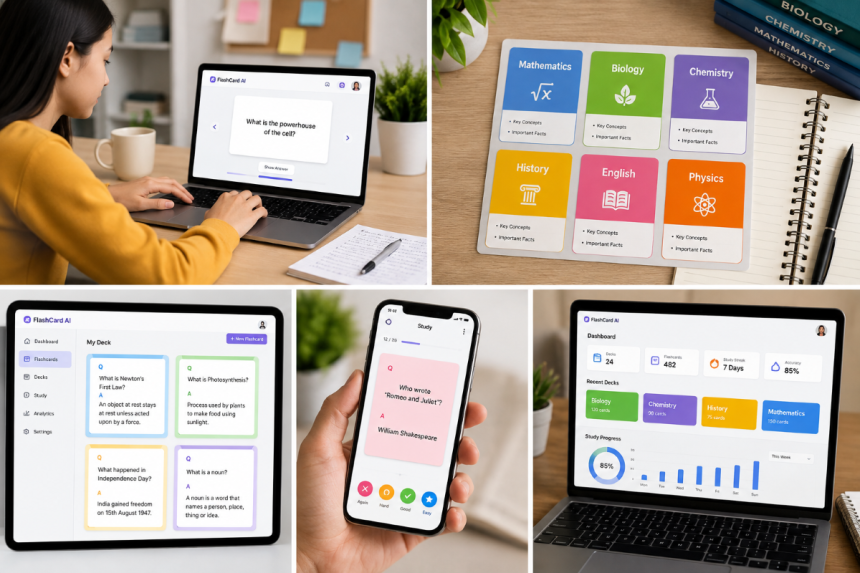

10 Powerful Benefits of Color Flashcards for Smarter Learning
Discover 10 powerful benefits of color flashcards and learn how they can organize study material, support active recall, and make learning more engaging with FlashCard AI.
Introduction
Learning can become easier when information is presented in a simple and visual way. Students often need to remember vocabulary, definitions, formulas, facts, names, and other important information. Traditional notes can be useful, but visual learning tools can make revision more interesting and easier to organize.
Color flashcards are learning cards that use different colors to highlight information, organize topics, and make important details easier to notice. They can be used by students, teachers, parents, and anyone who wants a more engaging way to study. With tools such as FlashCard AI, learners can also create digital cards and organize study material more efficiently.
What Are Color Flashcards?
Color flashcards are cards that combine short learning content with visual color cues. A card may contain a question on the front and an answer on the back, while colors are used to identify topics, categories, or levels of importance.
For example:
- Blue cards can represent vocabulary.
- Green cards can represent definitions.
- Yellow cards can highlight important facts.
- Red cards can identify difficult concepts.
- Purple cards can represent formulas or key terms.
The color system is flexible. Learners can create their own system based on the subject and study goals.
Digital platforms such as FlashCard AI can make it easier to organize and review these cards without needing to create every card manually.
10 Powerful Benefits of Color Flashcards1. Make Learning More Visual
One of the main advantages of color flashcards is their visual design.
Color can help separate information into clear groups. Instead of seeing a large block of text, students can quickly identify different sections based on color.
For example, a biology student might use one color for body systems, another for vocabulary, and another for important processes.
This can make study material easier to scan during revision.
2. Improve Study Organization
Large amounts of information can become confusing when everything looks the same.
Colors can provide a simple organization system. Students can assign different colors to different subjects, chapters, or types of information.
A student studying several subjects could use:
- Blue for mathematics
- Green for biology
- Orange for chemistry
- Purple for history
This approach can make a large collection of study flashcards easier to manage.
3. Help Highlight Important Information
Not every piece of information has the same level of importance.
Color can help learners identify information that needs extra attention. A student may use a bright color for concepts they frequently forget and another color for information they already understand.
This makes revision more focused.
Instead of reviewing every card in exactly the same way, learners can quickly identify areas that need more practice.
4. Make Revision More Engaging
Studying the same notes repeatedly can feel boring.
Colorful cards can add visual variety to a study session. This can make reviewing information feel more active and engaging.
Students can also experiment with different layouts, colors, icons, and short explanations to create cards that match their learning style.
The goal is not to use as many colors as possible. A simple and consistent color system is usually easier to understand.
5. Support Active Recall
Flashcards are commonly used for active recall, a learning technique where students try to remember information before looking at the answer.
For example:
Front: What is photosynthesis?
The student tries to answer from memory before turning the card over.
Back: Photosynthesis is the process by which plants use light energy to make food.
Color can help organize these questions without changing the basic active-recall process.
6. Make Difficult Topics Easier to Review
Some subjects contain complex concepts that require repeated practice.
Color-coded cards can separate difficult topics from easier ones. Students can assign a specific color to concepts that need additional review.
For example:
- Green = already understood
- Yellow = needs some review
- Red = difficult
Students can then focus their study time on red cards before moving to easier material.
7. Help With Vocabulary Learning
Language learners can use colorful cards to organize vocabulary.
A card might include:
Front: “Efficient”
Back: “Working well without wasting time or resources.”
Students could use different colors for nouns, verbs, adjectives, and phrases.
This can make vocabulary practice more organized and easier to navigate.
8. Useful for Different Subjects
Color flashcards are not limited to language learning. They can be adapted to many subjects.
Mathematics
Use cards for formulas, equations, definitions, and problem-solving steps.
Science
Create cards for scientific terms, processes, classifications, and important facts.
History
Use cards for dates, people, events, and historical concepts.
Languages
Create vocabulary, grammar, translation, and pronunciation cards.
Professional Learning
Use cards to review terminology, procedures, concepts, and important information.
The same basic flashcard method can be adapted to almost any topic.
9. Make Digital Studying More Flexible
Technology has made it easier to create and review study material from different devices.
Instead of carrying physical cards, learners can use digital flashcards on a computer, tablet, or smartphone.
Tools that allow users to create flashcards online can save time and make it easier to update cards when study material changes.
FlashCard AI can be used as part of a digital learning workflow to help learners create and organize flashcard-based study material.
10. Save Time During Study Preparation
Creating study materials manually can take a lot of time, especially when students have large chapters to review.
Digital flashcard tools can simplify the process by helping users organize questions and answers more efficiently.
AI-powered tools can also assist with generating draft flashcards from study material. Students should still review the generated information for accuracy before using it for important exams.
The result is a study process that can focus more on reviewing information and less on formatting cards.
How to Create Effective Color Flashcards
Creating useful flashcards is more important than simply making them colorful.
Follow these simple steps:
1. Choose One Topic
Start with a specific subject or chapter rather than putting everything into one deck.
2. Keep Questions Short
Write clear questions that test one idea at a time.
3. Use Simple Answers
Keep the answer focused on the information the learner needs to remember.
4. Create a Color System
Choose a few colors and give each one a clear purpose.
5. Add Visual Elements Carefully
Images, symbols, and simple diagrams can be useful when they support the topic.
6. Review Regularly
Use your cards repeatedly instead of creating them and never reviewing them.
7. Update Difficult Cards
If a card is confusing, rewrite it using simpler language.
Frequently Asked QuestionsWhat are color flashcards?
Color flashcards are study cards that use colors to organize, categorize, or highlight learning information.
Are color flashcards effective for studying?
They can be useful because they combine flashcard-based active recall with visual organization. Their effectiveness depends on how consistently and correctly they are used.
Can I create color flashcards online?
Yes. Digital flashcard platforms allow learners to create, organize, edit, and review cards online.
What colors should I use for flashcards?
There is no single correct color system. Choose a few colors and give each color a specific meaning, such as topic, difficulty, or information type.
Can color flashcards be used for different subjects?
Yes. They can be used for mathematics, science, history, languages, professional learning, and many other subjects.
Can I use FlashCard AI to create study flashcards?
FlashCard AI can support digital flashcard creation and organization, helping learners prepare study material more efficiently.
Should every flashcard have multiple colors?
No. Using too many colors can make cards confusing. A small, consistent color system is usually easier to follow.
Can color flashcards replace traditional studying?
No. Flashcards are one study method. They work best when combined with understanding, practice, reading, problem-solving, and other suitable learning techniques.
Conclusion
Color flashcards provide a simple way to make study material more visual and organized. By using colors to separate subjects, highlight difficult concepts, and identify different types of information, learners can create a study system that is easier to navigate.
They can be useful for vocabulary, science, mathematics, history, languages, and many other subjects. Digital tools also make it easier to create flashcards online, edit study material, and access cards from different devices.
FlashCard AI can support learners who want a more convenient digital approach to creating and organizing flashcard-based study materials. Whether you prefer physical or digital cards, the most important factor is how you use them. Keep cards clear, practice active recall, review regularly, and use colors as a helpful learning aid rather than a distraction.
For more detail visit:https://phat4life.mn.co/posts/powerful-benefits-of-ai-flashcard-generator-for-smart-learning