
أَعُوذُ بِاللّٰهِ مِنَ الشَّيْطَانِ الرَّجِيمِ
بِسۡمِ ٱللهِ ٱلرَّحۡمَـٰنِ ٱلرَّحِيمِ
In the name of ALLAH, the Most Gracious, the Most Merciful
The Hoax of Liberal Left In Muslim Countries
Across many Muslim-majority nations, the phrase "the hoax of the liberal left" has emerged as a pointed critique of secular, progressive, and self-described leftist movements. Rather than questioning the universal value of human dignity or social justice, this critique exposes a profound contradiction between the stated ideals of these elites and their actual political behavior. When examined through the lens of post-Cold War geopolitics, institutional co-optation, and class dynamics, the disillusionment with the liberal left in countries like Pakistan and across the Middle East reveals a movement that has largely abandoned its foundational principles.
The Betrayal of Anti-Imperialism After the Berlin Wall
Historically, the intellectual backbone of the genuine left in the Global South—shaped by thinkers like Eqbal Ahmad, Edward Said, and Noam Chomsky—was rooted in fierce anti-imperialism and solidarity with oppressed peoples. Yet, in the decades following the fall of the Berlin Wall and the rise of a unipolar world order, a troubling shift occurred among the self-proclaimed liberal intelligentsia.
Instead of resisting unbridled foreign intervention, many adopted "nuanced" geopolitical takes that effectively manufactured consent for Western military campaigns, drone strikes, and imperial interventions. By framing foreign bombings as a "necessary" tool against extremism, or drawing false equivalences between local populations and global superpowers, this faction betrayed the most basic tenet of leftist thought: standing against the slaughter of one's own people by foreign empires.
The NGO-Industrial Complex and Compromised Media
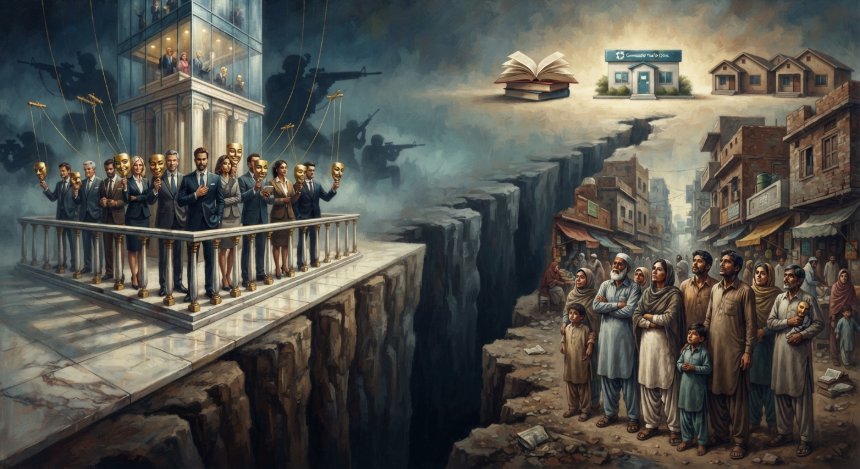
A major driver of this ideological hollowing-out has been the rise of the foreign-funded "civil society" apparatus. In nations like Pakistan, organizations backed by entities such as USAID and the National Endowment for Democracy (NED) reshaped the progressive landscape. Idealistic young writers and activists who entered these spaces hoping to document social injustices and halt war often discovered an ecosystem designed not for grassroots liberation, but for absorbing foreign grants and aligning domestic narratives with Western geopolitical interests.
Simultaneously, mainstream English-language media—long seen as a bastion of progressive thought—frequently enforced strict ideological gatekeeping. Dissenting voices that challenged the consensus of prominent liberal columnists or exposed their eventual alignment with domestic military establishments were swiftly sidelined or banned. What presented itself as an independent fourth estate often functioned as an echo chamber protecting entrenched institutional power.
The Paradox of Authoritarian Liberalism
This domestic alignment highlights another core contradiction: the willingness of self-proclaimed liberals to abandon democratic principles when the electorate chooses populist, conservative, or religious representation. Whether in the Middle East or South Asia, segments of the liberal elite have repeatedly made peace with military establishments and autocratic crackdowns to keep political rivals out of power.
By adopting a posture of "neither the populist leader nor the establishment" during moments of acute authoritarian repression—or actively cheering on state censorship—these elites undermine their own claims to championing constitutional democracy. To ordinary citizens, a liberalism that only defends free speech and electoral integrity when its own faction benefits is merely an ideological cover for elite privilege.
Lifestyle Liberalism Over Working-Class Solidarity
Beneath these political compromises lies a deep socio-economic and cultural divide. While genuine leftist movements historically grew out of labor unions and working-class struggles, the modern "liberal left" in many Muslim societies is heavily concentrated within affluent, Westernized enclaves.
For many within this stratum, progressivism has been reduced to superficial lifestyle markers—an insular culture of exclusivity, privilege, and social indulgence entirely detached from the material hardships of the working poor. By prioritizing cultural aesthetics over economic justice and refusing to engage respectfully with the lived faith and traditions of the broader public, this elite alienates the very people it claims to represent.
A Brief Historical Overview of Liberal Left In Pakistan
Before 1947, the leftist movement in colonial India-Pakistan included a mix of communists, socialists, and radical nationalists who combined the struggle for independence with class struggle and social reform. Historians generally recognize the following five figures as among the most prominent leaders of that era:
• M. N. Roy (Manabendra Nath Roy): A foundational figure in Indian communism, Roy co-founded both the Mexican Communist Party and the émigré Communist Party of India in Tashkent in 1920. He later broke with orthodox Marxism-Leninism to develop the philosophy of "Radical Humanism."
• Bhagat Singh: One of the most iconic revolutionaries of the independence movement, Singh was a committed socialist and atheist who co-founded the Hindustan Socialist Republican Association (HSRA). Before his execution in 1931 at age 23, his writings articulated a vision of a classless, socialist India free from both British imperialism and domestic capitalism.
• Subhas Chandra Bose: Although primarily known as a militant nationalist and leader of the Indian National Army (INA), Bose was a prominent voice of the left wing within the Indian National Congress. As Congress President in 1938 and 1939, he championed rapid industrialization, state-led economic planning, and socialist policies, later forming the All India Forward Bloc to consolidate the leftist forces.
• Jayaprakash Narayan (JP): A key architect of democratic socialism in India, Narayan was educated in the United States where he was influenced by Marxism. In 1934, he co-founded the Congress Socialist Party (CSP) alongside figures like Acharya Narendra Deva and Ram Manohar Lohia, playing a major role in mobilizing workers and peasants during the 1942 Quit India Movement.
• S. A. Dange (Shripad Amrit Dange): A pioneering trade unionist and founding member of the Communist Party of India (CPI), Dange was instrumental in organizing the industrial working class in Bombay (now Mumbai) during the 1920s. He authored the influential early Marxist pamphlet Gandhi vs. Lenin (1921) and was imprisoned by British authorities in major conspiracy cases, including the Kanpur and Meerut Conspiracy Cases.
Several Muslim intellectuals, poets, and organizers played foundational roles in the communist, socialist, and progressive movements in colonial India prior to 1947. Historians widely recognize the following three figures as among the most prominent:
• Muzaffar Ahmad: One of the foundational pillars of the Indian communist movement, Ahmad co-founded the Communist Party of India (CPI) in the 1920s and was a central figure in organizing workers and peasants in Bengal. Alongside poet Kazi Nazrul Islam, he edited pioneering left-wing publications like Langal (The Plough) and Ganavani, and was imprisoned by the British in both the Kanpur (1924) and Meerut (1929) Conspiracy Cases.
• Hasrat Mohani: A celebrated Urdu poet, journalist, and radical nationalist, Mohani was a towering figure in early Indian leftism and one of the founding members of the CPI at its 1925 Kanpur conference. He famously coined the revolutionary slogan "Inquilab Zindabad" (Long Live the Revolution) in 1921 and was the first activist in Indian history to demand complete independence (Purna Swaraj) at the Ahmedabad session of the Indian National Congress that same year.
• Sajjad Zaheer: A leading Marxist intellectual, writer, and communist organizer, Zaheer was a primary architect of the Progressive Writers' Movement, co-founding the All-India Progressive Writers' Association (PWA) in 1936 with Munshi Premchand. He used literature and cultural activism to advance anti-imperialist and socialist ideals across undivided India, and later became the first General Secretary of the Communist Party of Pakistan following the 1947 Partition.
In post-1947 West Pakistan, leftist leaders frequently faced state bans, censorship, and imprisonment while advocating for democratic rights, provincial autonomy, and socialist reforms. Replacing Maulana Bhashani with a major figure from West Pakistan, historians generally recognize the following three individuals as among the most prominent leftists of that era:-
• Faiz Ahmad Faiz: One of the most celebrated Urdu poets of the 20th century, Faiz was also a prominent Marxist intellectual, journalist, and trade union leader based in Lahore. He served as the editor of The Pakistan Times and was Vice President of the Pakistan Trade Union Federation. Because of his leftist activism, he was imprisoned in 1951 during the Rawalpindi Conspiracy Case and spent years in prison or exile while continuing to write influential political poetry.
• Mian Iftikharuddin: A prominent progressive politician, publisher, and socialist from Punjab, Iftikharuddin was a central voice of the left in West Pakistan's early parliament. He founded Progressive Papers Limited (PPL), which published influential left-leaning newspapers like The Pakistan Times and Imroze, and later co-founded the Azad Pakistan Party in 1950 before merging it into the National Awami Party (NAP) to oppose feudalism and military alliances with the West.
• Hyder Bux Jatoi: Often referred to as Baba-e-Sindh (Father of Sindh), Jatoi resigned from his civil service post in 1945 to dedicate his life to organizing landless peasants (haris) in Sindh. As the longtime president of the Sindh Hari Committee after 1947, he campaigned relentlessly for the abolition of feudalism (zamindari), equitable water distribution, and tenant farmers' rights, facing repeated imprisonment by the state for his activism.
Following the fall of the Berlin Wall in 1989 and the collapse of the Soviet Union in 1991, the leftist movement in Pakistan experienced a severe ideological crisis, organizational fragmentation, and a shift from revolutionary politics toward civil society and NGOs. Already weakened by a decade of state repression, media censorship, and bans on student unions under General Zia-ul-Haq (1977–1988), Pakistan’s left entered the post-Cold War era facing profound structural shifts:-
1. Ideological Disillusionment and Party Fragmentation
• Loss of External Backing and Models: The dissolution of the USSR eliminated the primary ideological and material reference point for pro-Soviet parties like the Communist Party of Pakistan (CPP). Many cadres became disillusioned with orthodox Marxism-Leninism, viewing socialist revolution as no longer viable.
• Splintering of Factions: Existing socialist and communist groups broke into small, competing factions—such as the Communist Mazdoor Kissan Party (CMKP) and Labour Party Pakistan (LPP)—leaving the left with negligible parliamentary representation.
2. The "NGO-ization" of the Left
• Shift to Civil Society: With traditional trade unions and student wings decimated, thousands of former leftist activists, intellectuals, and organizers transitioned into non-governmental organizations (NGOs), human rights commissions, and development sector roles funded by Western donors.
• Issue-Based Advocacy: Rather than organizing around class struggle or anti-capitalist revolution, progressive activism largely pivoted toward single-issue advocacy—focusing on women’s rights, minority protections, legal aid, and democratic governance. Critics within the left often termed this "NGO-ization," arguing it depoliticized grassroots working-class mobilization.
3. Mainstream Shift Toward Neoliberalism
• Transformation of the PPP: The Pakistan Peoples Party (PPP), which had originally channeled socialist rhetoric ("Roti, Kapra, aur Makan") in the 1970s, abandoned its socialist platform under Benazir Bhutto in the 1990s. Both the PPP and the center-right Pakistan Muslim League-Nawaz (PML-N) embraced privatization, deregulation, and International Monetary Fund (IMF) structural adjustment programs, leaving working-class voters without a mainstream leftist alternative.
• Rise of Identity and Religious Politics: In the vacuum left by class-based politics, ethnic nationalism, sectarian movements, and populist politics became the dominant forces mobilizing the Pakistani public.
4. Modern Reorganization Efforts (2010s–Present)
• Consolidation Attempts: In response to decades of marginalization, several small socialist factions merged in 2012 to form the Awami Workers Party (AWP), aiming to unite workers, peasants, students, and marginalized ethnic groups. Newer groups like the Haqooq-e-Khalq Party (HKP) also emerged to contest local and national politics.
• Ongoing Challenges: Despite organizing grassroots campaigns around tenant rights, climate justice, and student union restoration, the contemporary left remains small, mostly urban-middle-class led, and divided over strategy—illustrated by internal splits such as the 2025–2026 division of the AWP into separate factions.
Reclaiming True Principles: Dignity, Liberty, and Basic Necessities
To move beyond this failure, progressive politics in the Muslim world must return to the foundational principles that genuinely harness democracy, freedom, and liberty for all—especially the common citizen. True liberty cannot exist in a vacuum of empty slogans while millions struggle to survive; political freedom is inseparable from economic dignity. A principled movement must treat universal access to quality education, healthcare, and dignified housing not as charitable afterthoughts, but as non-negotiable fundamental rights. Only by championing an egalitarian system that guarantees these basic necessities of life, protects the rule of law without exception, and respects the sovereignty of the public will can democracy become a living reality for the working class rather than a playground for the elite.
Conclusion
Ultimately, characterizing the liberal left as a "hoax" is not a rejection of justice, equality, or human rights—it is a demand for political authenticity. When a movement becomes dependent on foreign patronage, compromises with domestic authoritarianism, and trades anti-imperialist conviction for elite comfort, it forfeits its moral authority. Real progressive change in the Muslim world cannot be outsourced to foreign-funded NGOs or compromised media gatekeepers; it requires independent, principled work rooted firmly in the struggles, material well-being, and dignity of the people themselves.