
أَعُوذُ بِاللّٰهِ مِنَ الشَّيْطَانِ الرَّجِيمِ
بِسۡمِ ٱللهِ ٱلرَّحۡمَـٰنِ ٱلرَّحِيمِ
In the name of ALLAH, the Most Gracious, the Most Merciful
Story: Let’s Be Friend of Earth
It was the night of Zahra’s birthday. The house was bustling with joy, and the entire family had gathered. After the cake was cut to a round of applause, 70-year-old Rana Begum’s beloved granddaughter, Zahra, innocently asked, "Nano, when and where did you celebrate your very first birthday?"
Rana Begum smiled, gently stroked Zahra’s head, and said, "My dear, stay over tonight, and I will tell all of you together."
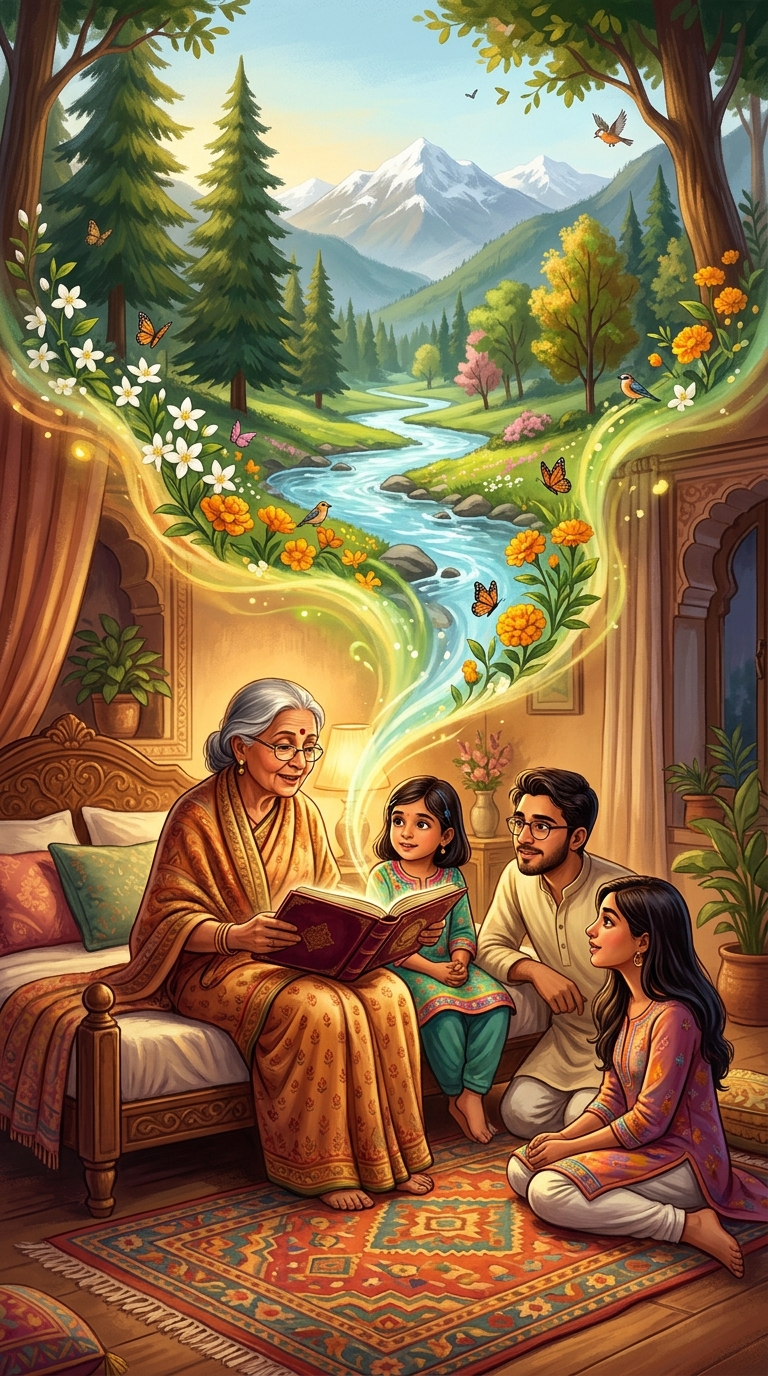
As soon as the dinner party ended, all the Gen Z and Gen Alpha grandchildren surrounded Rana Begum in her bedroom. Some climbed onto the bed while others sat cross-legged on the rug, eager to ask questions.
Rana Begum took out an old velvet album and began, "My children, I was born in a breathtaking valley in Kashmir. I spent the first five years of my childhood there, and I kept visiting even after I grew up. So, my very first birthday was celebrated right there. Come, let me show you a picture of it."
She turned to a page in the album. It was a black-and-white photograph, yet remarkably clear. Little Rana was sitting in a meadow full of flowers, smiling brightly. In the background, towering deodar and chinar trees stood in all their majesty, framed by snow-capped mountains and a crystal-clear stream.
All the children exclaimed in unison, "Wow, Nano! You were so pretty!"
Rana Begum laughed softly, "You are all lovely too, my darlings! But look closely at how beautiful the place behind me was. Our elders used to say that these streams, these waterfalls, these springs, those trees, those birds, the clouds in the sky, and the wind—they all talk to us. As a child, I found their words strange, but as I grew older, every single word they said proved true. In this album, you will find wonderful memories of that place. I went there again and again. After my marriage, I visited with your grandfather too, and together with him, I had long conversations with the winds, the birds, the trees, and the flowing waters there."
Hearing this, her granddaughter Iman giggled and said, "Wow, Dadi! How romantic!"
Rana Begum smiled affectionately, "My dear, the next time we go, I will show you and let you listen to their songs!"
Hamza, her university-going grandson, looked closely at the photograph and let out a deep sigh. "Dado, when we visited there last year, more than half the trees had been cut down, and the stream was full of plastic and garbage. Why have humans ruined this paradise?"
A shadow of sadness crossed Rana Begum’s face for a moment. She adjusted her glasses and said, "Hamza, my son, your question is the biggest question facing the entire world today. Come, tonight I will tell you the story of where humanity went wrong, and why we forgot how to listen to the songs of nature."
All the children leaned in, listening with rapt attention.
The False Divide Between Nature and Humanity
Rana Begum continued: "Children, centuries ago, modern Western thought created a strange division. It split the world into two halves: on one side was 'Culture'—meaning humans, their intellect, language, and politics; and on the other side was 'Nature'—meaning trees, rivers, mountains, and animals, which were reduced to mere inert matter or commodities to be used. Humanity declared itself the 'master and possessor' of the universe.
"But we never treated our land that way. We loved our earth, the sky, the trees, the birds, the fruits, the flowers, the butterflies, and the flowing springs—and we still do. Yet, we were not unique in this! Last year, I read a book (Beyond Nature and Culture) written by a French thinker and anthropologist named Philippe Descola. In the 1970s, he spent several years living with an indigenous tribe called the Achuar in the Amazon rainforest of South America. What Descola found there amazed him! In their language, there was no word for 'nature' at all. They did not view the forest trees, rivers, and birds as inanimate objects, but as relatives and living persons. The women there sang lullabies to their garden plants just as one nurtures children, and hunters asked forgiveness and permission from the spirits of the forest before hunting—just as our own elders used to converse with streams and winds."
Little Zahra widened her eyes in wonder, "Nano, are there really different ways of looking at the world?"
"Yes, my child," Nano smiled. "By studying civilizations across the globe, Descola explained that there are four ways (Ontologies) of viewing the relationship between humans and the cosmos, which he mapped out based on inner consciousness (interiority) and outer form (physicality):
- Naturalism: This is the modern approach. Here, we believe that our bodies and animals' bodies are made of the same physical elements, yet intellect and soul belong only to humans. This arrogance taught us to see trees merely as timber and rivers merely as water channels—resulting in today's climate change and ecological devastation.
- Animism: This is the way of indigenous communities who believe that while animals, trees, and rivers look different from us on the outside, they possess souls, feelings, and social lives just like ours.
- Totemism: Like the Aboriginal peoples of Australia, who believe that a specific human clan and a particular animal or tree descend from common ancestors—meaning they share both a spiritual essence and a physical kinship.
- Analogism: And this fourth way is our own Eastern and South Asian worldview! In this view, every element in the universe, though distinct, is interconnected—just as the stars influence the seasons, the seasons shape the crops, and human actions affect the balance of the Earth."
The Forgotten Wisdom of Our Region
Rana Begum gently stroked the album and said, "Children, Descola reminded me of my own Nano's words. She used to tell me that when the British came to the subcontinent, they severed our centuries-old bond with the land. Before that, our people viewed the forest as a protector and the river as a symbol of life. The British turned forests into a 'Forestry Department' and began measuring trees merely in 'cubic feet of timber.'
"Just think of our Sufi poetry! Whether it is Shah Abdul Latif Bhittai, Bulleh Shah, or Khwaja Ghulam Farid—in their verses, the Indus River, the Rohi desert, and the birds are living characters and confidants of humanity. And in the 1970s, when women in the Himalayas hugged trees to protect them from commercial loggers (the Chipko Movement), they were actually protecting the elders of their own family! Above all, our faith has not made us 'owners' of the Earth, but 'Khalifas' (stewards) and 'Ameens' (trustees), forbidding us from disturbing the cosmic balance—the 'Mizan'."
The Children’s Pledge and Action Plan
Sara, her college-going granddaughter, asked, "So Nano, what can we—Gen Z and Gen Alpha—do now, so that the next time Iman visits Kashmir, she gets to hear those same old songs?"
Rana Begum looked affectionately at everyone and said, "Descola says we don't need to go backward; rather, we must move forward by abandoning the illusion of being 'masters' of the universe and becoming 'World-Composers' and 'Stewards' instead. Look, the world is already changing. The court in Bangladesh granted all its rivers legal rights like 'living persons,' and now in Pakistan too, there is a growing movement to grant legal personhood to the Indus River so that no one can poison its waters.
"And my children, to make the Earth so vibrant and alive that every color of nature seems to converse with us, love for nature and a commitment to its restoration are the very first steps. When we give the Earth respect and peace, the trees, flowers, and birds return on their own, and the symphony of life echoes through the air once again. Now, tell me together: what can be some beautiful ways to turn this dream into reality?"
Hearing Nano’s question, a wave of excitement swept through the room, and the children began sharing their ideas one after another:
1. Inviting Nature Back (Greenery and Fragrance)
Sara spoke up first, "Nano! We will invite nature back. We will plant native trees and flowers that belong to our soil and climate—like tamarind, neem, amaltas (golden shower), jasmine, and roses—so fragrant blossoms perfume the air and become nature's language."
Hamza added, "Exactly! And we will create urban forests and small green corners along streets, in empty plots, and on rooftops so the Earth has room to breathe amidst concrete jungles."
2. Welcoming Birds and Butterflies as Guests
Little Zahra chimed in eagerly, "And I will make birds and butterflies our guests! We will hang small wooden birdhouses on trees and keep fresh water and grains in clay bowls in our courtyard and on the roof every day, so we can hear nature's conversation in the morning and evening chirping of birds."
Iman smiled and added, "And we will plant colorful, nectar-rich flowers to attract butterflies and honeybees, bringing a wave of life into our garden!"
3. Keeping the Sky and Air Clean
Zain, her eighth-grade grandson, spoke seriously, "Dado, if we want starry skies and fresh air back, we have to reduce pollution and noise. We will give up single-use plastics, never burn garbage, and avoid unnecessary honking and noise so that the environment regains the calm needed to hear the rustling of the wind and the whisper of leaves."
4. Lightening the Earth's Burden
Hamza wrapped up their plan, "And most importantly, we will lighten the Earth's burden. Instead of chemical fertilizers, we will use natural compost made from kitchen waste so the tiny living organisms in the soil stay safe, and we will treat keeping streams, parks, and streets free of litter as an act of devotion."
Listening to the children, Rana Begum’s eyes shone with joy. Embracing them, she said, "Well done, my children! Remember, when humans become friends with nature, the gentle breeze, blooming flowers, and soaring birds truly feel as though they are speaking straight to the heart. Tomorrow morning, we will begin this new journey right from our own lawn!"
When the children went to bed that night, their minds were filled not with concrete cities, but with dreams of a lush, chirping, and conversing Earth. The architects of illusion were fading away, and the true stewards of the Earth had awakened.
Come, Let Us Save Our Companion
Once, these rivers, these trees and blossoms, the gentle breezes, this azure sky,
Were our companions, our cherished kindred, the silent keepers of our life’s lore—
Yet what strange arrogance awoke within us, that crowning ourselves as gods on high,
We deemed our comrades mute and helpless, and laid them waste from shore to shore!
We built a wall of cold division between ourselves and this living Earth,
Yet hear the truth, O fellow travelers: these trees, these waters, each soaring wing,
Possess a spirit akin to ours—they ache, they smile, they sing of mirth;
If they should wither, we too shall perish; if they are shattered, we lose our spring!
We are not masters of this creation, nor sovereign lords of this garden fair;
The Maker sent us upon this planet as humble stewards, to guard and tend—
So let us crumble this house of illusions, and build together a world of care,
Restore that ancient bond of affection, and make the rivers and trees our friend!
Let’s plant the saplings, adorn the meadows, and weave safe nests for the birds above,
Cleanse the heavens, heal the soil, and breathe new life into every stream—
Arise! For the sake of Nano’s memories, and Kashmir’s valleys that we love,
Our comrade calls us—come, save our companion, and reawaken the living dream!